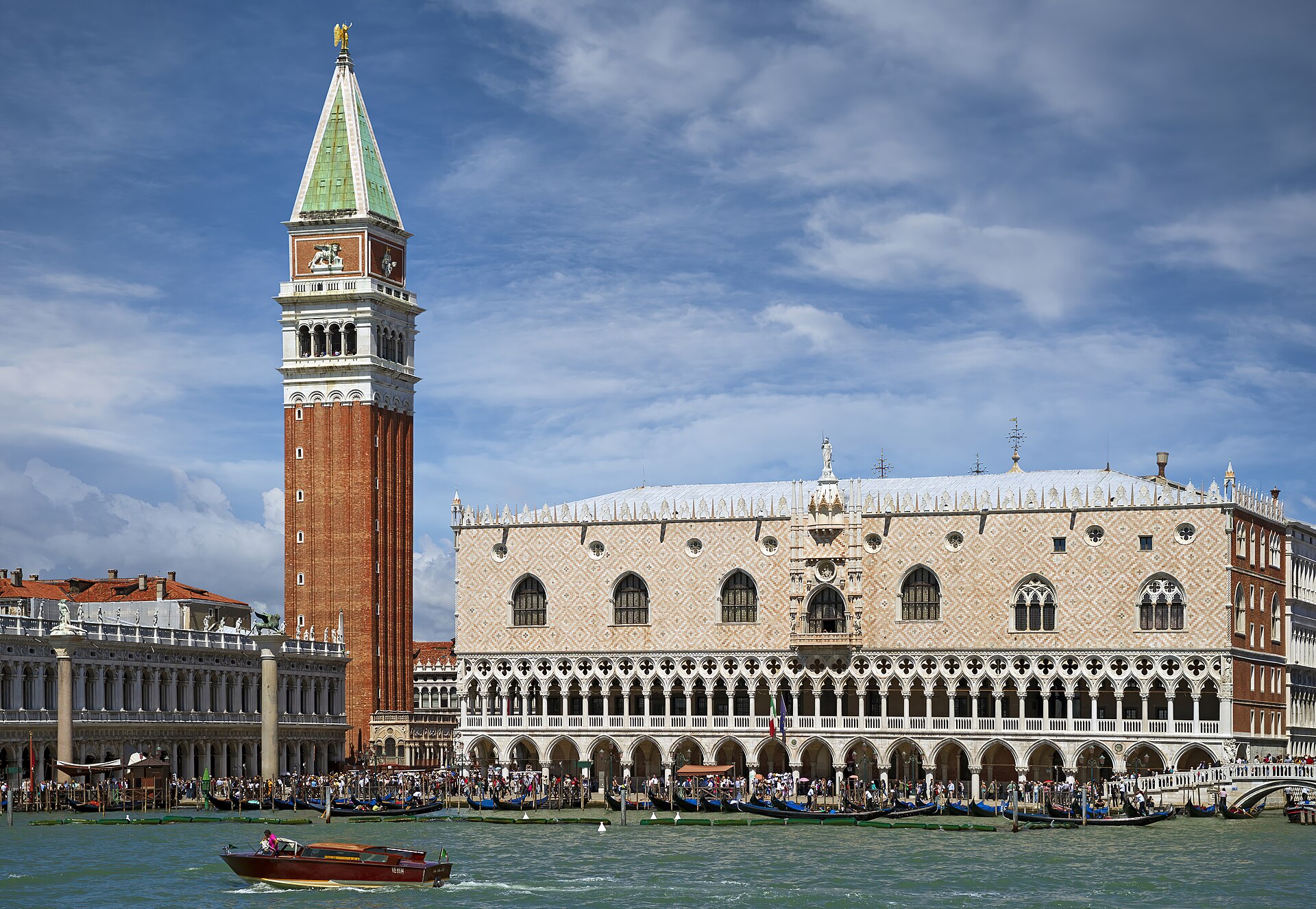
The Palazzo Ducale (Doge’s Palace) is a historic palace in Venice that served as the residence of the Doge and the institutional center of the Venetian Republic. Located adjacent to St. Mark’s Basilica in Piazza San Marco, the structure functioned as the seat of government, courts, and administrative offices. The current building largely dates to the 14th and 15th centuries, replacing earlier fortified structures. Its Venetian Gothic façade, characterized by arcaded loggias and patterned marble surfaces, reflects the maritime republic’s wealth, political structure, and connections across the eastern Mediterranean.
Key Facts
- Materials
- Istrian stone, Verona marble, Brick
- Dimensions
- Complex of interconnected wings surrounding a central courtyard
- Civilization
- Republic of Venice
- Date(s)
- 14th-15th centuries (with later modifications)
- Condition
- Preserved palace museum
- Original Function
- Residence of the Doge and seat of Venetian government
- Key Figures
- Various Doges of Venice, Marino Faliero
- Architectural Style
- Venetian Gothic
Early Fortified Palace
9th-13th centuriesThe original structure on the site was a fortified residence reflecting Venice’s early political instability. Fires and political reforms led to successive reconstructions that gradually transformed the building from a defensive stronghold into a civic palace.
Gothic Reconstruction
14th-15th centuriesThe palace was rebuilt in a distinctive Gothic style beginning in the 14th century. The southern and western façades, facing the lagoon and the Piazzetta, feature arcaded galleries and decorative tracery. Interior chambers were designed to accommodate governing councils, including the Great Council.
Renaissance and Post-Fire Modifications
16th centuryFires in 1483 and 1577 required restoration of major halls, including the Sala del Maggior Consiglio. Renaissance artists such as Tintoretto and Veronese contributed monumental paintings celebrating Venetian political mythology and civic ideology.
End of the Republic and Modern Use
1797 - presentThe Venetian Republic fell to Napoleon in 1797. Subsequent Austrian and Italian administrations repurposed the palace for bureaucratic use before it was converted into a museum. Today it forms part of the Fondazione Musei Civici di Venezia.
Cultural Significance
The Palazzo Ducale embodied the constitutional structure of the Venetian Republic, housing deliberative councils, judicial chambers, and the Doge’s apartments within a single architectural complex. Its decorative programs reinforced narratives of divine favor, maritime dominance, and civic unity. As a monument, it represents Venice’s identity as a mercantile republic distinct from territorial monarchies. The palace’s architecture and political symbolism have influenced interpretations of republican governance in European history.
Interpretive Notes
Scholarly debates and areas of uncertainty
Scholars analyze the palace’s architectural form as a visual statement of political ideology, debating how its openness and decorative richness conveyed republican stability rather than autocratic power. Art historians also reassess the iconographic programs of its council chambers, examining how mythological and religious imagery functioned as state propaganda within the Venetian constitutional system.
Visiting Information
Entry Rules
Paid admission required. Combined tickets available with other civic museums in St. Mark’s Square. Security screening may apply.
Best Times to Visit
Early morning or late afternoon visits reduce peak tour congestion. High tourist seasons in spring and summer result in extended queues.
Photography
Non-flash photography generally permitted in many areas. Tripods and commercial filming require authorization. Restrictions may apply in certain exhibition rooms.
Preservation Notes
Do not touch painted surfaces or historic furnishings. Some stairways and passageways are narrow or uneven. Portions of the palace may close temporarily for conservation.
Nearby POIs
11 shown- Biblioteca Nazionale Marciana0.1 km
- Basilica di San Marco0.1 km
- Museo di Correr0.3 km
- Museo di Palazzo Grimani0.4 km
- Basilica di Santa Maria della Salute0.6 km
- Basilica dei Santi Giovanni e Paolo0.6 km
- Peggy Guggenheim Collection0.8 km
- Palazzo Grassi1 km
- Gallerie dell'Accademia1 km
- Ca' Pesaro International Gallery of Modern Art1.1 km
- Ca' Rezzonico1.1 km
Sources & Further Reading
- [1]The Doge's Palace in Venice — Antonio Manno. Marsilio Editori
- [2]Venice: A Maritime Republic — Frederic C. Lane. Johns Hopkins University Press (1973)
- [3]Venetian Gothic Architecture — John Ruskin. Smith, Elder & Co.
Key Facts
- Materials
- Istrian stone, Verona marble, Brick
- Dimensions
- Complex of interconnected wings surrounding a central courtyard
- Civilization
- Republic of Venice
- Date(s)
- 14th-15th centuries (with later modifications)
- Condition
- Preserved palace museum
- Original Function
- Residence of the Doge and seat of Venetian government
- Key Figures
- Various Doges of Venice, Marino Faliero
- Architectural Style
- Venetian Gothic
Nearby POIs
11 shown- Biblioteca Nazionale Marciana0.1 km
- Basilica di San Marco0.1 km
- Museo di Correr0.3 km
- Museo di Palazzo Grimani0.4 km
- Basilica di Santa Maria della Salute0.6 km
- Basilica dei Santi Giovanni e Paolo0.6 km
- Peggy Guggenheim Collection0.8 km
- Palazzo Grassi1 km
- Gallerie dell'Accademia1 km
- Ca' Pesaro International Gallery of Modern Art1.1 km
- Ca' Rezzonico1.1 km