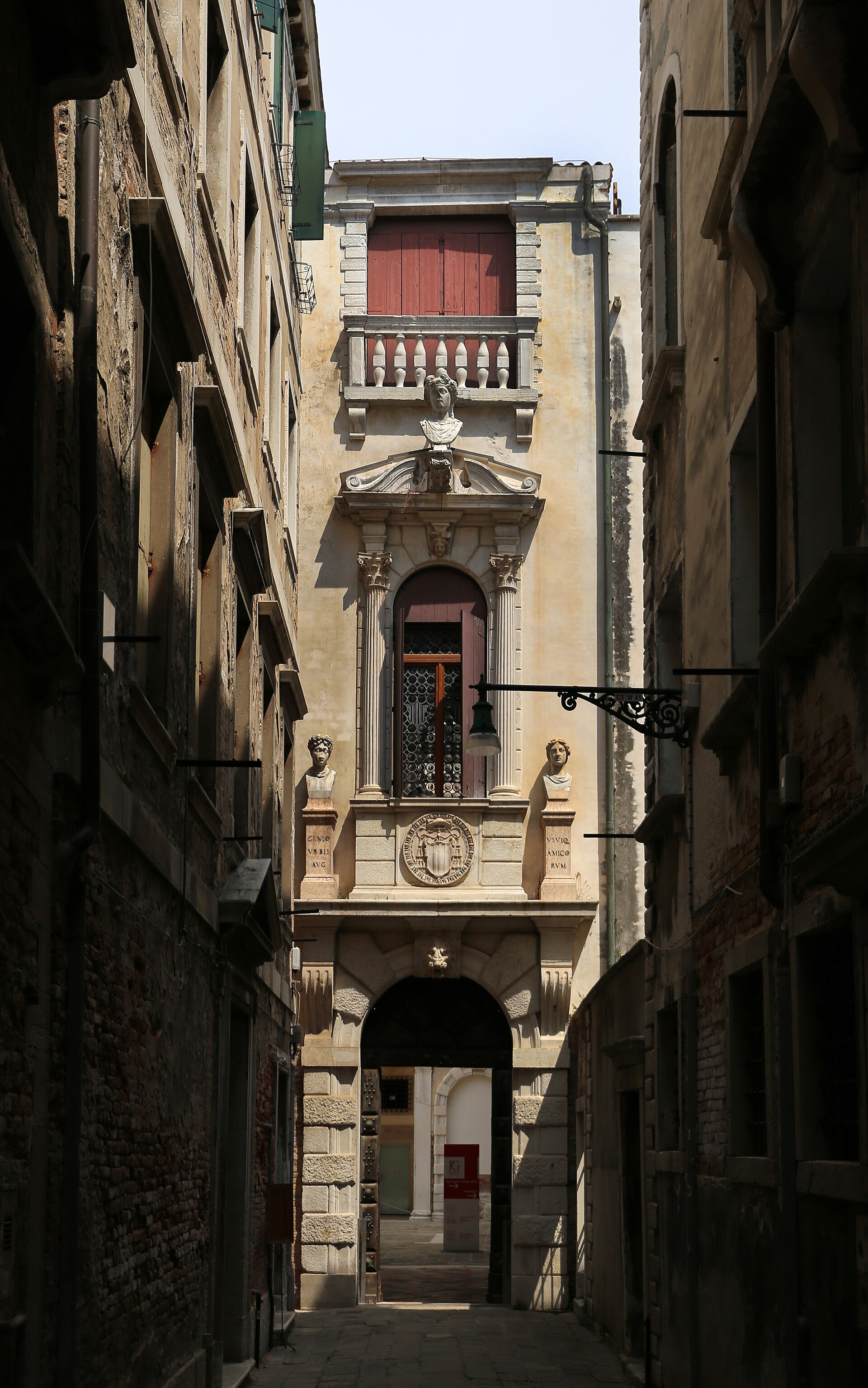
Palazzo Grimani di Santa Maria Formosa is a historic Venetian palace that served as the residence of the powerful Grimani di San Luca family. The building is renowned for its unique architectural synthesis, blending traditional Venetian Gothic foundations with Roman Mannerist influences introduced by the patriarch Giovanni Grimani in the 16th century.
Following extensive restoration, the palace now functions as a state museum. It houses a significant collection of classical antiquities, Renaissance paintings, and decorative arts, while its interiors—notably the Tribuna and the Cammino d'Oro—remain some of the most elaborate examples of 16th-century interior design in Venice.
Key Facts
- Materials
- Istrian stone, Marble, Stucco, Gold leaf
- Civilization
- Venetian
- Accessibility
- Limited; ground floor accessible, upper floors via stairs
- Date(s)
- 16th century
- Condition
- Restored and open as a state museum
- Original Function
- Private aristocratic residence
- Key Figures
- Giovanni Grimani, Michele Sanmicheli, Giovanni da Udine
Origins and Expansion
15th-16th centuryThe original structure was a modest Gothic house acquired by the Grimani family. In the mid-16th century, Patriarch Giovanni Grimani commissioned a major expansion, transforming the building into a residence that reflected his humanist interests and his extensive collection of classical sculpture.
Mannerist Transformation
1532-1575Architects including Michele Sanmicheli and Giovanni da Udine were employed to redesign the palace. The project introduced a central courtyard and the 'Tribuna,' a room specifically designed to display the family's collection of ancient Roman statues, inspired by the Pantheon in Rome.
Decline and Public Acquisition
19th-20th centuryFollowing the decline of the Grimani family, the palace underwent various uses and periods of neglect. In 1981, the Italian State acquired the building, initiating a decades-long restoration project to stabilize the structure and recover its original decorative programs.
Modern Museum
2008-presentThe museum officially opened to the public in 2008. It currently serves as a venue for both permanent collections of antiquities and temporary exhibitions of contemporary art, bridging the gap between historical Venetian heritage and modern cultural discourse.
Cultural Significance
Palazzo Grimani represents a pivotal moment in Venetian history where the city's traditional aesthetic was challenged by the influx of Roman Mannerist ideals. It stands as a testament to the intellectual ambition of the Venetian patriciate, who used their homes as private museums to display their status and classical learning.
Today, the palace is a critical site for understanding the history of collecting. The restoration of the Tribuna has allowed scholars and the public to visualize how 16th-century humanists curated their environments, influencing modern approaches to museum display and historical preservation in Venice.
Interpretive Notes
Scholarly debates and areas of uncertainty
The exact attribution of the architectural design remains a subject of discussion, as the palace was a collaborative effort involving multiple architects over several decades. Additionally, the original arrangement of the statues within the Tribuna is debated, as historical inventories provide conflicting accounts of the placement of specific classical busts.
Visiting Information
Entry Rules
Open Tuesday to Sunday. Tickets can be purchased at the entrance or online. Visitors are requested to refrain from touching the walls or decorative elements.
Best Times to Visit
Weekday mornings are generally quieter. The palace is particularly pleasant during the shoulder seasons (spring and autumn) when the courtyard environment is most comfortable.
Photography
Personal photography is permitted for non-commercial use without flash or tripods.
Preservation Notes
The palace features delicate stucco and fresco work; visitors must remain on designated paths. Due to the historic nature of the building, climate control is strictly maintained to protect the artwork.
Nearby POIs
11 shown- Basilica dei Santi Giovanni e Paolo0.2 km
- Basilica di San Marco0.3 km
- Palazzo Ducale0.4 km
- Biblioteca Nazionale Marciana0.5 km
- Museo di Correr0.6 km
- Basilica di Santa Maria della Salute0.9 km
- Ca' Pesaro International Gallery of Modern Art1 km
- Peggy Guggenheim Collection1.1 km
- Palazzo Grassi1.2 km
- Basilica di Santa Maria Gloriosa dei Frari1.3 km
- Ca' Rezzonico1.3 km
Sources & Further Reading
- [1]Palazzo Grimani: The Restoration of a Venetian Masterpiece — Annalisa Bristot. Marsilio Editori (2008)
- [2]The Grimani Collection of Classical Antiquities — Marcello De Paoli. L'Erma di Bretschneider (2004)
Key Facts
- Materials
- Istrian stone, Marble, Stucco, Gold leaf
- Civilization
- Venetian
- Accessibility
- Limited; ground floor accessible, upper floors via stairs
- Date(s)
- 16th century
- Condition
- Restored and open as a state museum
- Original Function
- Private aristocratic residence
- Key Figures
- Giovanni Grimani, Michele Sanmicheli, Giovanni da Udine
Nearby POIs
11 shown- Basilica dei Santi Giovanni e Paolo0.2 km
- Basilica di San Marco0.3 km
- Palazzo Ducale0.4 km
- Biblioteca Nazionale Marciana0.5 km
- Museo di Correr0.6 km
- Basilica di Santa Maria della Salute0.9 km
- Ca' Pesaro International Gallery of Modern Art1 km
- Peggy Guggenheim Collection1.1 km
- Palazzo Grassi1.2 km
- Basilica di Santa Maria Gloriosa dei Frari1.3 km
- Ca' Rezzonico1.3 km