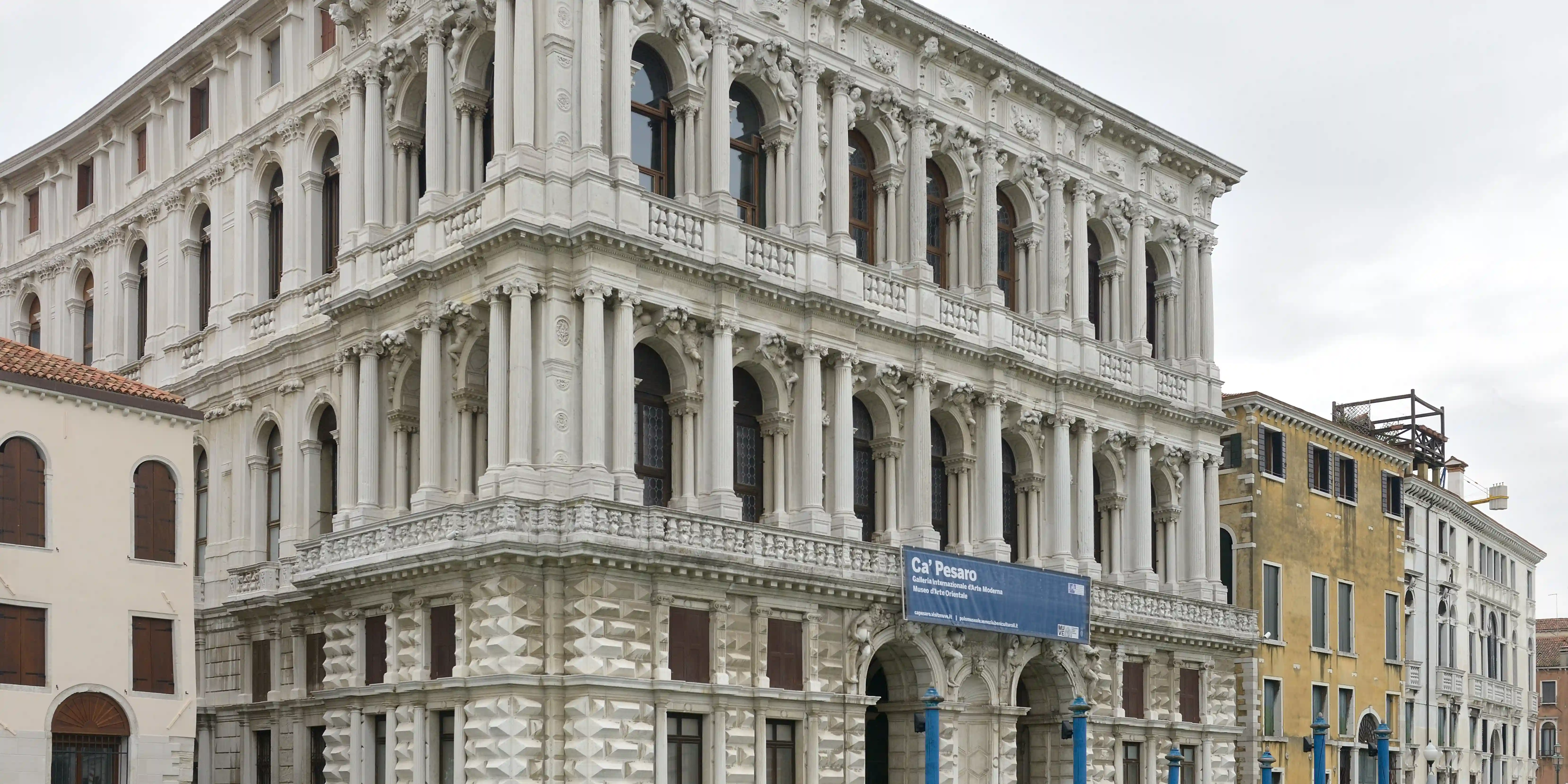
Ca' Pesaro is a monumental marble palace situated on the Grand Canal in the Santa Croce district of Venice. Designed by the architect Baldassare Longhena in the mid-17th century, the building serves as a prime example of Venetian Baroque architecture, characterized by its ornate facade and rhythmic use of columns and arches.
Since 1902, the palace has functioned as the International Gallery of Modern Art. It houses a significant collection of 19th and 20th-century paintings and sculptures, including works by artists such as Gustav Klimt, Marc Chagall, and Wassily Kandinsky, alongside a dedicated section for Oriental art.
Key Facts
- Materials
- Istrian stone, Marble
- Civilization
- Venetian
- Accessibility
- Wheelchair accessible via elevator
- Date(s)
- 1652-1710
- Condition
- Well-preserved, active museum
- Original Function
- Private residence for the Pesaro family
- Key Figures
- Baldassare Longhena, Gian Antonio Gaspari, Felicita Bevilacqua
Commission and Construction
1652-1710The palace was commissioned by the noble Pesaro family. Construction began under the direction of Baldassare Longhena, the architect of the Santa Maria della Salute. Following Longhena's death in 1682, the project was completed by Gian Antonio Gaspari.
Family Decline and Sale
18th-19th centuryAs the Pesaro family's influence waned, the palace passed through several hands, including the Gradenigo family and the Mechitarist monks. During this period, much of the original interior furnishings were dispersed.
Establishment of the Museum
1899-1902The palace was bequeathed to the City of Venice by the Duchess Felicita Bevilacqua La Masa with the explicit intent of establishing a gallery for young artists. The museum officially opened its doors to the public in 1902.
Cultural Significance
Ca' Pesaro represents the transition of Venetian palatial architecture from the classical Renaissance style to the more dramatic, sculptural Baroque. Its role as a museum has been pivotal in the Venetian art scene, particularly through the Bevilacqua La Masa Foundation, which has historically supported emerging contemporary artists.
The palace also serves as a testament to the Venetian tradition of collecting, bridging the gap between the city's historical maritime wealth and its modern cultural identity as a global hub for contemporary art exhibitions.
Interpretive Notes
Scholarly debates and areas of uncertainty
There is ongoing academic discussion regarding the extent of the original interior decorative program, as much of the palace's internal layout was modified during its transition from a private residence to a public institution. Additionally, the attribution of certain late-stage architectural details between Longhena and Gaspari remains a subject of study.
Visiting Information
Entry Rules
Open Tuesday to Sunday. Tickets can be purchased online or at the entrance. Reduced rates are available for students and seniors. Visitors are requested to leave large bags in the cloakroom.
Best Times to Visit
Weekday mornings are generally quieter. The museum is less crowded during the winter months compared to the peak summer tourist season.
Photography
Personal photography is permitted for non-commercial use without flash or tripods. Professional photography requires prior authorization from the museum administration.
Preservation Notes
The building is subject to strict conservation protocols due to its location on the Grand Canal. Visitors are asked to refrain from touching the artworks and to maintain a respectful distance from the historic architectural elements.
Nearby POIs
11 shown- Basilica di Santa Maria Gloriosa dei Frari0.6 km
- Madonna dell'Orto0.6 km
- Ghetto di Venezia0.6 km
- Chiesa di San Rocco0.7 km
- Scuola Grande di San Rocco0.7 km
- Palazzo Grassi0.8 km
- Basilica dei Santi Giovanni e Paolo0.9 km
- Ca' Rezzonico0.9 km
- Museo di Correr0.9 km
- Museo di Palazzo Grimani1 km
- Basilica di San Marco1 km
Key Facts
- Materials
- Istrian stone, Marble
- Civilization
- Venetian
- Accessibility
- Wheelchair accessible via elevator
- Date(s)
- 1652-1710
- Condition
- Well-preserved, active museum
- Original Function
- Private residence for the Pesaro family
- Key Figures
- Baldassare Longhena, Gian Antonio Gaspari, Felicita Bevilacqua
Nearby POIs
11 shown- Basilica di Santa Maria Gloriosa dei Frari0.6 km
- Madonna dell'Orto0.6 km
- Ghetto di Venezia0.6 km
- Chiesa di San Rocco0.7 km
- Scuola Grande di San Rocco0.7 km
- Palazzo Grassi0.8 km
- Basilica dei Santi Giovanni e Paolo0.9 km
- Ca' Rezzonico0.9 km
- Museo di Correr0.9 km
- Museo di Palazzo Grimani1 km
- Basilica di San Marco1 km