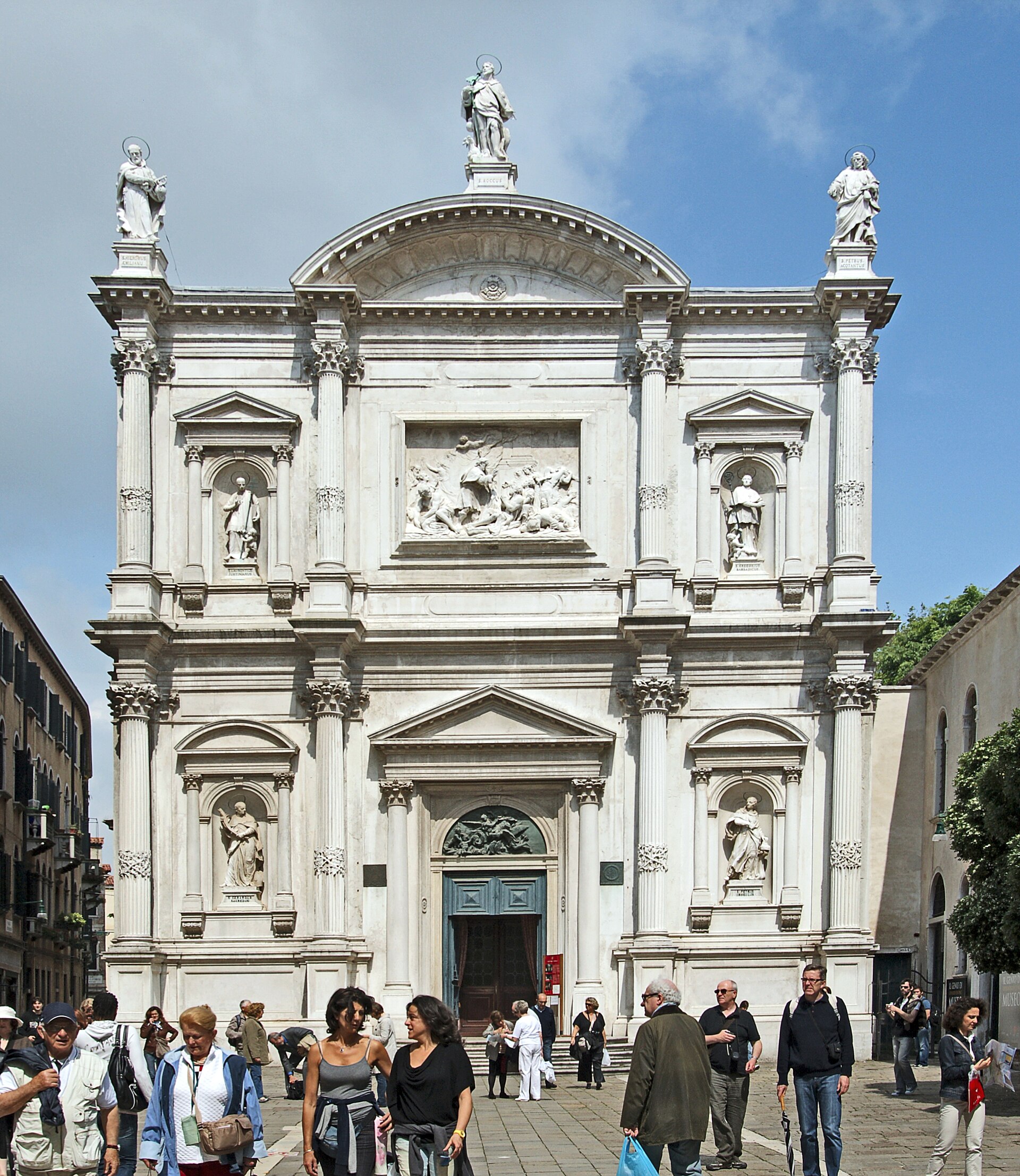
The Chiesa di San Rocco is a Roman Catholic church located in the Sestiere of San Polo in Venice. It was constructed between 1489 and 1508 by Bartolomeo Bon the Younger, with the intention of housing the relics of Saint Roch, a saint invoked for protection against the plague. The church serves as a significant example of Venetian Renaissance architecture, characterized by its harmonious proportions and refined stonework.
The facade, completed later in the 18th century by Bernardino Maccaruzzi, integrates seamlessly with the adjacent Scuola Grande di San Rocco. The interior is renowned for its collection of paintings by Tintoretto, who was a member of the confraternity and contributed several major works to the church, cementing its status as a vital site for Venetian art history.
Key Facts
- Materials
- Istrian stone, Marble, Brick
- Civilization
- Venetian
- Accessibility
- Ground level access
- Date(s)
- 1489-1508
- Condition
- Well-preserved, active place of worship
- Original Function
- Plague church and reliquary
- Key Figures
- Saint Roch, Tintoretto, Bartolomeo Bon the Younger
Foundation and Construction
1489-1508The church was commissioned by the Scuola di San Rocco to house the body of Saint Roch, which had been acquired by the confraternity. Construction began in 1489 under the direction of Bartolomeo Bon, and the building was consecrated in 1508.
Artistic Expansion
16th centuryDuring the 16th century, the church became a repository for significant art, most notably the works of Tintoretto. His paintings, depicting scenes from the life of Saint Roch, were integrated into the church's decorative program, enhancing its spiritual and aesthetic importance.
Facade Reconstruction
1765-1771The original facade was replaced in the mid-18th century by Bernardino Maccaruzzi. This project was designed to harmonize the church's exterior with the neighboring Scuola Grande, creating the unified architectural ensemble seen today.
Cultural Significance
The church is deeply tied to the history of the Venetian confraternities (Scuole), which played a crucial role in the social and religious life of the city. As a plague church, it reflects the historical Venetian preoccupation with health and divine protection during recurring outbreaks of the bubonic plague.
Beyond its religious function, the church is a cornerstone of the Venetian artistic heritage. The presence of Tintoretto's works makes it a site of pilgrimage for art historians and enthusiasts, representing the height of Venetian Mannerist painting.
Interpretive Notes
Scholarly debates and areas of uncertainty
There is ongoing scholarly discussion regarding the extent of Tintoretto's involvement in the specific placement and lighting design of his paintings within the church, as the interior has undergone various modifications over the centuries that may have altered the original intended viewing experience.
Visiting Information
Entry Rules
Open daily. Entry is free, though donations are encouraged. Visitors are expected to maintain a respectful demeanor as it is an active place of worship. Modest dress is required.
Best Times to Visit
Weekday mornings are generally quieter, allowing for better viewing of the artworks without the crowds associated with the nearby Scuola Grande.
Photography
Photography is permitted for personal use without flash. Tripods and professional equipment require prior authorization.
Preservation Notes
The church is subject to ongoing conservation efforts to protect the paintings from humidity and environmental degradation common in the Venetian lagoon.
Nearby POIs
11 shown- Scuola Grande di San Rocco
- Basilica di Santa Maria Gloriosa dei Frari0.1 km
- Ca' Rezzonico0.4 km
- Palazzo Grassi0.4 km
- Gallerie dell'Accademia0.7 km
- Ca' Pesaro International Gallery of Modern Art0.7 km
- Peggy Guggenheim Collection0.8 km
- Ghetto di Venezia0.9 km
- Museo di Correr1 km
- Basilica di Santa Maria della Salute1 km
- Biblioteca Nazionale Marciana1.2 km
Sources & Further Reading
- [1]Tintoretto: Tradition and Identity — Tom Nichols. Reaktion Books (1999)
- [2]The Churches of Venice — Deborah Howard. Yale University Press (2002)
Key Facts
- Materials
- Istrian stone, Marble, Brick
- Civilization
- Venetian
- Accessibility
- Ground level access
- Date(s)
- 1489-1508
- Condition
- Well-preserved, active place of worship
- Original Function
- Plague church and reliquary
- Key Figures
- Saint Roch, Tintoretto, Bartolomeo Bon the Younger
Nearby POIs
11 shown- Scuola Grande di San Rocco
- Basilica di Santa Maria Gloriosa dei Frari0.1 km
- Ca' Rezzonico0.4 km
- Palazzo Grassi0.4 km
- Gallerie dell'Accademia0.7 km
- Ca' Pesaro International Gallery of Modern Art0.7 km
- Peggy Guggenheim Collection0.8 km
- Ghetto di Venezia0.9 km
- Museo di Correr1 km
- Basilica di Santa Maria della Salute1 km
- Biblioteca Nazionale Marciana1.2 km