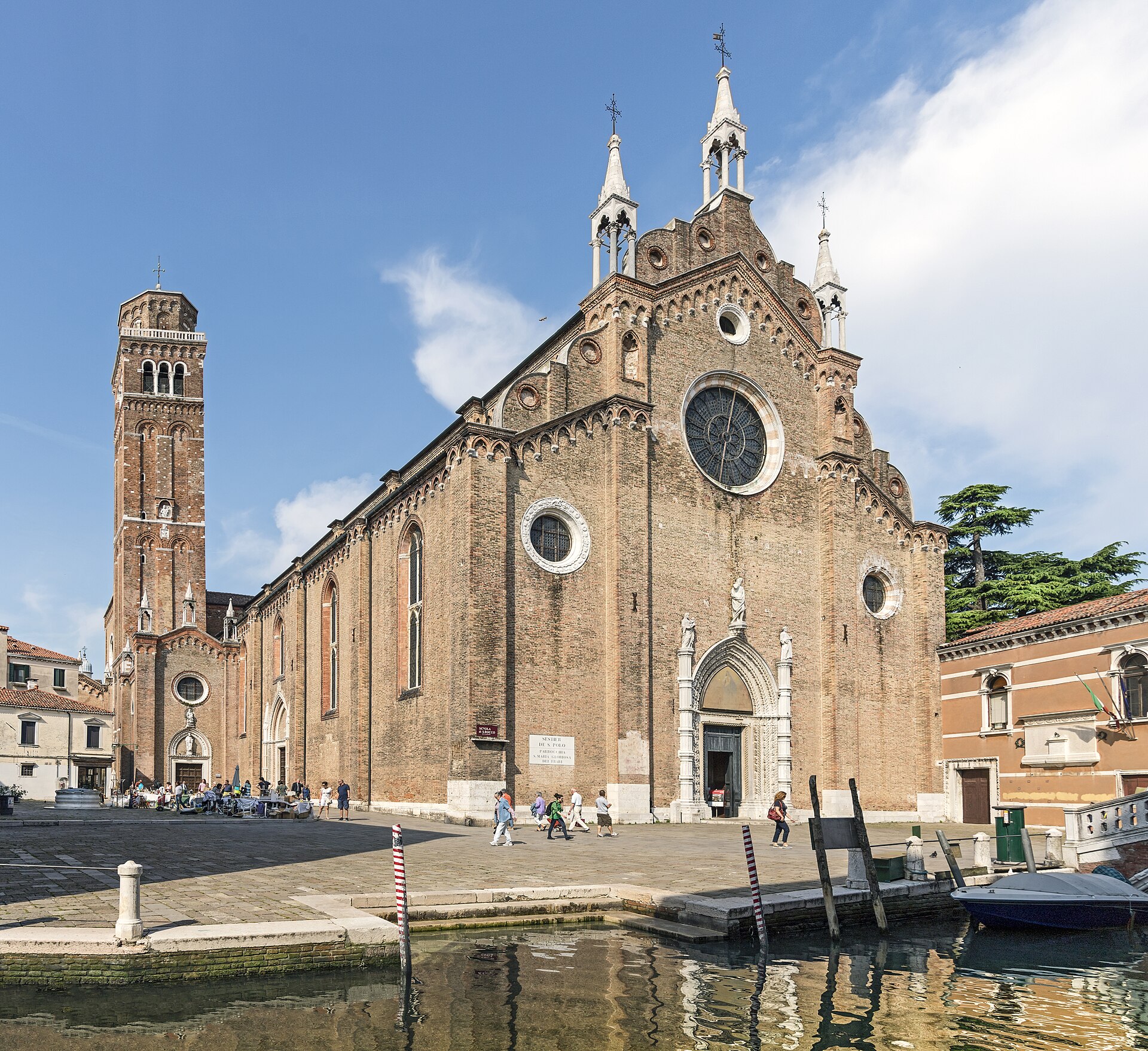
The Basilica di Santa Maria Gloriosa dei Frari, commonly known as the Frari, is a monumental Franciscan church located in the San Polo district of Venice. Construction of the current Gothic structure began in 1340 and continued for over a century, replacing an earlier 13th-century church. It is renowned for its vast interior, which houses an extraordinary collection of Venetian Renaissance art, including masterpieces by Titian, Giovanni Bellini, and Donatello.
The church serves as a significant pantheon for Venice, containing the tombs of numerous doges, artists, and prominent citizens, including Titian and Antonio Canova. Its architectural design reflects the austere yet grand aesthetic of the Franciscan order, characterized by its massive brick facade and soaring nave, which remains one of the most important examples of Italian Gothic architecture in the city.
Key Facts
- Materials
- Brick, Istrian stone, Marble
- Civilization
- Venetian
- Accessibility
- Ground level accessible, some areas restricted
- Date(s)
- 1340 - 1469
- Condition
- Active parish church and museum
- Original Function
- Franciscan Church
- Key Figures
- Titian, Giovanni Bellini, Antonio Canova, Doge Francesco Dandolo
Foundations and Early Construction
1250 - 1340The Franciscan order was granted land in Venice in 1236. A smaller church was initially constructed, but as the order's influence grew, the need for a larger space led to the laying of the foundation for the current basilica in 1340.
Gothic Expansion
1340 - 1469Construction proceeded in stages, heavily influenced by the Italian Gothic style. The campanile, the second tallest in Venice after St. Mark's, was completed in 1396. The main structure was consecrated in 1469, though decorative elements continued to be added.
Artistic Flourishing
15th - 16th centuryDuring the Renaissance, the Frari became a repository for major artistic commissions. Titian's 'Assumption of the Virgin', installed in 1518, redefined the high altar and solidified the church's status as a premier site for Venetian painting.
Modern Preservation
19th century - presentFollowing the Napoleonic suppression of religious orders, the church was designated as a state monument. Extensive restoration projects in the 20th and 21st centuries have focused on stabilizing the brickwork and preserving the delicate frescoes and altarpieces.
Cultural Significance
The Frari is central to Venetian cultural identity, acting as both a spiritual center and a historical archive of the city's elite. Its role as a burial site for Doges and artists highlights the intersection of religious devotion and civic pride in the Venetian Republic.
Beyond its religious function, the basilica is a primary destination for art historians and pilgrims alike, preserving the 'in situ' context of works that define the Venetian School of painting. It remains a focal point for the study of Franciscan architecture and the evolution of Venetian funerary monuments.
Interpretive Notes
Scholarly debates and areas of uncertainty
There is ongoing academic discussion regarding the original placement of certain funerary monuments, as many were relocated during 19th-century renovations. Additionally, the extent of the influence of Northern European Gothic styles on the basilica's structural design compared to local Venetian traditions remains a subject of architectural analysis.
Visiting Information
Entry Rules
Open to the public daily. Entry requires a ticket purchase. Modest dress is strictly enforced (shoulders and knees must be covered). As an active place of worship, visitors are requested to maintain silence and avoid photography during liturgical services.
Best Times to Visit
Early morning or late afternoon on weekdays to avoid the heaviest tourist traffic. The church is particularly significant during the Feast of the Assumption in August.
Photography
Photography is permitted for personal use without flash. Tripods and professional equipment are prohibited without prior authorization from the parish office.
Preservation Notes
The church is highly sensitive to humidity and light. Visitors are asked to refrain from touching marble surfaces or funerary monuments. Some areas may be closed periodically for conservation work.
Nearby POIs
11 shown- Chiesa di San Rocco0.1 km
- Scuola Grande di San Rocco0.1 km
- Palazzo Grassi0.4 km
- Ca' Rezzonico0.4 km
- Ca' Pesaro International Gallery of Modern Art0.6 km
- Gallerie dell'Accademia0.6 km
- Peggy Guggenheim Collection0.8 km
- Museo di Correr0.9 km
- Ghetto di Venezia0.9 km
- Basilica di Santa Maria della Salute1 km
- Basilica di San Marco1.1 km
Sources & Further Reading
- [1]The Frari: Art and Architecture in Venice — Peter Humfrey. Yale University Press (2007)
- [2]Venetian Gothic Architecture — Deborah Howard. Cambridge University Press (2002)
Key Facts
- Materials
- Brick, Istrian stone, Marble
- Civilization
- Venetian
- Accessibility
- Ground level accessible, some areas restricted
- Date(s)
- 1340 - 1469
- Condition
- Active parish church and museum
- Original Function
- Franciscan Church
- Key Figures
- Titian, Giovanni Bellini, Antonio Canova, Doge Francesco Dandolo
Nearby POIs
11 shown- Chiesa di San Rocco0.1 km
- Scuola Grande di San Rocco0.1 km
- Palazzo Grassi0.4 km
- Ca' Rezzonico0.4 km
- Ca' Pesaro International Gallery of Modern Art0.6 km
- Gallerie dell'Accademia0.6 km
- Peggy Guggenheim Collection0.8 km
- Museo di Correr0.9 km
- Ghetto di Venezia0.9 km
- Basilica di Santa Maria della Salute1 km
- Basilica di San Marco1.1 km