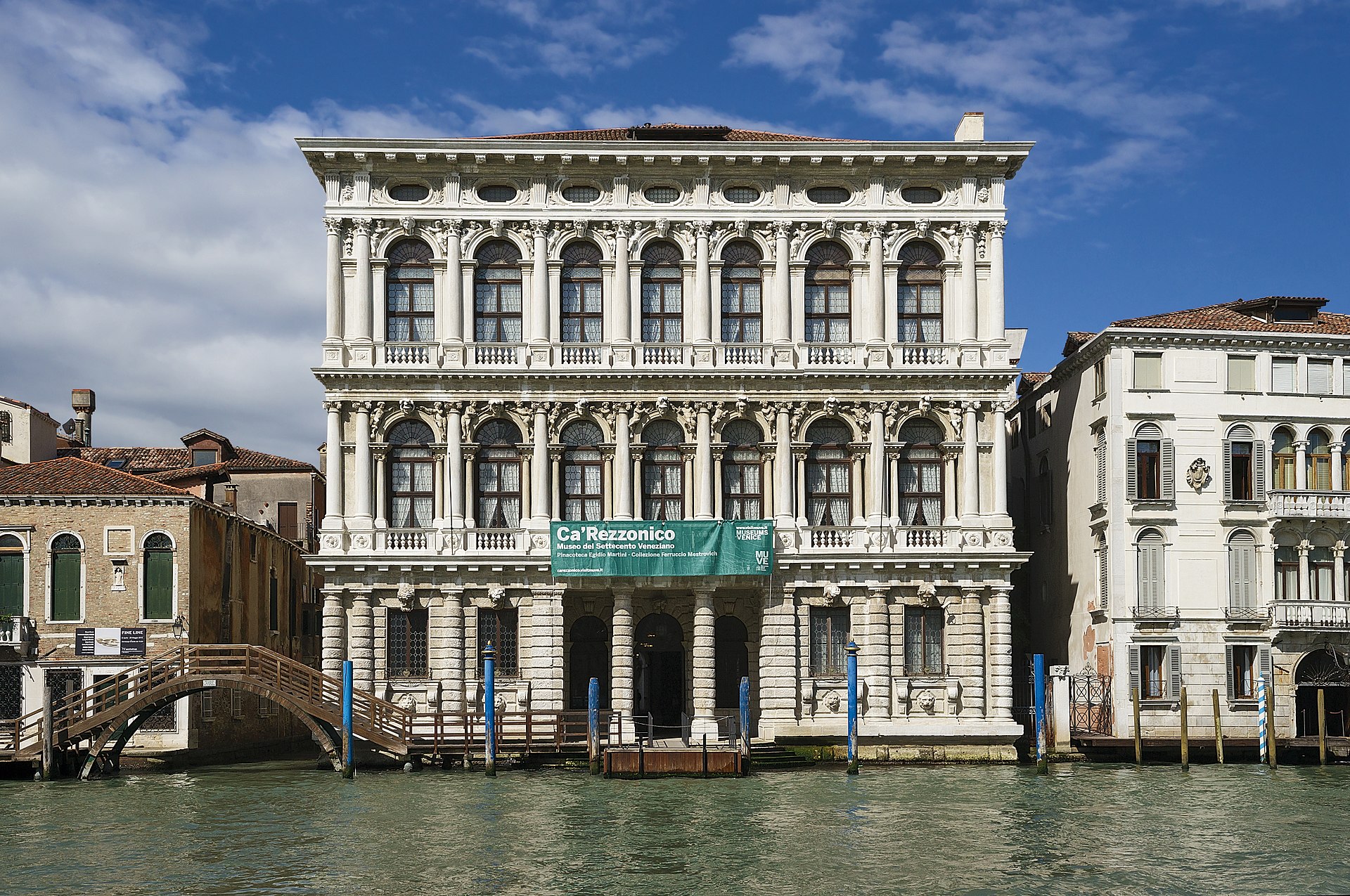
Ca' Rezzonico is a grand palace located on the Grand Canal in the Dorsoduro district of Venice. Designed by Baldassare Longhena in the mid-17th century for the Bon family, construction was later completed by Giorgio Massari for the Rezzonico family. The building serves as a prime example of Venetian Baroque and Rococo architecture, characterized by its imposing marble facade and opulent interior decoration.
Today, the palace functions as a public museum dedicated to 18th-century Venice. It houses an extensive collection of paintings, furniture, and decorative arts, including works by Canaletto, Pietro Longhi, and Giambattista Tiepolo. The museum provides a comprehensive view of the lifestyle and artistic achievements of the Venetian aristocracy during the final century of the Republic.
Key Facts
- Materials
- Istrian stone, Marble, Stucco
- Civilization
- Venetian
- Accessibility
- Wheelchair accessible via elevator
- Date(s)
- 1649–1756
- Condition
- Well-preserved museum
- Original Function
- Residential palace
- Key Figures
- Baldassare Longhena, Giorgio Massari, Giambattista Tiepolo
Design and Early Construction
1649–1682The project was commissioned by Filippo Bon, who hired the renowned architect Baldassare Longhena. Construction began in 1649 but stalled due to the family's financial difficulties, leaving the structure unfinished at the time of Longhena's death.
Completion by the Rezzonico Family
1750–1756The unfinished palace was purchased by the wealthy Rezzonico family in 1750. They commissioned Giorgio Massari to complete the building, who maintained Longhena's original design while adding sophisticated Rococo interior elements, including the grand staircase and the ballroom.
Decline and Museum Conversion
19th–20th centuryFollowing the fall of the Venetian Republic, the palace passed through several owners, including the poet Robert Browning. In 1935, the City of Venice acquired the property to house the Museum of 18th-Century Venice, opening it to the public after extensive restoration.
Cultural Significance
Ca' Rezzonico is a vital repository of Venetian cultural history, representing the zenith of the city's artistic output before the end of the Republic. It is one of the few palaces in Venice where the original architectural layout and decorative schemes remain intact, allowing visitors to experience the domestic environment of the 18th-century Venetian elite.
Interpretive Notes
Scholarly debates and areas of uncertainty
There is ongoing academic discussion regarding the attribution of certain decorative frescoes and the extent to which Massari modified Longhena's original plans for the upper floors. Additionally, the provenance of several pieces in the collection remains a subject of study due to the palace's history of changing ownership.
Visiting Information
Entry Rules
Open Wednesday to Monday. Tickets can be purchased online or at the entrance. Visitors are requested to leave large bags in the cloakroom.
Best Times to Visit
Early morning or late afternoon to avoid peak tourist traffic on the Grand Canal. Weekdays are generally quieter than weekends.
Photography
Personal photography is permitted without flash or tripods. Commercial photography requires prior authorization from the Fondazione Musei Civici di Venezia.
Preservation Notes
The palace is a historic structure; visitors are asked to refrain from touching the furniture, wall coverings, or artworks. Climate control is strictly maintained to protect the delicate 18th-century paintings.
Nearby POIs
11 shown- Palazzo Grassi0.1 km
- Gallerie dell'Accademia0.3 km
- Scuola Grande di San Rocco0.4 km
- Basilica di Santa Maria Gloriosa dei Frari0.4 km
- Chiesa di San Rocco0.4 km
- Peggy Guggenheim Collection0.5 km
- Basilica di Santa Maria della Salute0.7 km
- Museo di Correr0.8 km
- Ca' Pesaro International Gallery of Modern Art0.9 km
- Biblioteca Nazionale Marciana1 km
- Basilica di San Marco1 km
Sources & Further Reading
- [1]Ca' Rezzonico: The Museum of 18th-Century Venice — Filippo Pedrocco. Marsilio Editori (2002)
- [2]Venetian Architecture of the 17th and 18th Centuries — Deborah Howard. Yale University Press (2002)
Key Facts
- Materials
- Istrian stone, Marble, Stucco
- Civilization
- Venetian
- Accessibility
- Wheelchair accessible via elevator
- Date(s)
- 1649–1756
- Condition
- Well-preserved museum
- Original Function
- Residential palace
- Key Figures
- Baldassare Longhena, Giorgio Massari, Giambattista Tiepolo
Nearby POIs
11 shown- Palazzo Grassi0.1 km
- Gallerie dell'Accademia0.3 km
- Scuola Grande di San Rocco0.4 km
- Basilica di Santa Maria Gloriosa dei Frari0.4 km
- Chiesa di San Rocco0.4 km
- Peggy Guggenheim Collection0.5 km
- Basilica di Santa Maria della Salute0.7 km
- Museo di Correr0.8 km
- Ca' Pesaro International Gallery of Modern Art0.9 km
- Biblioteca Nazionale Marciana1 km
- Basilica di San Marco1 km