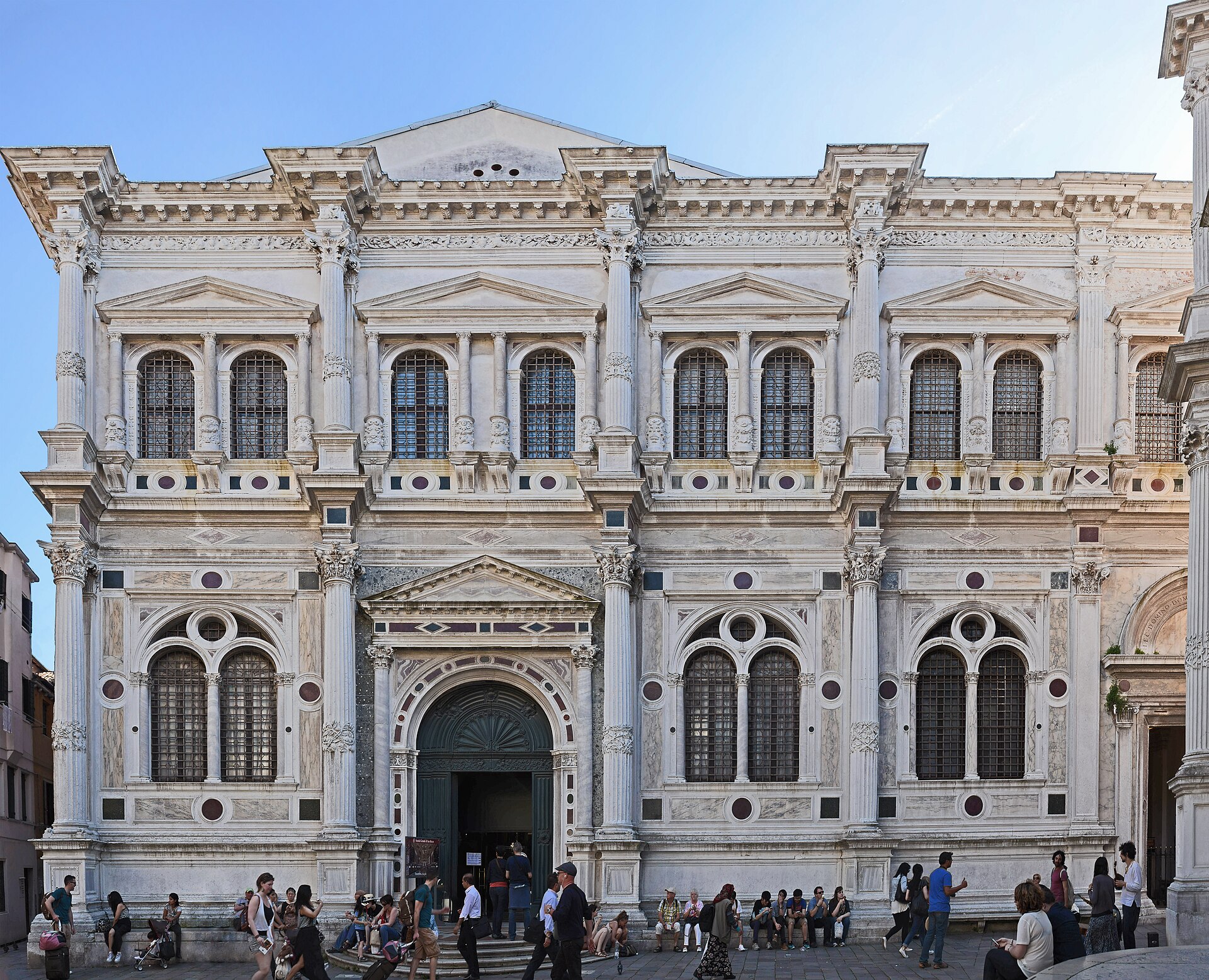
The Scuola Grande di San Rocco is a historic building in Venice, Italy, renowned for its extensive collection of paintings by the Venetian master Tintoretto. Established in 1478 as a confraternity dedicated to Saint Roch, the current structure was built between 1515 and 1560 to house the charitable organization and its growing art collection.
The interior is celebrated for its cycle of over 60 paintings by Tintoretto, executed between 1564 and 1587. These works, which cover the walls and ceilings of the Sala dell'Albergo and the upper and lower halls, are considered the artist's magnum opus and a definitive example of Venetian Mannerist art.
Key Facts
- Materials
- Istrian stone, Marble, Brick
- Civilization
- Venetian Republic
- Accessibility
- Limited; stairs required for upper floors
- Date(s)
- 1515-1560
- Condition
- Well-preserved, active museum
- Original Function
- Confraternity headquarters and charitable institution
- Key Figures
- Tintoretto, Bartolomeo Bon, Sante Lombardo
Foundation and Purpose
1478The Confraternity of San Rocco was founded to provide charitable aid to the sick and poor, particularly during the frequent plague outbreaks in Venice. It was one of the six 'Scuole Grandi', the most prestigious lay confraternities in the city.
Construction of the Scuola
1515-1560Construction of the current building began in 1515 under the direction of Bartolomeo Bon. The project continued under Sante Lombardo and Antonio Scarpagnino, resulting in a grand Renaissance structure that served as both a meeting hall and a treasury for the confraternity's religious relics.
The Tintoretto Commission
1564-1587In 1564, the Scuola held a competition to decorate the Sala dell'Albergo. Tintoretto famously bypassed the competition by presenting a finished painting, 'Saint Roch in Glory', which he donated to the confraternity. This led to a multi-decade commission that transformed the interior into a cohesive narrative cycle.
Modern Preservation
20th century - presentThe building remains under the stewardship of the original confraternity. Extensive restoration projects have been undertaken to preserve the integrity of the canvases, which are highly sensitive to the humid Venetian environment.
Cultural Significance
The Scuola Grande di San Rocco represents the intersection of civic charity and artistic patronage in the Venetian Republic. It serves as a primary site for understanding the role of lay confraternities in supporting the social fabric of Venice while simultaneously acting as a repository for the city's most significant artistic achievements.
For art historians, the site is essential for studying the development of Tintoretto's style, from his early narrative clarity to his later, more dramatic and ethereal compositions. It remains a focal point for the study of Mannerist painting techniques and large-scale decorative programs.
Interpretive Notes
Scholarly debates and areas of uncertainty
There is ongoing academic discussion regarding the specific iconographic program of the paintings. While some scholars argue the cycle follows a strict theological narrative related to the confraternity's charitable mission, others suggest the placement of certain works was dictated more by the architectural constraints of the rooms than by a unified liturgical plan.
Visiting Information
Entry Rules
Open daily. Tickets are required for entry. Visitors are expected to dress modestly as the building retains its status as a religious site. Large bags are not permitted inside the galleries.
Best Times to Visit
Early morning or late afternoon to avoid the peak tourist crowds that congregate in the San Polo district. Weekdays are generally quieter than weekends.
Photography
Non-commercial photography is permitted without flash or tripods. Video recording is strictly prohibited.
Preservation Notes
Do not touch the canvases or the gilded wood carvings. The building is climate-sensitive; please follow all posted instructions regarding movement through the halls to maintain air quality.
Nearby POIs
11 shown- Chiesa di San Rocco
- Basilica di Santa Maria Gloriosa dei Frari0.1 km
- Ca' Rezzonico0.4 km
- Palazzo Grassi0.4 km
- Gallerie dell'Accademia0.6 km
- Ca' Pesaro International Gallery of Modern Art0.7 km
- Peggy Guggenheim Collection0.8 km
- Museo di Correr1 km
- Ghetto di Venezia1 km
- Basilica di Santa Maria della Salute1 km
- Biblioteca Nazionale Marciana1.2 km
Sources & Further Reading
- [1]Tintoretto: Tradition and Identity — Tom Nichols. Reaktion Books (1999)
- [2]The Scuola Grande di San Rocco: A Guide — Franco Bernabei. Scuola Grande di San Rocco Publications (2015)
Key Facts
- Materials
- Istrian stone, Marble, Brick
- Civilization
- Venetian Republic
- Accessibility
- Limited; stairs required for upper floors
- Date(s)
- 1515-1560
- Condition
- Well-preserved, active museum
- Original Function
- Confraternity headquarters and charitable institution
- Key Figures
- Tintoretto, Bartolomeo Bon, Sante Lombardo
Nearby POIs
11 shown- Chiesa di San Rocco
- Basilica di Santa Maria Gloriosa dei Frari0.1 km
- Ca' Rezzonico0.4 km
- Palazzo Grassi0.4 km
- Gallerie dell'Accademia0.6 km
- Ca' Pesaro International Gallery of Modern Art0.7 km
- Peggy Guggenheim Collection0.8 km
- Museo di Correr1 km
- Ghetto di Venezia1 km
- Basilica di Santa Maria della Salute1 km
- Biblioteca Nazionale Marciana1.2 km