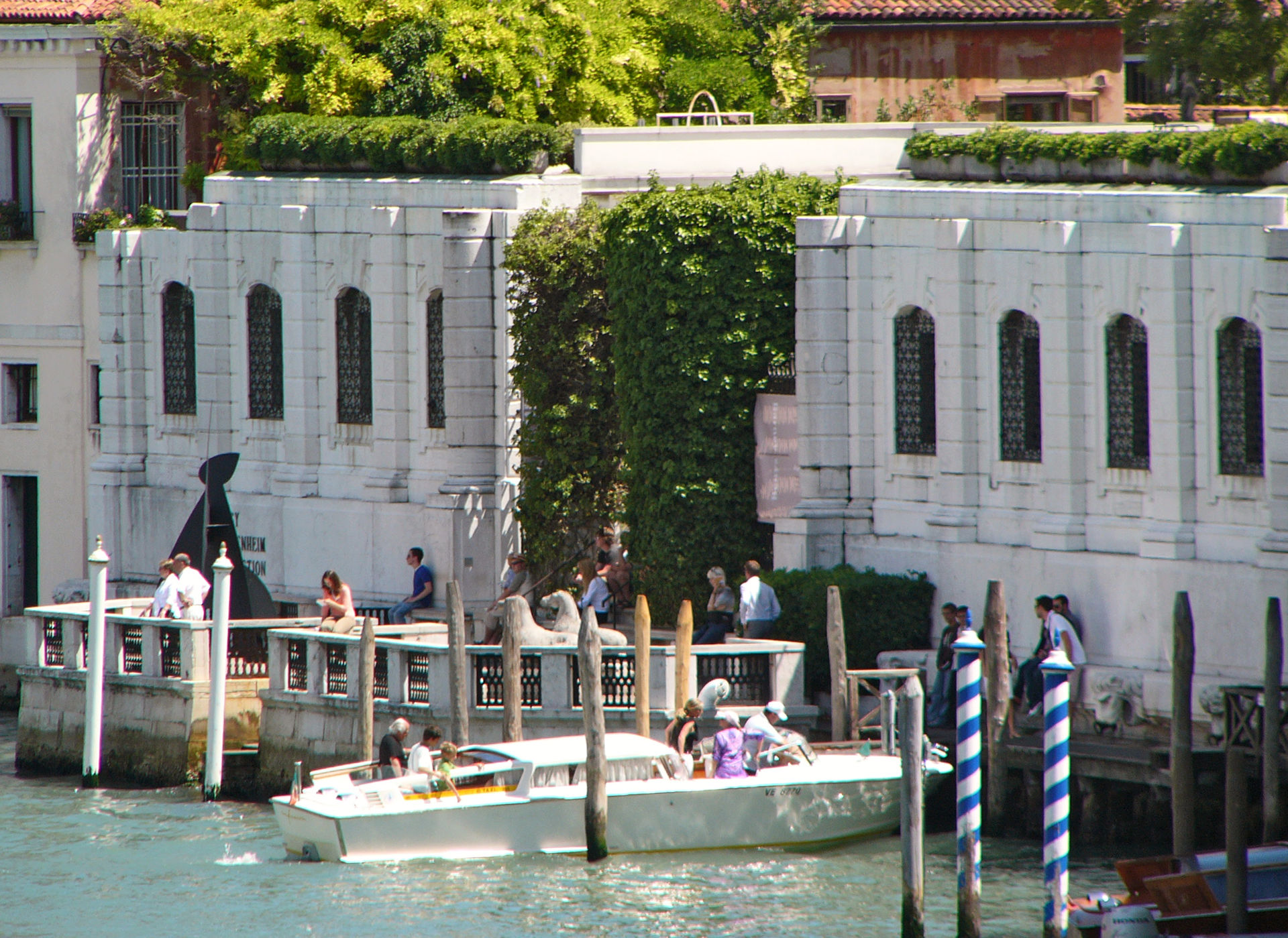
The Peggy Guggenheim Collection is a modern art museum located on the Grand Canal in the Dorsoduro sestiere of Venice. Housed in the Palazzo Venier dei Leoni, an unfinished 18th-century palace that served as the home of American heiress and art collector Peggy Guggenheim for three decades, the museum holds one of the most significant collections of European and American art of the first half of the 20th century.
The collection features works by prominent artists associated with Cubism, Surrealism, Abstract Expressionism, and Italian Futurism. Notable holdings include pieces by Pablo Picasso, Salvador Dalí, René Magritte, Jackson Pollock, and Umberto Boccioni. The museum also maintains the Nasher Sculpture Garden, which displays works by contemporary artists alongside the permanent collection.
Key Facts
- Materials
- Istrian stone, Brick, Plaster
- Civilization
- Modern Western
- Accessibility
- Wheelchair accessible
- Date(s)
- 1748 (Palazzo structure)
- Condition
- Well-preserved, active museum
- Original Function
- Private residence
- Key Figures
- Peggy Guggenheim, Lorenzo Boschetti, Solomon R. Guggenheim Foundation
Palazzo Origins
18th CenturyThe Palazzo Venier dei Leoni was designed by architect Lorenzo Boschetti in 1748. Construction was halted after the first floor was completed, leaving the building as a low-profile structure that contrasts with the taller palaces along the Grand Canal.
Acquisition and Residence
1949-1979Peggy Guggenheim purchased the unfinished palace in 1949. She lived there for thirty years, opening her private collection to the public during the summer months and hosting many of the era's most influential artists and intellectuals.
Institutionalization
1979-PresentFollowing her death in 1979, Guggenheim bequeathed the palace and her collection to the Solomon R. Guggenheim Foundation. The site was subsequently transformed into a permanent public museum, undergoing several expansions to accommodate growing visitor numbers and temporary exhibitions.
Cultural Significance
The museum is a cornerstone of modern art in Italy, serving as a vital link between the American art scene and European modernism. It is instrumental in the preservation of the legacy of Peggy Guggenheim, whose patronage was essential to the careers of many mid-century abstract and surrealist artists.
Interpretive Notes
Scholarly debates and areas of uncertainty
Debates often center on the tension between the building's historical architectural context and its function as a modern art space, as well as the curatorial challenges of maintaining the 'domestic' atmosphere of Guggenheim's original living space while managing high-volume public museum traffic.
Visiting Information
Entry Rules
Open daily except Tuesdays. Tickets should be purchased online in advance to guarantee entry. Large bags and backpacks must be left in the cloakroom.
Best Times to Visit
Early morning or late afternoon on weekdays to avoid peak tourist crowds. The garden is particularly pleasant during the spring and autumn months.
Photography
Personal photography is permitted for non-commercial use without flash or tripods. Photography of temporary exhibitions may be restricted.
Preservation Notes
Visitors are requested not to touch the artworks or sculptures in the garden. The palace is a historic structure; please follow all marked pathways.
Nearby POIs
11 shown- Basilica di Santa Maria della Salute0.3 km
- Gallerie dell'Accademia0.3 km
- Palazzo Grassi0.4 km
- Ca' Rezzonico0.5 km
- Museo di Correr0.5 km
- Biblioteca Nazionale Marciana0.7 km
- Basilica di San Marco0.8 km
- Palazzo Ducale0.8 km
- Basilica di Santa Maria Gloriosa dei Frari0.8 km
- Scuola Grande di San Rocco0.8 km
- Chiesa di San Rocco0.8 km
Sources & Further Reading
- [1]Peggy Guggenheim: A Collector's Life — Anton Gill. HarperCollins (2001)
- [2]The Peggy Guggenheim Collection of Modern Art — Angelica Zander Rudenstine. Harry N. Abrams (1985)
Key Facts
- Materials
- Istrian stone, Brick, Plaster
- Civilization
- Modern Western
- Accessibility
- Wheelchair accessible
- Date(s)
- 1748 (Palazzo structure)
- Condition
- Well-preserved, active museum
- Original Function
- Private residence
- Key Figures
- Peggy Guggenheim, Lorenzo Boschetti, Solomon R. Guggenheim Foundation
Nearby POIs
11 shown- Basilica di Santa Maria della Salute0.3 km
- Gallerie dell'Accademia0.3 km
- Palazzo Grassi0.4 km
- Ca' Rezzonico0.5 km
- Museo di Correr0.5 km
- Biblioteca Nazionale Marciana0.7 km
- Basilica di San Marco0.8 km
- Palazzo Ducale0.8 km
- Basilica di Santa Maria Gloriosa dei Frari0.8 km
- Scuola Grande di San Rocco0.8 km
- Chiesa di San Rocco0.8 km