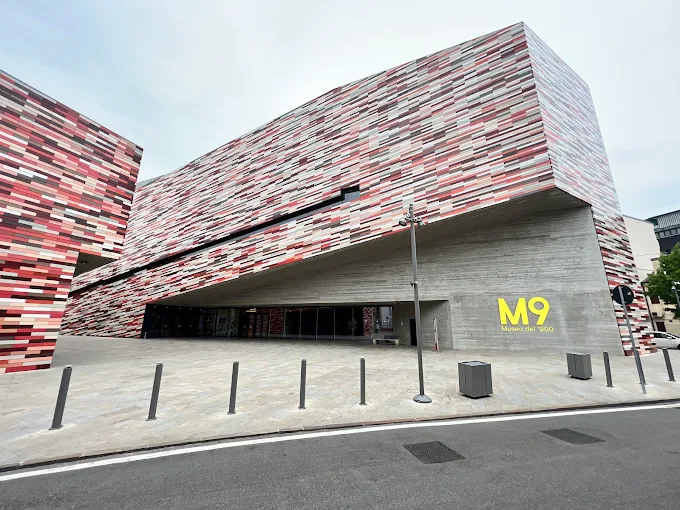
The M9 Museum, located in Mestre, Venice, is a contemporary history museum dedicated to the social, economic, and environmental transformations of Italy during the 20th century. Unlike traditional museums, M9 utilizes immersive multimedia installations, interactive digital archives, and sensory experiences to engage visitors with historical narratives rather than relying solely on physical artifacts.
The museum complex is housed in a sustainable architectural project designed by Sauerbruch Hutton, which integrates modern design with the historic urban fabric of Mestre. It serves as a cultural hub intended to revitalize the urban center while providing a critical perspective on the rapid modernization and industrialization of the Italian peninsula.
Key Facts
- Materials
- Ceramic tiles, Glass, Steel, Concrete
- Civilization
- Modern Italian
- Accessibility
- Fully wheelchair accessible
- Date(s)
- 2015-2018
- Condition
- Active
- Original Function
- Museum of 20th-century history
- Key Figures
- Sauerbruch Hutton, Fondazione di Venezia
Urban Regeneration Project
2010-2015The M9 project was initiated by the Fondazione di Venezia as part of a broader urban renewal strategy for Mestre. The goal was to transform a former military district into a vibrant cultural and commercial center.
Architectural Development
2015-2018Designed by the Berlin-based firm Sauerbruch Hutton, the building was constructed with a focus on sustainability and energy efficiency. The facade features thousands of polychrome ceramic tiles that reflect the surrounding urban environment.
Inauguration and Operation
2018-PresentThe museum officially opened to the public in December 2018. It has since functioned as a digital-first institution, focusing on educational outreach and the preservation of 20th-century Italian history through interactive technology.
Cultural Significance
M9 represents a shift in Italian museology, moving away from the 'temple of objects' model toward a 'narrative-based' approach. It plays a significant role in the cultural identity of the Venetian mainland, offering a space for reflection on the rapid industrialization and social changes that defined modern Italy.
Interpretive Notes
Scholarly debates and areas of uncertainty
There is ongoing discussion regarding the efficacy of purely digital and multimedia exhibitions in conveying historical nuance compared to traditional artifact-based displays. Scholars also debate the impact of such 'starchitecture' projects on the gentrification of the Mestre district.
Visiting Information
Entry Rules
Open Tuesday through Sunday. Tickets can be purchased online or at the entrance. No specific dress code is required.
Best Times to Visit
Weekday mornings are generally quieter. The museum is a good indoor alternative during the high-humidity summer months in the Venice area.
Photography
Personal photography is permitted in most areas. Flash and tripods are prohibited in exhibition galleries.
Preservation Notes
The building is a modern structure with climate-controlled environments. Visitors are asked to respect the digital equipment and avoid touching projection surfaces.
Nearby POIs
11 shown- Ghetto di Venezia8.4 km
- Madonna dell'Orto8.8 km
- Chiesa di San Rocco9 km
- Scuola Grande di San Rocco9 km
- Basilica di Santa Maria Gloriosa dei Frari9 km
- Ca' Pesaro International Gallery of Modern Art9.1 km
- Ca' Rezzonico9.3 km
- Palazzo Grassi9.4 km
- Gallerie dell'Accademia9.6 km
- Peggy Guggenheim Collection9.8 km
- Basilica dei Santi Giovanni e Paolo9.8 km
Sources & Further Reading
- [1]
- [2]The Architecture of M9 — Luca Molinari. Skira (2018)
Key Facts
- Materials
- Ceramic tiles, Glass, Steel, Concrete
- Civilization
- Modern Italian
- Accessibility
- Fully wheelchair accessible
- Date(s)
- 2015-2018
- Condition
- Active
- Original Function
- Museum of 20th-century history
- Key Figures
- Sauerbruch Hutton, Fondazione di Venezia
Nearby POIs
11 shown- Ghetto di Venezia8.4 km
- Madonna dell'Orto8.8 km
- Chiesa di San Rocco9 km
- Scuola Grande di San Rocco9 km
- Basilica di Santa Maria Gloriosa dei Frari9 km
- Ca' Pesaro International Gallery of Modern Art9.1 km
- Ca' Rezzonico9.3 km
- Palazzo Grassi9.4 km
- Gallerie dell'Accademia9.6 km
- Peggy Guggenheim Collection9.8 km
- Basilica dei Santi Giovanni e Paolo9.8 km