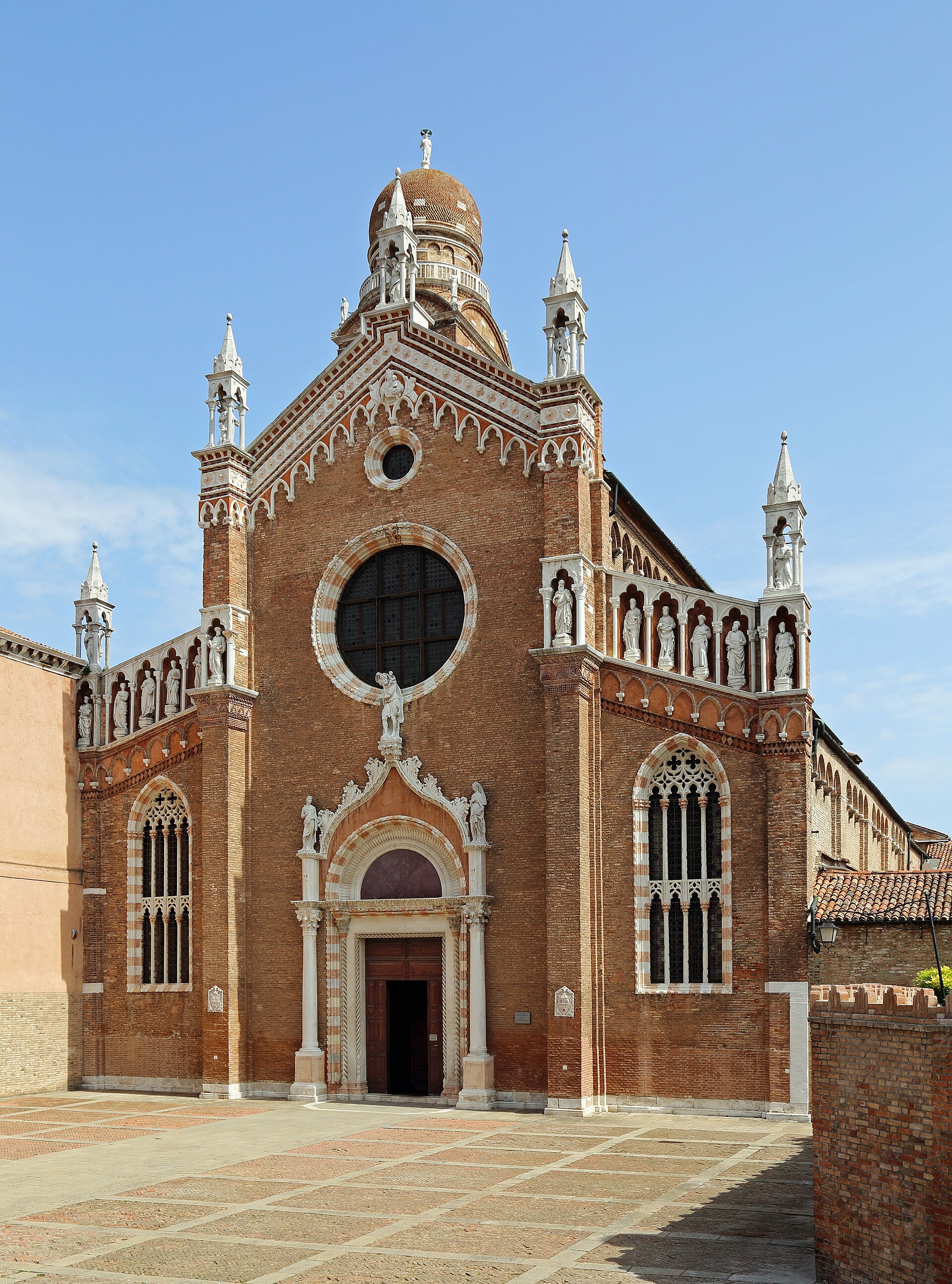
The Church of Madonna dell'Orto is a prominent Gothic-style religious building located in the Cannaregio district of Venice. Originally dedicated to Saint Christopher, it was renamed in the 14th century following the discovery of a miraculous statue of the Virgin Mary in a nearby garden.
The structure is renowned for its brick facade, which features intricate terracotta decorations and a series of statues representing the Apostles. Internally, the church serves as a significant repository of Venetian art, most notably housing several major works by the Renaissance master Tintoretto, who was a parishioner and is buried within the church walls.
Key Facts
- Materials
- Brick, Istrian stone, Terracotta
- Civilization
- Venetian
- Accessibility
- Ground level access with some uneven flooring
- Date(s)
- 1350 - 1473
- Condition
- Well-preserved, active place of worship
- Original Function
- Parish church
- Key Figures
- Tintoretto, Cima da Conegliano
Founding and Early Years
14th CenturyThe church was commissioned by the Humiliati order in 1350. Initially dedicated to Saint Christopher, the site gained local fame after a statue of the Virgin Mary, found in a nearby orchard, was reported to perform miracles.
Architectural Completion
15th CenturyThe facade was completed in 1473, showcasing the characteristic Venetian Gothic style. The interior was expanded and refined during this period, incorporating the distinct brickwork and stone carvings that define its exterior appearance today.
The Tintoretto Era
16th CenturyThe church became deeply associated with the painter Jacopo Tintoretto, who lived in the neighborhood. He contributed several massive canvases to the interior, including 'The Last Judgment' and 'The Adoration of the Golden Calf', which remain in their original locations.
Modern Preservation
20th Century - PresentFollowing years of neglect and structural challenges common to Venetian buildings, the church underwent significant restoration in the late 20th century. It is now managed as part of the Chorus Association, ensuring the preservation of its artistic heritage.
Cultural Significance
The Madonna dell'Orto is a cornerstone of Venetian cultural identity, representing the intersection of religious devotion and the city's artistic zenith. It is widely considered the 'Tintoretto church' due to the concentration of his works, which provide a unique opportunity to view his art in the architectural context for which it was originally commissioned.
Beyond its artistic value, the church serves as a vital community hub in the Cannaregio district. Its preservation is a priority for local heritage organizations, reflecting the ongoing effort to maintain Venice's historic fabric against the pressures of tourism and environmental degradation.
Interpretive Notes
Scholarly debates and areas of uncertainty
There is ongoing academic discussion regarding the attribution of certain minor sculptural elements on the facade, as well as the exact sequence of Tintoretto's commissions for the church. Scholars continue to analyze the environmental impact of the lagoon on the preservation of the large-scale canvases housed within the humid environment of the church.
Visiting Information
Entry Rules
Open to the public for visits. Entry requires a ticket or a Chorus Pass. Modest dress is required as it is an active place of worship. Please remain quiet during religious services.
Best Times to Visit
Weekday mornings are generally quieter. Avoid visiting during Sunday morning mass to ensure the best access to the artworks.
Photography
Personal photography is permitted without flash or tripods. Commercial photography requires prior authorization from the church administration.
Preservation Notes
Do not touch the paintings or the marble surfaces. The church is subject to high humidity; please follow all posted signage regarding climate control and visitor flow.
Nearby POIs
11 shown- Ghetto di Venezia0.5 km
- Ca' Pesaro International Gallery of Modern Art0.6 km
- Basilica dei Santi Giovanni e Paolo1.1 km
- Basilica di Santa Maria Gloriosa dei Frari1.2 km
- Chiesa di San Rocco1.2 km
- Scuola Grande di San Rocco1.2 km
- Museo di Palazzo Grimani1.3 km
- Basilica di San Marco1.4 km
- Palazzo Grassi1.5 km
- Museo di Correr1.5 km
- Ca' Rezzonico1.5 km
Sources & Further Reading
- [1]The Churches of Venice — Deborah Howard. Yale University Press (2002)
- [2]Tintoretto: Tradition and Identity — Tom Nichols. Reaktion Books (1999)
Key Facts
- Materials
- Brick, Istrian stone, Terracotta
- Civilization
- Venetian
- Accessibility
- Ground level access with some uneven flooring
- Date(s)
- 1350 - 1473
- Condition
- Well-preserved, active place of worship
- Original Function
- Parish church
- Key Figures
- Tintoretto, Cima da Conegliano
Nearby POIs
11 shown- Ghetto di Venezia0.5 km
- Ca' Pesaro International Gallery of Modern Art0.6 km
- Basilica dei Santi Giovanni e Paolo1.1 km
- Basilica di Santa Maria Gloriosa dei Frari1.2 km
- Chiesa di San Rocco1.2 km
- Scuola Grande di San Rocco1.2 km
- Museo di Palazzo Grimani1.3 km
- Basilica di San Marco1.4 km
- Palazzo Grassi1.5 km
- Museo di Correr1.5 km
- Ca' Rezzonico1.5 km