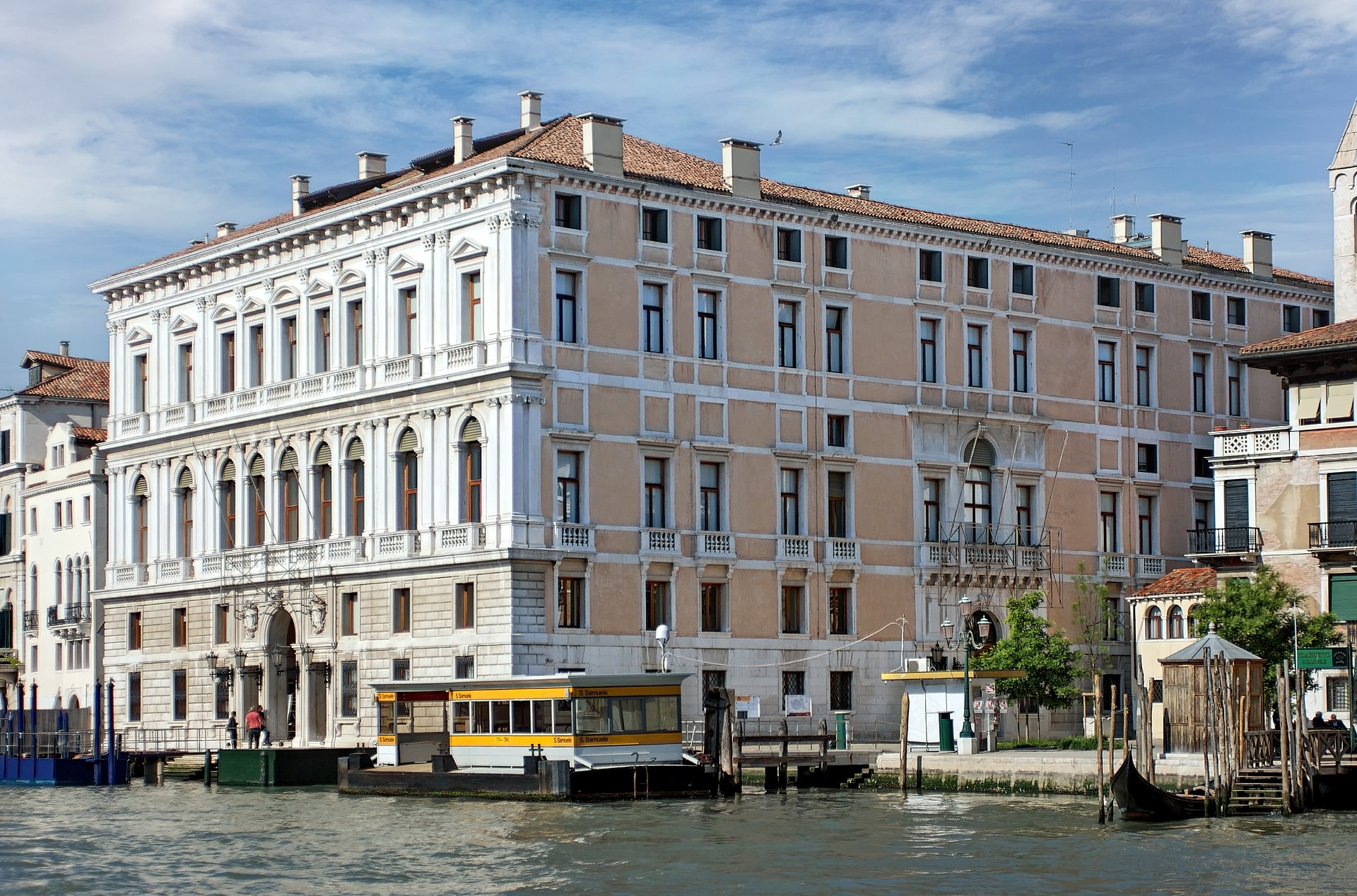
Palazzo Grassi is a prominent Venetian palace located on the Grand Canal in the San Samuele district. Designed by architect Giorgio Massari and constructed between 1748 and 1772, it represents one of the final major aristocratic residences built in Venice before the fall of the Republic. The building is noted for its classical facade, which breaks from the traditional Venetian Gothic and Renaissance styles prevalent along the canal.
Since its acquisition by the Pinault Collection in 2005, the palace has been repurposed as a contemporary art museum. The interior underwent significant renovations led by architect Tadao Ando to accommodate large-scale exhibitions while preserving the original 18th-century architectural elements and frescoes.
Key Facts
- Materials
- Istrian stone, Brick, Marble
- Civilization
- Venetian
- Accessibility
- Wheelchair accessible with elevator access to exhibition floors
- Date(s)
- 1748-1772
- Condition
- Restored and active as a contemporary art museum
- Original Function
- Private residence for the Grassi family
- Key Figures
- Giorgio Massari, François Pinault, Tadao Ando
Construction and Origins
1748-1772The palace was commissioned by the Grassi family, a wealthy merchant family from Bologna who had been admitted to the Venetian patriciate. Giorgio Massari was tasked with the design, creating a structure that emphasized symmetry and classical proportions.
Ownership Changes
19th-20th centuryFollowing the decline of the Grassi family, the palace passed through several owners, including the industrialist Giovanni Stucky and later the Fiat group, which utilized the space for exhibitions and cultural events.
Pinault Collection Era
2005-presentIn 2005, French businessman François Pinault purchased the building. Architect Tadao Ando was commissioned to renovate the interior, creating a dialogue between the historic Venetian architecture and modern exhibition requirements.
Cultural Significance
Palazzo Grassi serves as a bridge between Venice's historical architectural legacy and the global contemporary art scene. Its transformation into a museum has revitalized the San Samuele area, establishing it as a key node for international art exhibitions during the Venice Biennale.
Interpretive Notes
Scholarly debates and areas of uncertainty
Debate exists regarding the extent of the architectural interventions by Tadao Ando. While some critics praise the minimalist integration of modern materials within the 18th-century shell, others argue that the modifications obscure the original spatial logic of the palace's piano nobile.
Visiting Information
Entry Rules
Open Wednesday to Monday. Tickets can be purchased online or at the entrance. Visitors are required to leave large bags in the cloakroom.
Best Times to Visit
Weekday mornings to avoid peak tourist traffic on the Grand Canal and weekend crowds.
Photography
Personal photography is permitted without flash or tripods. Professional photography requires prior authorization.
Preservation Notes
The building is subject to strict conservation guidelines due to its location on the Grand Canal and its status as a protected historical monument. Visitors are asked to refrain from touching the walls or frescoes.
Nearby POIs
11 shown- Ca' Rezzonico0.1 km
- Gallerie dell'Accademia0.3 km
- Basilica di Santa Maria Gloriosa dei Frari0.4 km
- Scuola Grande di San Rocco0.4 km
- Chiesa di San Rocco0.4 km
- Peggy Guggenheim Collection0.4 km
- Basilica di Santa Maria della Salute0.6 km
- Museo di Correr0.7 km
- Ca' Pesaro International Gallery of Modern Art0.8 km
- Biblioteca Nazionale Marciana0.9 km
- Basilica di San Marco0.9 km
Sources & Further Reading
- [1]Palazzo Grassi: The History of a Venetian Palace — Giandomenico Romanelli. Marsilio Editori (2006)
- [2]Tadao Ando: The Pinault Collection at Palazzo Grassi — Philip Jodidio. Skira (2013)
Key Facts
- Materials
- Istrian stone, Brick, Marble
- Civilization
- Venetian
- Accessibility
- Wheelchair accessible with elevator access to exhibition floors
- Date(s)
- 1748-1772
- Condition
- Restored and active as a contemporary art museum
- Original Function
- Private residence for the Grassi family
- Key Figures
- Giorgio Massari, François Pinault, Tadao Ando
Nearby POIs
11 shown- Ca' Rezzonico0.1 km
- Gallerie dell'Accademia0.3 km
- Basilica di Santa Maria Gloriosa dei Frari0.4 km
- Scuola Grande di San Rocco0.4 km
- Chiesa di San Rocco0.4 km
- Peggy Guggenheim Collection0.4 km
- Basilica di Santa Maria della Salute0.6 km
- Museo di Correr0.7 km
- Ca' Pesaro International Gallery of Modern Art0.8 km
- Biblioteca Nazionale Marciana0.9 km
- Basilica di San Marco0.9 km