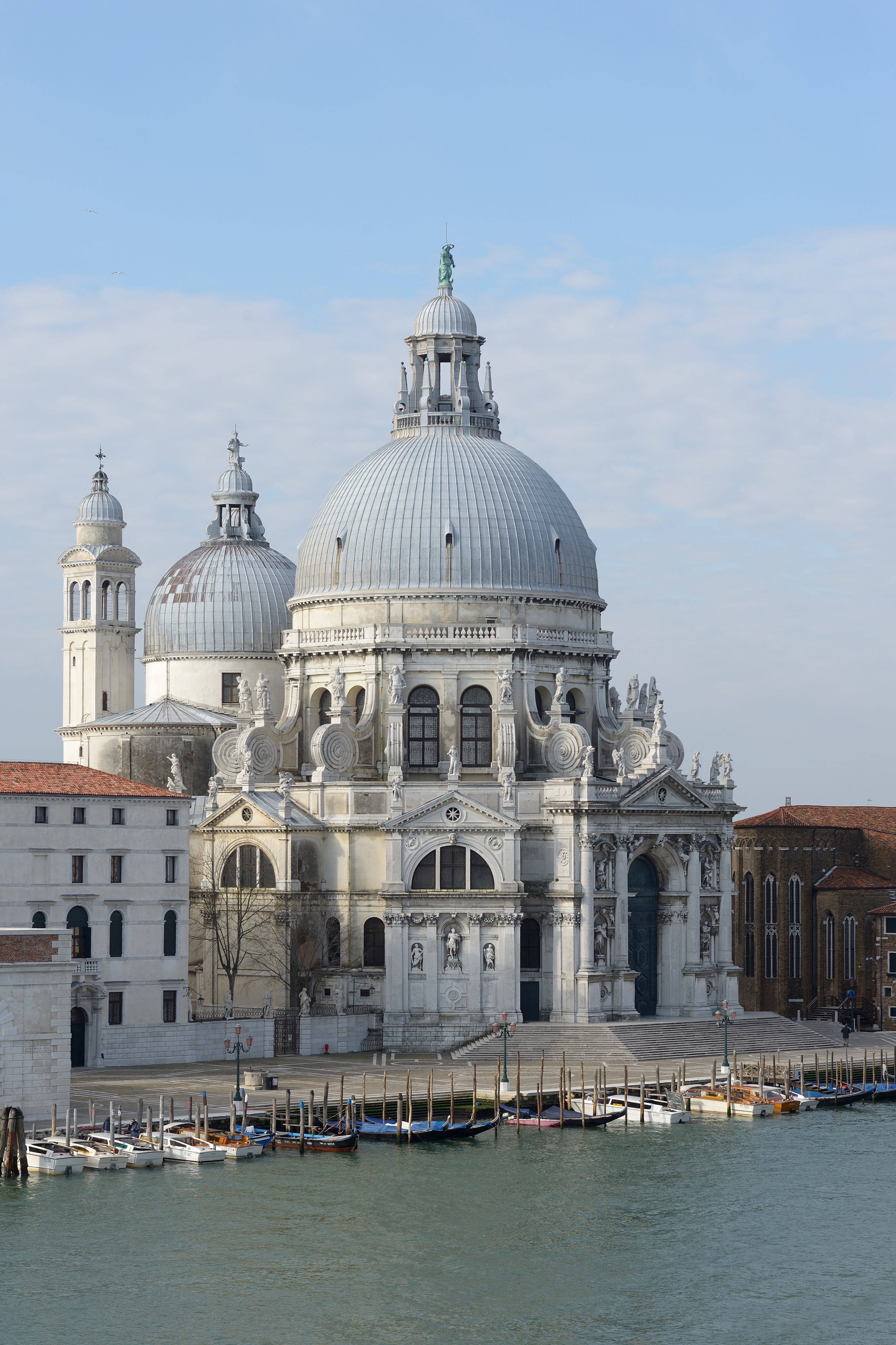
The Basilica di Santa Maria della Salute, commonly known simply as the Salute, is a Roman Catholic church and minor basilica located at the tip of the Punta della Dogana in the Dorsoduro sestiere of Venice. It was commissioned by the Venetian Senate as a votive offering for the city's deliverance from a devastating outbreak of the plague in 1630. The structure occupies a prominent position at the entrance to the Grand Canal, serving as a visual anchor for the Venetian skyline.
Designed by architect Baldassare Longhena, the church is a masterpiece of Venetian Baroque architecture. Its octagonal plan, surmounted by a massive dome, was intended to symbolize the crown of the Virgin Mary. The building is supported by over one million wooden piles driven into the marshy ground, a testament to the advanced engineering required to sustain such a monumental structure on the Venetian lagoon.
Key Facts
- Materials
- Istrian stone, Marmorino plaster, Brick
- Civilization
- Venetian Republic
- Accessibility
- Accessible via ramp at the main entrance
- Date(s)
- 1631-1681
- Condition
- Well-preserved, active religious site
- Original Function
- Votive church dedicated to the Virgin Mary
- Key Figures
- Baldassare Longhena, Doge Nicolò Contarini
The Plague Vow
1630Following the outbreak of the bubonic plague that killed nearly a third of Venice's population, the Senate vowed to build a church dedicated to the Virgin Mary if the city were spared. The site at the Punta della Dogana was chosen for its visibility from the Doge's Palace.
Architectural Competition
1631A competition was held to select the design for the new basilica. Baldassare Longhena, a young architect, won the commission over established masters, proposing an innovative octagonal design that departed from the traditional longitudinal church plans of the era.
Construction and Consecration
1631-1681Construction spanned five decades due to the immense engineering challenges of building on the unstable lagoon floor. The basilica was finally consecrated in 1687, six years after the death of its architect.
Cultural Significance
The Salute is deeply embedded in Venetian cultural identity, serving as the site of the annual Festa della Madonna della Salute on November 21st. On this day, a temporary pontoon bridge is constructed across the Grand Canal, allowing thousands of Venetians to cross and light candles in gratitude for the city's health. It remains one of the most iconic silhouettes in the city, frequently depicted by artists such as Canaletto and J.M.W. Turner.
Interpretive Notes
Scholarly debates and areas of uncertainty
Scholars often debate the extent to which Longhena's design was influenced by Palladian classicism versus the emerging Roman Baroque style. Additionally, the symbolic meaning of the two domes and the specific iconographic program of the interior sculptures remain subjects of ongoing art historical analysis.
Visiting Information
Entry Rules
Open daily. Entry to the main body of the church is free. A small fee is required to visit the sacristy, which houses significant works by Tintoretto and Titian. Modest dress is required; shoulders and knees must be covered.
Best Times to Visit
Early morning or late afternoon to avoid the peak tourist traffic of the Grand Canal. November 21st is the most significant day for local cultural observation.
Photography
Personal photography is permitted without flash. Tripods and professional equipment require prior authorization from the ecclesiastical authorities.
Preservation Notes
The basilica is subject to constant monitoring due to its location on the water. Visitors are asked to remain within designated areas and refrain from touching the marble surfaces or historical altarpieces.
Nearby POIs
11 shown- Peggy Guggenheim Collection0.3 km
- Museo di Correr0.4 km
- Biblioteca Nazionale Marciana0.5 km
- Gallerie dell'Accademia0.5 km
- Palazzo Ducale0.6 km
- Basilica di San Marco0.6 km
- Palazzo Grassi0.6 km
- Ca' Rezzonico0.7 km
- Museo di Palazzo Grimani0.9 km
- Basilica di Santa Maria Gloriosa dei Frari1 km
- Scuola Grande di San Rocco1 km
Sources & Further Reading
- [1]The Architecture of the Venetian Baroque — Deborah Howard. Yale University Press (2002)
- [2]Baldassare Longhena and the Venetian Baroque — Andrew Hopkins. Electa (2006)
Key Facts
- Materials
- Istrian stone, Marmorino plaster, Brick
- Civilization
- Venetian Republic
- Accessibility
- Accessible via ramp at the main entrance
- Date(s)
- 1631-1681
- Condition
- Well-preserved, active religious site
- Original Function
- Votive church dedicated to the Virgin Mary
- Key Figures
- Baldassare Longhena, Doge Nicolò Contarini
Nearby POIs
11 shown- Peggy Guggenheim Collection0.3 km
- Museo di Correr0.4 km
- Biblioteca Nazionale Marciana0.5 km
- Gallerie dell'Accademia0.5 km
- Palazzo Ducale0.6 km
- Basilica di San Marco0.6 km
- Palazzo Grassi0.6 km
- Ca' Rezzonico0.7 km
- Museo di Palazzo Grimani0.9 km
- Basilica di Santa Maria Gloriosa dei Frari1 km
- Scuola Grande di San Rocco1 km