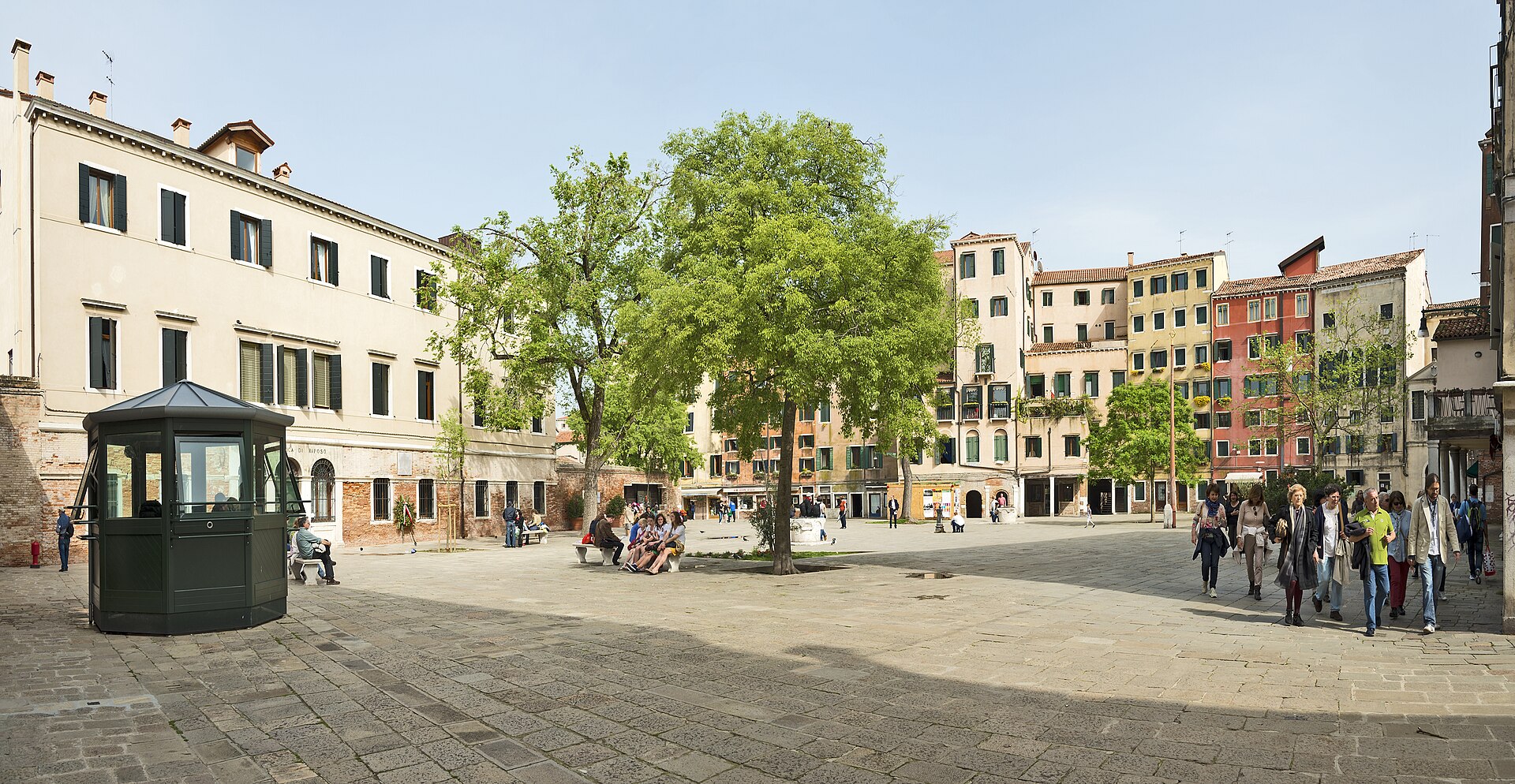
The Ghetto di Venezia is the historic Jewish quarter established by decree of the Venetian Republic in 1516. Located in the Cannaregio district, it functioned as a segregated residential area where Jews were required to reside under state regulation. The term “ghetto” originated from this site, derived from the area’s earlier use as a foundry (getto). The district contains multiple synagogues (scole), communal institutions, and residential buildings that reflect the social, religious, and economic life of Venice’s Jewish communities over several centuries.
Key Facts
- Materials
- Brick, Stone
- Civilization
- Venetian Republic
- Date(s)
- Established 1516
- Condition
- Active residential area and heritage site
- Original Function
- Legally mandated Jewish residential quarter
- Key Figures
- Venetian Senate
Establishment of the Ghetto
1516In 1516 the Venetian Senate ordered the confinement of Jewish residents to a designated island in Cannaregio. Gates controlled entry and exit, and guards enforced nightly curfews. Despite restrictions, the community was permitted to practice religion and engage in regulated economic activities.
Expansion and Community Life
16th-17th centuriesAs the Jewish population increased, additional sections known as the Ghetto Vecchio and Ghetto Nuovissimo were added. Distinct cultural groups, including Italian, German, Levantine, and Spanish Jews, established synagogues reflecting their liturgical traditions.
Napoleonic Emancipation
1797Following the fall of the Venetian Republic to Napoleon in 1797, the gates of the ghetto were removed and legal segregation ended. Jewish residents gained civil rights under new administrations.
20th Century and Commemoration
20th century - presentDuring the Second World War, members of Venice’s Jewish community were deported under Nazi occupation. Memorial plaques within the square commemorate victims. The area remains home to synagogues, the Jewish Museum of Venice, and an active community.
Cultural Significance
The Ghetto di Venezia represents one of the earliest formalized Jewish quarters in Europe and gave rise to a term later applied globally to segregated urban districts. It illustrates the complex relationship between restriction and relative autonomy within the Venetian Republic. Architecturally, the district’s unusually tall residential buildings reflect population density within a confined space. The site remains central to the history of Jewish life in Italy and to broader studies of urban segregation.
Interpretive Notes
Scholarly debates and areas of uncertainty
Historians debate the extent to which the Venetian ghetto represented pragmatic regulation versus systematic marginalization, noting that Venice allowed economic participation while enforcing residential confinement. Scholars also examine how the concept of the “ghetto” evolved linguistically and historically, especially in relation to later uses of the term in different political contexts.
Visiting Information
Entry Rules
Public square freely accessible. Entry to synagogues requires guided tour ticket through the Jewish Museum of Venice. Modest dress required for synagogue visits.
Best Times to Visit
Weekday mornings offer lower visitor volume. Guided synagogue tours operate on scheduled hours; advance booking recommended during peak tourist season.
Photography
Photography permitted in the public square. Restrictions apply inside synagogues and museum spaces. Flash and tripods prohibited.
Preservation Notes
Respect active religious spaces. Do not touch memorial plaques or architectural elements. Follow museum guidelines during guided visits.
Nearby POIs
11 shown- Madonna dell'Orto0.5 km
- Ca' Pesaro International Gallery of Modern Art0.6 km
- Chiesa di San Rocco0.9 km
- Basilica di Santa Maria Gloriosa dei Frari0.9 km
- Scuola Grande di San Rocco1 km
- Palazzo Grassi1.3 km
- Ca' Rezzonico1.3 km
- Basilica dei Santi Giovanni e Paolo1.4 km
- Museo di Correr1.5 km
- Gallerie dell'Accademia1.6 km
- Museo di Palazzo Grimani1.6 km
Sources & Further Reading
- [1]The Ghetto of Venice — Riccardo Calimani. M. Evans and Company (1987)
- [2]The Jews of Early Modern Venice — Benjamin Ravid. Johns Hopkins University Press (2001)
- [3]Venice: A New History — Thomas F. Madden. Viking (2012)
Key Facts
- Materials
- Brick, Stone
- Civilization
- Venetian Republic
- Date(s)
- Established 1516
- Condition
- Active residential area and heritage site
- Original Function
- Legally mandated Jewish residential quarter
- Key Figures
- Venetian Senate
Nearby POIs
11 shown- Madonna dell'Orto0.5 km
- Ca' Pesaro International Gallery of Modern Art0.6 km
- Chiesa di San Rocco0.9 km
- Basilica di Santa Maria Gloriosa dei Frari0.9 km
- Scuola Grande di San Rocco1 km
- Palazzo Grassi1.3 km
- Ca' Rezzonico1.3 km
- Basilica dei Santi Giovanni e Paolo1.4 km
- Museo di Correr1.5 km
- Gallerie dell'Accademia1.6 km
- Museo di Palazzo Grimani1.6 km