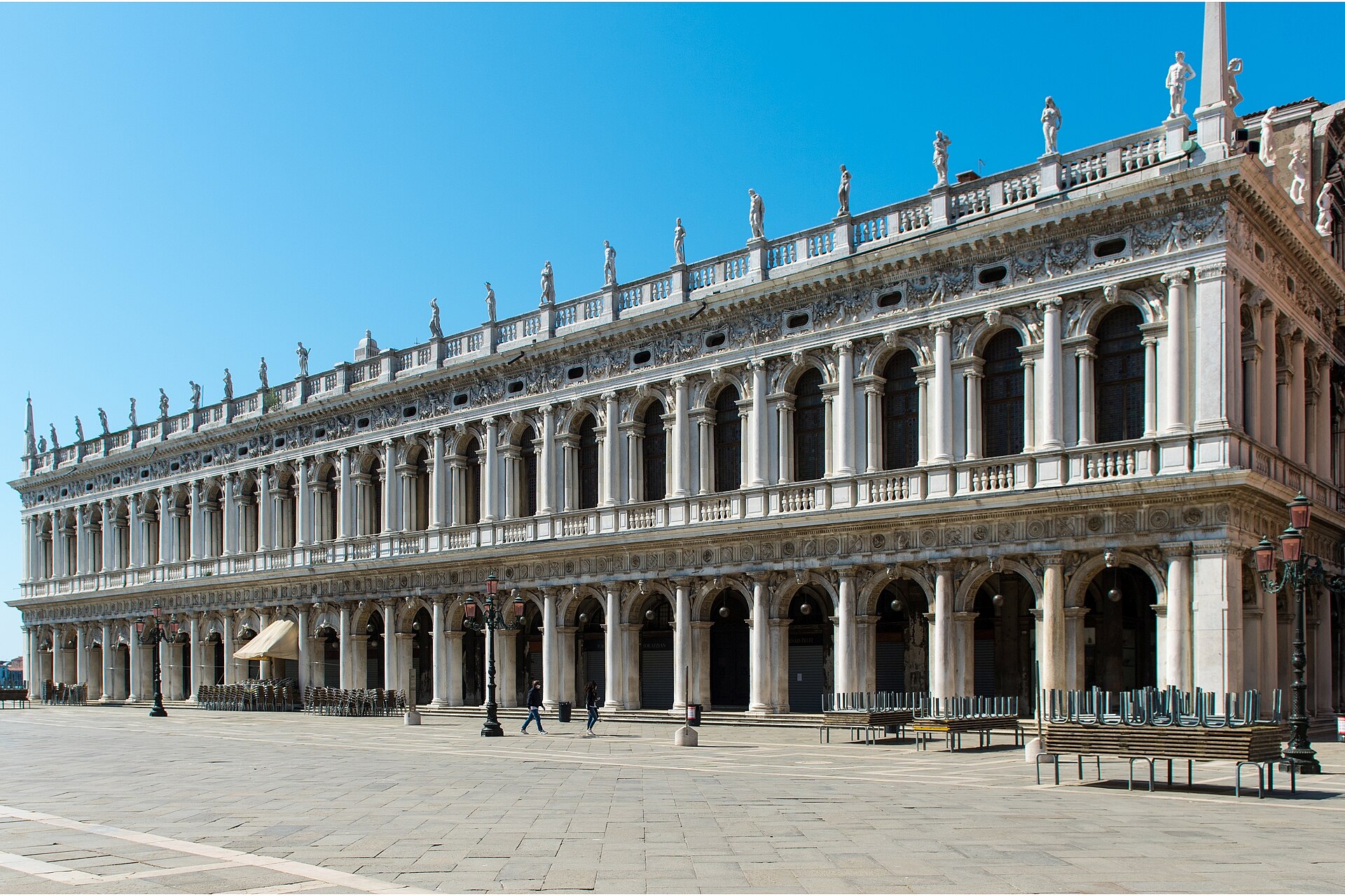
The Biblioteca Nazionale Marciana is a historic library in Venice located in the Libreria Sansoviniana on Piazza San Marco. Founded in the 15th century, it houses one of Italy’s most significant collections of classical manuscripts and early printed books. The institution emerged from a bequest of Greek and Latin codices and became a center for humanist scholarship within the Venetian Republic. The Renaissance building designed by Jacopo Sansovino reflects the republic’s investment in learning, civic prestige, and classical revival.
Key Facts
- Materials
- Istrian stone, Marble, Brick
- Civilization
- Venetian Republic
- Date(s)
- 1537-1588 (Libreria Sansoviniana)
- Condition
- Active national research library
- Original Function
- Public state library
- Key Figures
- Cardinal Bessarion, Jacopo Sansovino
Foundation and Bessarion’s Bequest
15th centuryIn 1468 Cardinal Bessarion donated his collection of Greek and Latin manuscripts to the Venetian Republic, stipulating the creation of a public library. The donation included significant classical and Byzantine texts, positioning Venice as a center for Renaissance humanism.
Construction of the Libreria
16th centuryJacopo Sansovino designed the monumental library building facing the Doge’s Palace. Completed in stages, the structure became a model of Venetian Renaissance architecture, with richly decorated interiors painted by artists such as Titian and Veronese.
Expansion and National Role
19th century - presentFollowing the fall of the Venetian Republic, the library was integrated into the Italian national system. It expanded through legal deposit requirements and acquisitions, becoming one of Italy’s principal research libraries.
Cultural Significance
The Biblioteca Marciana represents the institutionalization of Renaissance humanist scholarship within a republican political framework. Its collections preserve key sources for the study of classical antiquity, Byzantine transmission of texts, and early printing. Architecturally, the building forms part of the ceremonial and political landscape of Piazza San Marco, reinforcing the connection between governance, learning, and civic identity in Venice.
Interpretive Notes
Scholarly debates and areas of uncertainty
Scholars examine the political symbolism of establishing a public library in a republic, particularly how access to classical knowledge reinforced civic ideology. Debate also surrounds the transmission and preservation of Greek manuscripts from Byzantium to Italy, with the Marciana serving as a major repository for these materials.
Visiting Information
Entry Rules
Reading rooms accessible primarily to registered researchers. Monumental rooms may be visited with museum ticket. Identification required for research access.
Best Times to Visit
Research access follows institutional hours. Tourist visits to the monumental rooms are less crowded outside peak summer months.
Photography
Photography restricted in reading rooms and archival areas. Limited photography may be permitted in monumental rooms without flash.
Preservation Notes
Manuscripts and rare books are handled under supervised conditions. Environmental controls regulate humidity and temperature to protect fragile materials.
Nearby POIs
11 shown- Palazzo Ducale0.1 km
- Basilica di San Marco0.1 km
- Museo di Correr0.2 km
- Museo di Palazzo Grimani0.5 km
- Basilica di Santa Maria della Salute0.5 km
- Peggy Guggenheim Collection0.7 km
- Basilica dei Santi Giovanni e Paolo0.7 km
- Palazzo Grassi0.9 km
- Gallerie dell'Accademia0.9 km
- Ca' Rezzonico1 km
- Ca' Pesaro International Gallery of Modern Art1 km
Sources & Further Reading
- [1]The Marciana Library in Venice — Paul F. Grendler. Renaissance Quarterly
- [2]Venice: A New History — Thomas F. Madden. Viking (2012)
- [3]Jacopo Sansovino and Venetian Renaissance Architecture — Deborah Howard. Yale University Press
Key Facts
- Materials
- Istrian stone, Marble, Brick
- Civilization
- Venetian Republic
- Date(s)
- 1537-1588 (Libreria Sansoviniana)
- Condition
- Active national research library
- Original Function
- Public state library
- Key Figures
- Cardinal Bessarion, Jacopo Sansovino
Nearby POIs
11 shown- Palazzo Ducale0.1 km
- Basilica di San Marco0.1 km
- Museo di Correr0.2 km
- Museo di Palazzo Grimani0.5 km
- Basilica di Santa Maria della Salute0.5 km
- Peggy Guggenheim Collection0.7 km
- Basilica dei Santi Giovanni e Paolo0.7 km
- Palazzo Grassi0.9 km
- Gallerie dell'Accademia0.9 km
- Ca' Rezzonico1 km
- Ca' Pesaro International Gallery of Modern Art1 km