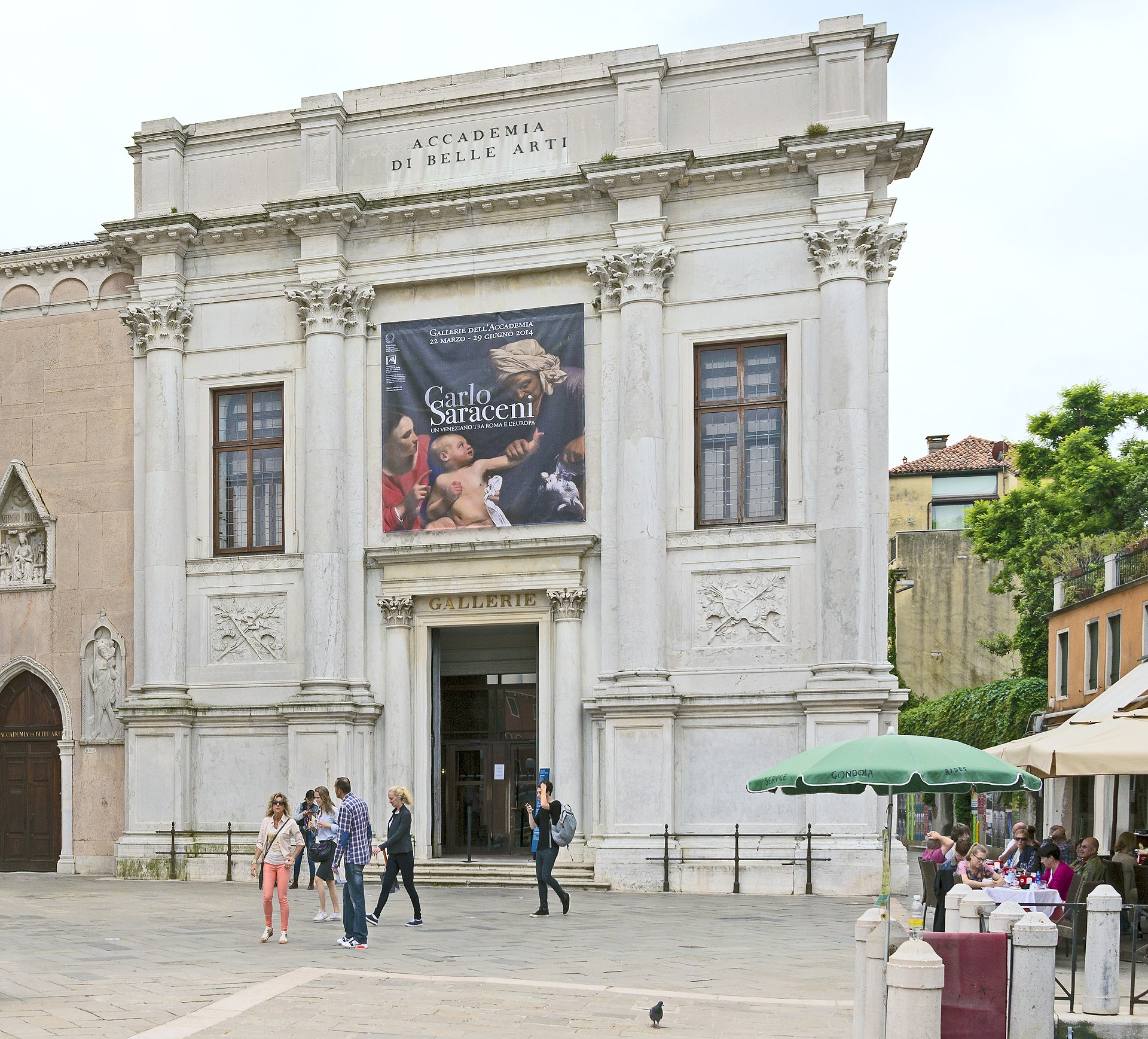
The Gallerie dell'Accademia is the preeminent museum of Venetian art, housing a collection that spans from the 14th to the 18th century. Located in the Sestiere of Dorsoduro, the museum occupies a complex that includes the former Church of Santa Maria della Carità, the Scuola Grande della Carità, and the Convento dei Canonici Lateranensi.
The collection was established in 1750 as the Accademia di Belle Arti and later expanded during the Napoleonic era to preserve works from suppressed churches and monasteries. It serves as the primary repository for the Venetian school of painting, featuring seminal works by masters such as Bellini, Giorgione, Titian, Tintoretto, Veronese, and Canaletto.
Key Facts
- Materials
- Brick, Istrian stone, Plaster
- Civilization
- Venetian
- Accessibility
- Wheelchair accessible
- Date(s)
- 1750 (Founding)
- Condition
- Active museum
- Original Function
- Art Academy and Convent
- Key Figures
- Giovanni Battista Piazzetta, Napoleon Bonaparte, Titian, Giovanni Bellini
Foundation and Napoleonic Era
1750-1807The Accademia was founded in 1750 as a school for painters and sculptors. Following the fall of the Venetian Republic and the subsequent Napoleonic occupation, the institution was reorganized in 1807 to house the vast collection of artworks confiscated from suppressed religious institutions across Venice.
Expansion and Integration
19th centuryThroughout the 19th century, the museum expanded its holdings through acquisitions and donations. The complex was unified into a single museum space, integrating the former church and monastery buildings into a cohesive gallery layout designed to showcase the evolution of Venetian painting.
Modern Restoration
20th century - presentThe museum underwent significant structural renovations in the late 20th century to modernize climate control and lighting. Recent efforts have focused on the restoration of large-scale canvases and the reorganization of the permanent collection to better reflect the chronological development of the Venetian school.
Cultural Significance
The Gallerie dell'Accademia is central to the understanding of Venetian cultural identity, preserving the visual legacy of the Republic of Venice. It provides the most comprehensive narrative of the Venetian school, which is characterized by its unique emphasis on color (colore) and light, distinguishing it from the more design-oriented (disegno) traditions of Florence and Rome.
Beyond its role as a museum, the site remains a vital educational resource for art historians and students of the Venetian Renaissance. Its collection is essential for studying the transition from Byzantine influences to the innovative techniques that defined the Venetian Golden Age.
Interpretive Notes
Scholarly debates and areas of uncertainty
The attribution of several early Renaissance works remains a subject of ongoing academic discussion, particularly regarding the collaborative efforts within the Bellini workshop. Additionally, the interpretation of Giorgione's 'The Tempest' continues to generate diverse scholarly theories, with no consensus on the specific iconographic meaning of the figures depicted.
Visiting Information
Entry Rules
Open daily. Tickets can be purchased online or at the entrance. Visitors are required to leave large bags in the cloakroom. No food or drink allowed in the galleries.
Best Times to Visit
Tuesday mornings or late afternoons on weekdays to avoid peak tourist crowds. The museum is generally quieter during the winter months.
Photography
Non-commercial photography is permitted without flash or tripods. Professional photography requires prior authorization from the museum administration.
Preservation Notes
Maintain a respectful distance from all canvases. Do not use flash, as it can cause long-term damage to pigments. Follow all posted signage regarding restricted areas.
Nearby POIs
11 shown- Ca' Rezzonico0.3 km
- Palazzo Grassi0.3 km
- Peggy Guggenheim Collection0.3 km
- Basilica di Santa Maria della Salute0.5 km
- Scuola Grande di San Rocco0.6 km
- Basilica di Santa Maria Gloriosa dei Frari0.6 km
- Chiesa di San Rocco0.7 km
- Museo di Correr0.8 km
- Biblioteca Nazionale Marciana0.9 km
- Basilica di San Marco1 km
- Palazzo Ducale1 km
Sources & Further Reading
- [1]The Gallerie dell'Accademia: A Guide to the Collection — Giovanna Scirè Nepi. Electa (1998)
- [2]Venetian Painting: A Concise History — John Steer. Thames & Hudson (1970)
Key Facts
- Materials
- Brick, Istrian stone, Plaster
- Civilization
- Venetian
- Accessibility
- Wheelchair accessible
- Date(s)
- 1750 (Founding)
- Condition
- Active museum
- Original Function
- Art Academy and Convent
- Key Figures
- Giovanni Battista Piazzetta, Napoleon Bonaparte, Titian, Giovanni Bellini
Nearby POIs
11 shown- Ca' Rezzonico0.3 km
- Palazzo Grassi0.3 km
- Peggy Guggenheim Collection0.3 km
- Basilica di Santa Maria della Salute0.5 km
- Scuola Grande di San Rocco0.6 km
- Basilica di Santa Maria Gloriosa dei Frari0.6 km
- Chiesa di San Rocco0.7 km
- Museo di Correr0.8 km
- Biblioteca Nazionale Marciana0.9 km
- Basilica di San Marco1 km
- Palazzo Ducale1 km