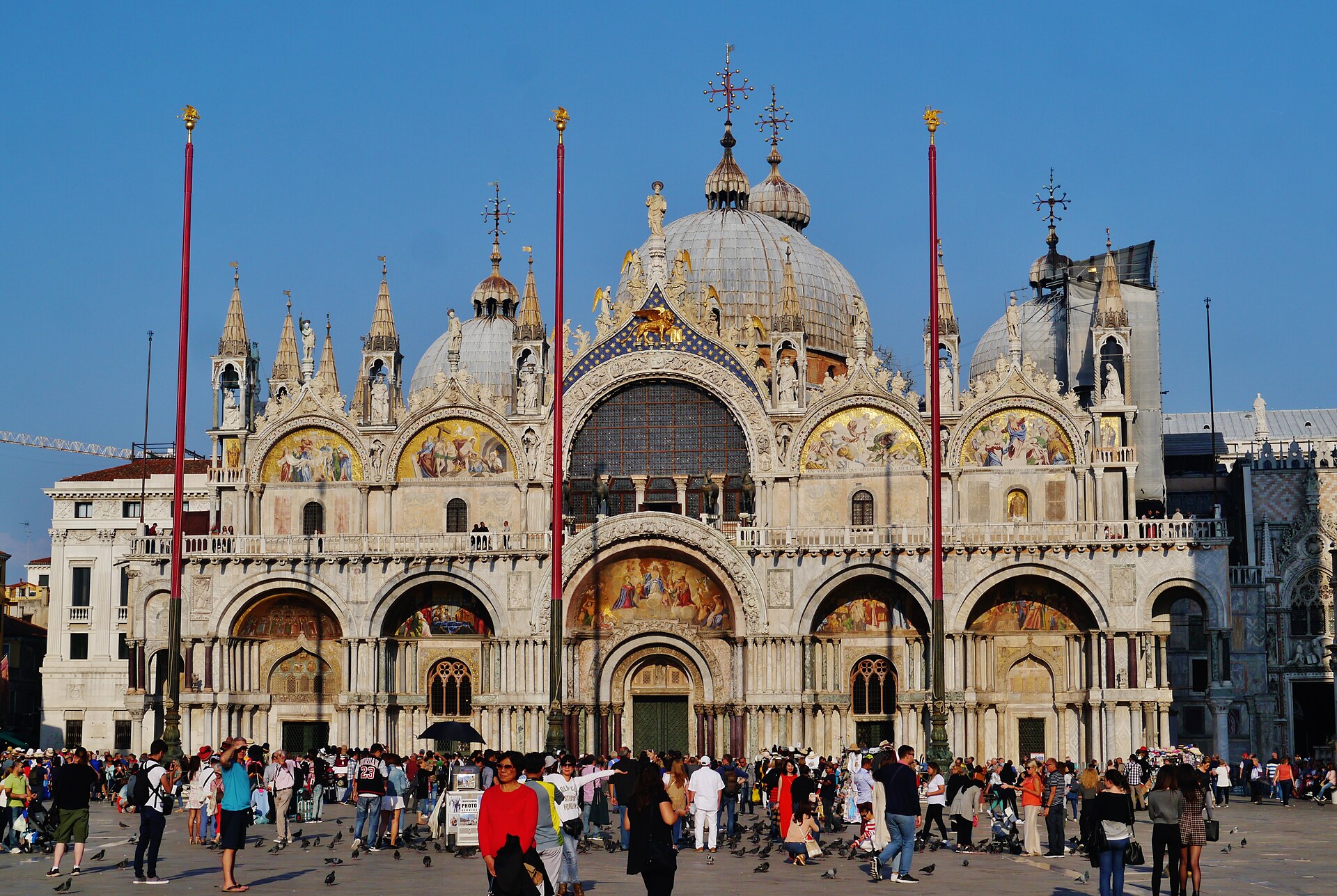
The Basilica di San Marco is the cathedral church of Venice and one of the most prominent examples of Italo-Byzantine architecture in Europe. Located in Piazza San Marco, it functioned historically as the private chapel of the Doge and the ceremonial center of the Venetian Republic. Constructed primarily in the 11th century and enriched over subsequent centuries, the basilica integrates Byzantine structural forms, mosaic decoration, and spolia acquired through Venice’s maritime expansion. Its domed roofline and gilded interiors reflect the republic’s commercial and political connections with the Eastern Mediterranean.
Key Facts
- Materials
- Brick, Marble revetment, Gold-ground mosaics
- Current Function
- Cathedral of the Patriarch of Venice
- Notable Features
- Five domes, Pala d’Oro altarpiece, Extensive mosaic cycles
- Date(s)
- Current structure begun 1063 CE
- Original Function
- Doge’s chapel and state church of the Venetian Republic
- Key Figures
- St. Mark the Evangelist, Various Doges of Venice
- Architectural Style
- Italo-Byzantine
- Religious Affiliation
- Roman Catholic
Foundation and Relics of St. Mark
9th centuryAccording to Venetian tradition, merchants transported the relics of St. Mark from Alexandria to Venice in 828 CE. A church was constructed to house the relics, establishing St. Mark as the city’s patron saint and reinforcing Venice’s religious and political legitimacy.
Reconstruction and Byzantine Influence
11th centuryAfter a fire in 976 damaged earlier structures, the current basilica began construction in 1063. Modeled partly on the Church of the Holy Apostles in Constantinople, it adopted a Greek-cross plan crowned by domes. Trade and contact with the Byzantine Empire shaped its architectural and decorative program.
Expansion and Decoration
12th-15th centuriesSuccessive centuries saw the addition of mosaics, marble cladding, and sculptural elements. Objects acquired during the Fourth Crusade in 1204, including the Horses of Saint Mark, were installed on the façade. The Pala d’Oro, a Byzantine enamel altarpiece, reflects Venice’s artistic exchanges with Constantinople.
Modern Role
19th century - presentFollowing the fall of the Venetian Republic in 1797, the basilica transitioned from a state church to the city’s cathedral. Ongoing conservation efforts address structural settlement and flooding associated with Venice’s lagoon environment.
Cultural Significance
The Basilica di San Marco functioned as both a religious sanctuary and a symbol of Venetian state power. Its architecture and decoration visually articulated Venice’s identity as a maritime republic connected to Byzantine and Mediterranean networks. The integration of Eastern and Western artistic traditions within a single structure makes it a key monument for understanding medieval cultural exchange and political symbolism in Europe.
Interpretive Notes
Scholarly debates and areas of uncertainty
Scholars debate the extent to which the basilica’s design directly replicates lost Byzantine prototypes versus adapting them within a Venetian context. Conservation specialists also examine how to balance structural stabilization and flood mitigation with the preservation of original mosaics and marble revetments.
Visiting Information
Entry Rules
General entry is free but requires timed reservation during peak periods. Separate fees apply for access to the museum, treasury, and Pala d’Oro. Modest dress required; large bags restricted.
Best Times to Visit
Early morning reservations reduce queue times. Spring and summer experience high visitor volume. Elevated walkways may be used during high water events.
Photography
Photography prohibited inside the basilica. Permitted in exterior areas. Flash and tripods prohibited.
Preservation Notes
Do not touch mosaic surfaces or marble columns. Flooding and humidity present ongoing conservation challenges. Follow designated visitor pathways to protect fragile flooring.
Nearby POIs
11 shown- Palazzo Ducale0.1 km
- Biblioteca Nazionale Marciana0.1 km
- Museo di Correr0.2 km
- Museo di Palazzo Grimani0.3 km
- Basilica dei Santi Giovanni e Paolo0.6 km
- Basilica di Santa Maria della Salute0.6 km
- Peggy Guggenheim Collection0.8 km
- Palazzo Grassi0.9 km
- Ca' Pesaro International Gallery of Modern Art1 km
- Gallerie dell'Accademia1 km
- Ca' Rezzonico1 km
Sources & Further Reading
- [1]St. Mark's Basilica in Venice — Otto Demus. University of Chicago Press
- [2]Venice: A New History — Thomas F. Madden. Viking (2012)
- [3]Byzantium and Venice — Donald M. Nicol. Cambridge University Press (1988)
Key Facts
- Materials
- Brick, Marble revetment, Gold-ground mosaics
- Current Function
- Cathedral of the Patriarch of Venice
- Notable Features
- Five domes, Pala d’Oro altarpiece, Extensive mosaic cycles
- Date(s)
- Current structure begun 1063 CE
- Original Function
- Doge’s chapel and state church of the Venetian Republic
- Key Figures
- St. Mark the Evangelist, Various Doges of Venice
- Architectural Style
- Italo-Byzantine
- Religious Affiliation
- Roman Catholic
Nearby POIs
11 shown- Palazzo Ducale0.1 km
- Biblioteca Nazionale Marciana0.1 km
- Museo di Correr0.2 km
- Museo di Palazzo Grimani0.3 km
- Basilica dei Santi Giovanni e Paolo0.6 km
- Basilica di Santa Maria della Salute0.6 km
- Peggy Guggenheim Collection0.8 km
- Palazzo Grassi0.9 km
- Ca' Pesaro International Gallery of Modern Art1 km
- Gallerie dell'Accademia1 km
- Ca' Rezzonico1 km