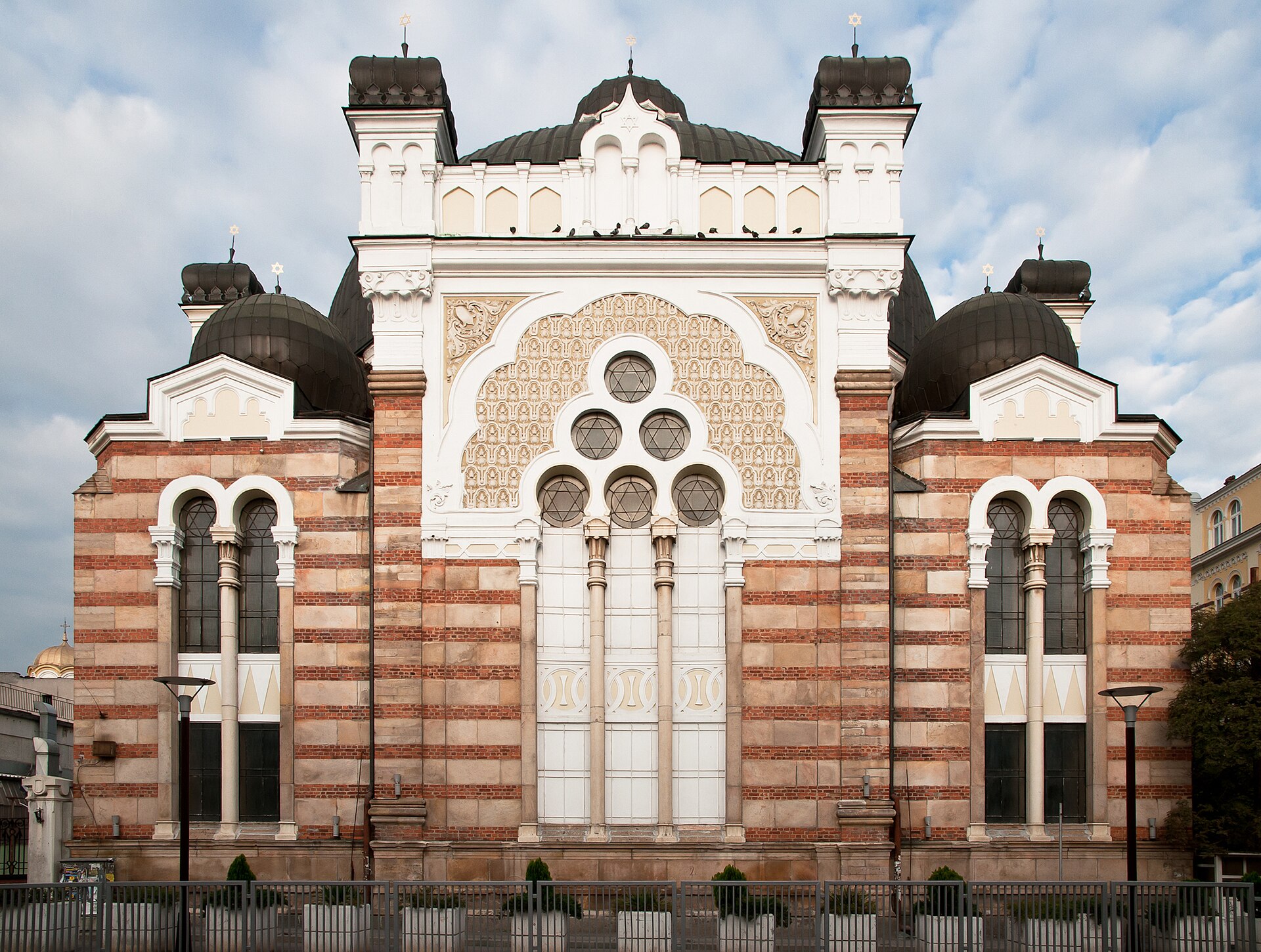
The Sofia Synagogue is the largest synagogue in Southeastern Europe and one of the largest active Sephardic synagogues in Europe. Completed in 1909, the building was constructed for Sofia’s historically significant Jewish community, which grew rapidly in the late 19th and early 20th centuries following Bulgaria’s independence from the Ottoman Empire. The synagogue was designed by Austrian architect Friedrich Grünanger and reflects a blend of Moorish Revival and Central European architectural influences. Its central dome dominates the structure and the interior contains elaborate decorative elements including marble columns, ornate woodwork, and one of the largest chandeliers in Bulgaria. Today the synagogue functions as both an active place of worship and a cultural landmark representing the historical presence of Jewish communities in Bulgaria.
Key Facts
- Capacity
- Approximately 1,300 worshippers
- Materials
- Stone, Brick, Marble, Decorative plaster
- Civilization
- Modern Bulgarian state
- Date(s)
- 1905–1909
- Condition
- Active synagogue and cultural monument
- Original Function
- Sephardic Jewish synagogue
- Key Figures
- Friedrich Grünanger
- Architectural Style
- Moorish Revival
- Religious Tradition
- Sephardic Judaism
Jewish Community in Sofia
15th–19th centuriesJewish communities had been present in Sofia since the Ottoman period, with many Sephardic Jews settling in the city after their expulsion from Spain in 1492. Over the following centuries the community developed religious institutions, schools, and commercial networks that played an important role in the urban life of Sofia.
Construction of the Synagogue
1905–1909As the Jewish population of Sofia expanded after Bulgaria gained independence in 1878, plans were developed to build a large central synagogue capable of serving the city's growing congregation. The building was designed by architect Friedrich Grünanger and constructed between 1905 and 1909. Its architectural design drew inspiration from the Great Synagogue of Vienna while incorporating Moorish decorative elements common in synagogue architecture of the period.
20th Century Challenges
1930s–1940sDuring World War II the Bulgarian Jewish community faced anti-Jewish legislation and restrictions under the government aligned with Nazi Germany. While Jews in Bulgaria were subjected to discrimination and forced labor, deportations from Bulgaria proper were ultimately prevented following public protests and political intervention. The synagogue survived the war years and continued to serve the local community.
Communist Period and Preservation
1944–1989After the establishment of the communist government in Bulgaria many Jewish residents emigrated, particularly to Israel, significantly reducing the size of the local congregation. The synagogue remained active but served a much smaller community during the later 20th century.
Modern Role
1990s – presentFollowing the political changes of 1989 the synagogue underwent restoration and renewed cultural recognition. Today it functions both as a religious institution and as a historical landmark representing the long presence of Jewish communities in Bulgaria. The nearby Jewish History Museum provides additional context about Jewish life in the country.
Cultural Significance
The Sofia Synagogue reflects the historical presence of Sephardic Jewish communities in the Balkans and their integration into the urban and cultural life of Bulgaria. Built during a period of modernization in the early 20th century, the synagogue symbolized both religious continuity and civic participation within the newly independent Bulgarian state. Today the building stands as an important monument to Jewish heritage in Bulgaria. It also serves as a reminder of the country's complex wartime history, including the survival of the Jewish population within Bulgaria's pre-war borders during World War II.
Interpretive Notes
Scholarly debates and areas of uncertainty
Historians continue to debate aspects of Bulgaria’s role during the Holocaust, particularly the contrast between the survival of Jews living within Bulgaria’s pre-1941 borders and the deportation of Jewish populations from territories administered by Bulgaria during the war. These discussions influence how institutions such as the Sofia Synagogue and the nearby Jewish History Museum interpret the wartime experience of Bulgarian Jews.
Visiting Information
Entry Rules
Open most days except Saturday and major Jewish holidays. Entry to the synagogue interior typically requires purchasing a ticket through the adjacent Jewish History Museum.
Best Times to Visit
Open most days except Saturday and major Jewish holidays. Entry to the synagogue interior typically requires purchasing a ticket through the adjacent Jewish History Museum.
Photography
Photography inside the synagogue may be restricted or require permission. Exterior photography is permitted in the surrounding square.
Preservation Notes
Visitors should respect the building’s role as an active religious site. Avoid entering during prayer services unless permitted and follow posted visitor guidelines inside the sanctuary.
Nearby POIs
11 shown- Banya Bashi Mosque0.2 km
- Sofia Central Mineral Baths0.3 km
- Church of St. Petka of the Saddlers0.3 km
- Serdica Archaeological Complex0.3 km
- Saint Nedelya Cathedral0.4 km
- Church of Saint George0.4 km
- Church of St. Nicholas of Myra0.5 km
- National Archaeological Institute0.5 km
- Amphitheatre of Serdica0.6 km
- National Art Gallery of Bulgaria0.6 km
- Church of St Nicholas the Miracle-Maker0.8 km
Sources & Further Reading
- [1]The Jews in Bulgaria: A Political History — Frederick B. Chary. University Press of America (1972)
- [2]
- [3]The Holocaust in Bulgaria: The Rescue of the Bulgarian Jews — Tzvetan Todorov. Princeton University Press (1999)
Key Facts
- Capacity
- Approximately 1,300 worshippers
- Materials
- Stone, Brick, Marble, Decorative plaster
- Civilization
- Modern Bulgarian state
- Date(s)
- 1905–1909
- Condition
- Active synagogue and cultural monument
- Original Function
- Sephardic Jewish synagogue
- Key Figures
- Friedrich Grünanger
- Architectural Style
- Moorish Revival
- Religious Tradition
- Sephardic Judaism
Nearby POIs
11 shown- Banya Bashi Mosque0.2 km
- Sofia Central Mineral Baths0.3 km
- Church of St. Petka of the Saddlers0.3 km
- Serdica Archaeological Complex0.3 km
- Saint Nedelya Cathedral0.4 km
- Church of Saint George0.4 km
- Church of St. Nicholas of Myra0.5 km
- National Archaeological Institute0.5 km
- Amphitheatre of Serdica0.6 km
- National Art Gallery of Bulgaria0.6 km
- Church of St Nicholas the Miracle-Maker0.8 km