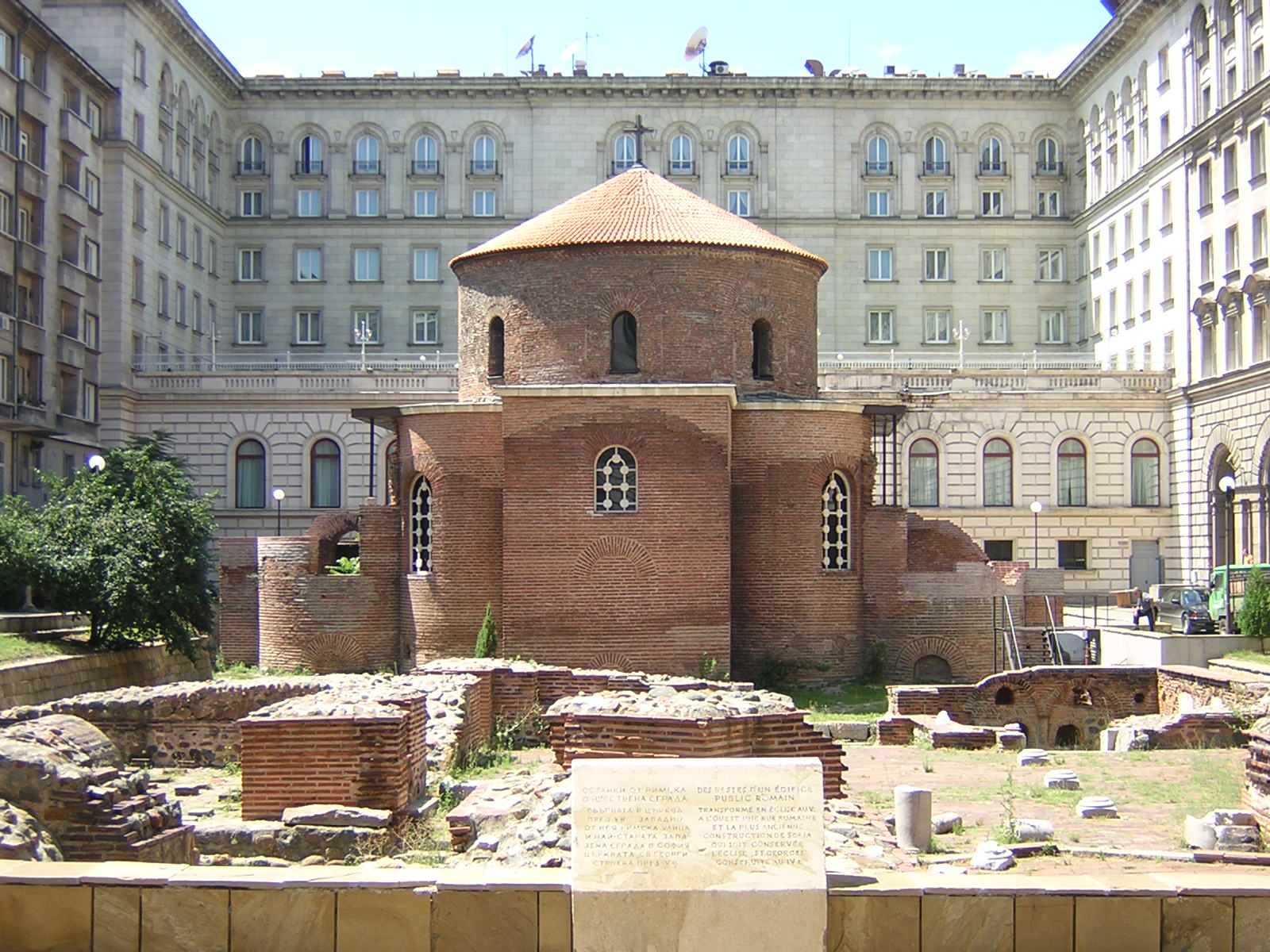
The Church of Saint George (Rotunda of St. George) is a Late Antique brick rotunda located in the historic center of Sofia, Bulgaria. The structure was originally constructed during the Roman period, likely in the early 4th century CE, within the administrative complex of the Roman city of Serdica. It is the oldest preserved building in the city and forms part of a broader archaeological area surrounded today by later government and institutional buildings. The building was converted into a Christian church during the Byzantine period and remained an important religious site through the medieval Bulgarian states. During Ottoman rule it was transformed into a mosque, a phase that led to the covering of earlier Christian frescoes. Archaeological restoration in the 20th century revealed multiple layers of wall paintings dating from the medieval and post-medieval periods, making the interior a valuable record of religious art across several centuries.
Key Facts
- Materials
- Red brick, Mortar
- Civilization
- Roman
- Date(s)
- Early 4th century CE
- Condition
- Well-preserved active Orthodox church and archaeological monument
- Original Function
- Roman civic or ceremonial rotunda, later adapted as a Christian church
- Key Figures
- Emperor Constantine I
- Architectural Style
- Roman rotunda
Roman Construction in Serdica
Early 4th century CEThe rotunda was constructed during the period when Serdica was an important administrative and military center of the Roman Empire in the Balkans. Built of red brick in a circular plan with a domed roof, the structure stood within a large Roman complex that likely included administrative buildings, courtyards, and bath structures. Its precise original function is debated, but it likely served a ceremonial or public role within the urban complex.
Christianization and Byzantine Period
5th–14th centuriesFollowing the spread of Christianity in the late Roman and Byzantine periods, the building was converted into a church. During this time the interior was decorated with Christian frescoes, several layers of which were applied between the 10th and 14th centuries. The church functioned as part of the Christian religious landscape of medieval Serdica, later known as Sredets.
Ottoman Conversion
16th centuryAfter the Ottoman conquest of the region, the building was converted into a mosque. Christian imagery inside the structure was plastered over in accordance with Islamic practice, which unintentionally preserved the earlier paintings beneath later layers of plaster.
Archaeological Rediscovery and Restoration
19th–20th centuriesArchaeological investigations during the late 19th and early 20th centuries began uncovering the earlier fresco layers beneath Ottoman plaster. Systematic restoration efforts exposed several distinct painting cycles dating from different historical periods. The building was reconsecrated as a Christian church and incorporated into the modern archaeological zone of central Sofia.
Present Day
20th century – presentToday the Rotunda of St. George functions as an active Orthodox church and an important archaeological monument within the capital. The structure stands inside the courtyard of the Presidency and government complex, surrounded by visible remains of Roman Serdica including streets and foundations that help contextualize the city's ancient urban layout.
Cultural Significance
The Rotunda of St. George represents one of the clearest physical links between modern Sofia and the Roman city of Serdica. Its continuous reuse across Roman, Byzantine, medieval Bulgarian, and Ottoman periods illustrates the layered religious and political history of the region. For the Bulgarian Orthodox Church, the building holds symbolic importance as a surviving early Christian structure within the capital. Its preserved fresco cycles, created across several centuries, provide rare visual documentation of religious art traditions that evolved under changing political authorities in the Balkans.
Interpretive Notes
Scholarly debates and areas of uncertainty
Scholars continue to debate the original function of the rotunda during the Roman period. Some interpret it as part of a bath complex or ceremonial hall within an imperial residence, while others argue it was constructed specifically as an early Christian building during the reign of Constantine I. The dating and attribution of several fresco layers also remain subjects of scholarly discussion. Differences in stylistic interpretation and fragmentary preservation make it difficult to determine precise chronological sequences for some of the medieval painting cycles.
Visiting Information
Entry Rules
Open daily. Entry is free as the church functions as an active Orthodox religious site within the archaeological complex of central Sofia.
Best Times to Visit
Early morning tends to have fewer visitors due to the site's location within a busy government district. Weekdays outside of midday tourist hours are generally quieter.
Photography
Personal photography permitted inside the church without flash. Tripods and professional equipment typically require permission.
Nearby POIs
17 shownSources & Further Reading
- [1]The Archaeology of Sofia and the Ancient City of Serdica — Vladimir Popov. Bulgarian Academy of Sciences (2015)
- [2]Early Christian Architecture in Bulgaria — Elka Bakalova. Sofia University Press (2002)
- [3]
Key Facts
- Materials
- Red brick, Mortar
- Civilization
- Roman
- Date(s)
- Early 4th century CE