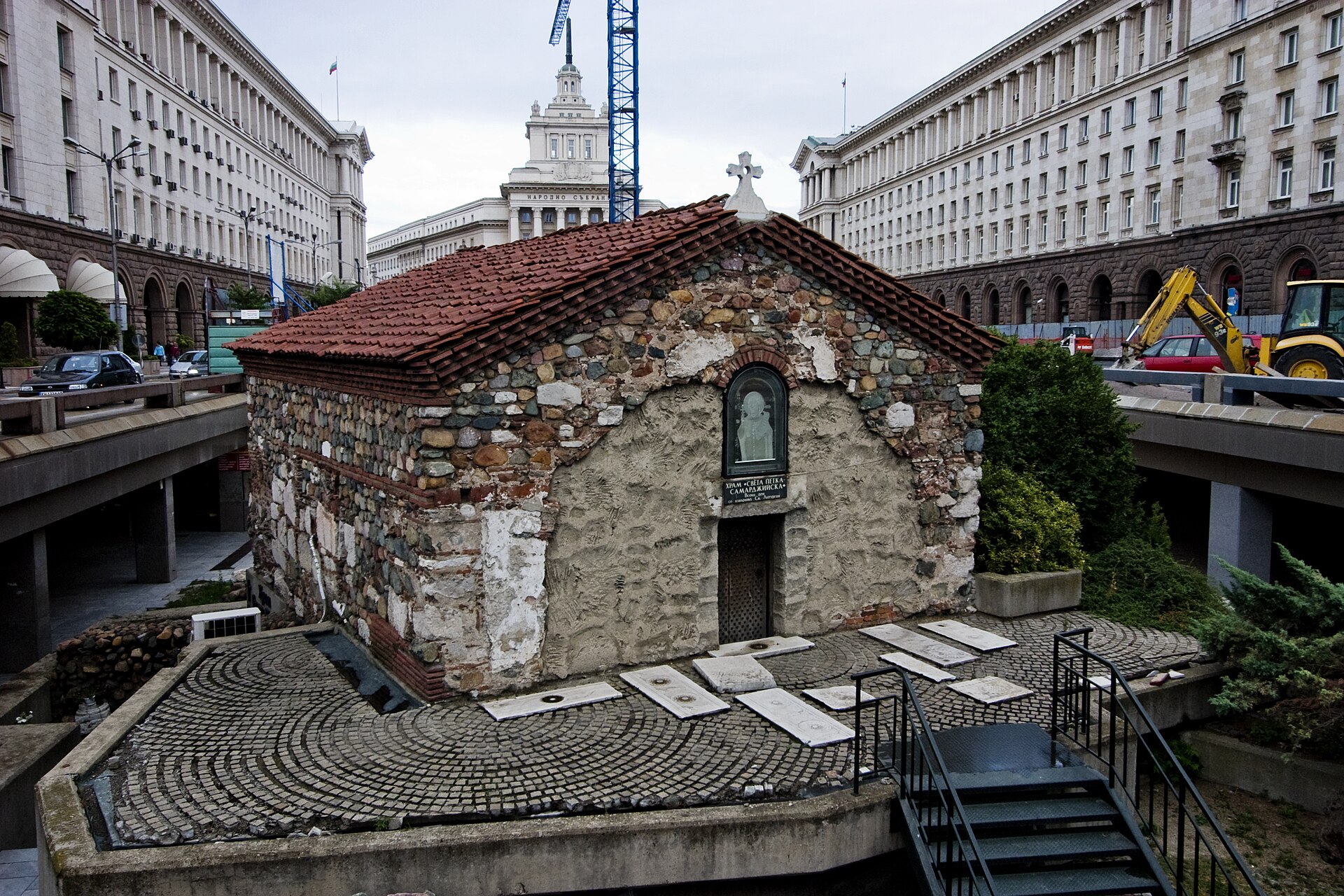
The Church of St. Petka of the Saddlers is a small medieval Orthodox church located in the historic center of Sofia, Bulgaria. Dedicated to Saint Petka (Paraskeva of the Balkans), a widely venerated Orthodox saint, the structure likely dates to the late medieval period and reflects the modest architectural scale typical of urban parish churches built during the late Second Bulgarian Empire and early Ottoman rule. The church stands partially below modern street level, reflecting the gradual rise of Sofia’s urban layers over centuries. Despite its small size, it has remained an active place of worship and is one of the few surviving medieval ecclesiastical structures in the city center, offering insight into the continuity of Orthodox religious life in Sofia through periods of political and cultural change.
Key Facts
- Materials
- Brick, Stone
- Civilization
- Bulgarian / Ottoman-era Orthodox community
- Date(s)
- 14th–15th century
- Condition
- Preserved and functioning religious site
- Original Function
- Orthodox parish church dedicated to Saint Petka
- Key Figures
- Saint Petka (Paraskeva of the Balkans)
Medieval Origins
14th–15th centuryThe Church of St. Petka of the Saddlers is believed to have been constructed during the late medieval period, possibly in the final centuries of the Second Bulgarian Empire or shortly after the Ottoman conquest of the region in the late 14th century. Its dedication to Saint Petka reflects the strong regional devotion to the saint across the Balkans. The church served a local Orthodox community in what was already an active commercial district of Sofia.
Urban Guild Context
Ottoman periodThe church’s modern name, 'of the Saddlers,' derives from the saddlers’ guild that historically operated in the surrounding market area. During the Ottoman period, many urban churches were associated with specific professional communities. The building functioned as a neighborhood parish church for craftsmen and merchants working in Sofia’s central bazaar.
Archaeological Study and Preservation
20th century – presentArchaeological investigations and restoration work during the 20th century helped stabilize the structure and clarify its historical phases. As Sofia modernized and surrounding buildings were constructed, the church remained preserved within the city center. Today it continues to function as a small active Orthodox church while also serving as a historical landmark representing Sofia’s medieval religious landscape.
Cultural Significance
Saint Petka is one of the most revered saints in Bulgarian and Balkan Orthodox tradition, and churches dedicated to her appear across the region. The Sofia church reflects the role of neighborhood parish churches in sustaining local religious life during centuries of Ottoman rule, when Orthodox communities maintained their institutions within the framework of the empire’s millet system. The association of the church with the saddlers’ guild highlights the close relationship between professional communities and religious institutions in Ottoman-era Balkan cities. Craft guilds often supported nearby churches financially and socially, reinforcing local identity and communal cohesion.
Visiting Information
Entry Rules
Open daily. As an active Orthodox church, visitors should remain respectful of services and worshippers. Entry is free.
Best Times to Visit
Early morning and late afternoon typically see fewer visitors. Weekday visits are generally quieter than weekends when local worshippers attend services.
Photography
Personal photography is generally permitted, but flash and photography during active services may be restricted.
Preservation Notes
Visitors should remain on designated paths and avoid touching icons or interior surfaces. The structure is small and historically fragile, so movement inside the church is limited.
Nearby POIs
11 shown- Serdica Archaeological Complex0.1 km
- Church of Saint George0.1 km
- Saint Nedelya Cathedral0.1 km
- Banya Bashi Mosque0.2 km
- Sofia Central Mineral Baths0.2 km
- Church of St. Nicholas of Myra0.2 km
- National Archaeological Institute0.3 km
- Sofia Synagogue0.3 km
- National Art Gallery of Bulgaria0.4 km
- Amphitheatre of Serdica0.4 km
- Church of St Nicholas the Miracle-Maker0.6 km
Sources & Further Reading
- [1]Medieval Bulgarian Churches and Monasteries — Ivan Bozhilov. Bulgarian Academy of Sciences (2003)
- [2]The Architecture of the Bulgarian Middle Ages — Nikola Mavrodinov. Bulgarian Academy of Sciences (1965)
- [3]Church of St. Petka of the Saddlers. National Institute for Immovable Cultural Heritage, Bulgaria
Key Facts
- Materials
- Brick, Stone
- Civilization
- Bulgarian / Ottoman-era Orthodox community
- Date(s)
- 14th–15th century
- Condition
- Preserved and functioning religious site
- Original Function
- Orthodox parish church dedicated to Saint Petka
- Key Figures
- Saint Petka (Paraskeva of the Balkans)
Nearby POIs
11 shown- Serdica Archaeological Complex0.1 km
- Church of Saint George0.1 km
- Saint Nedelya Cathedral0.1 km
- Banya Bashi Mosque0.2 km
- Sofia Central Mineral Baths0.2 km
- Church of St. Nicholas of Myra0.2 km
- National Archaeological Institute0.3 km
- Sofia Synagogue0.3 km
- National Art Gallery of Bulgaria0.4 km
- Amphitheatre of Serdica0.4 km
- Church of St Nicholas the Miracle-Maker0.6 km