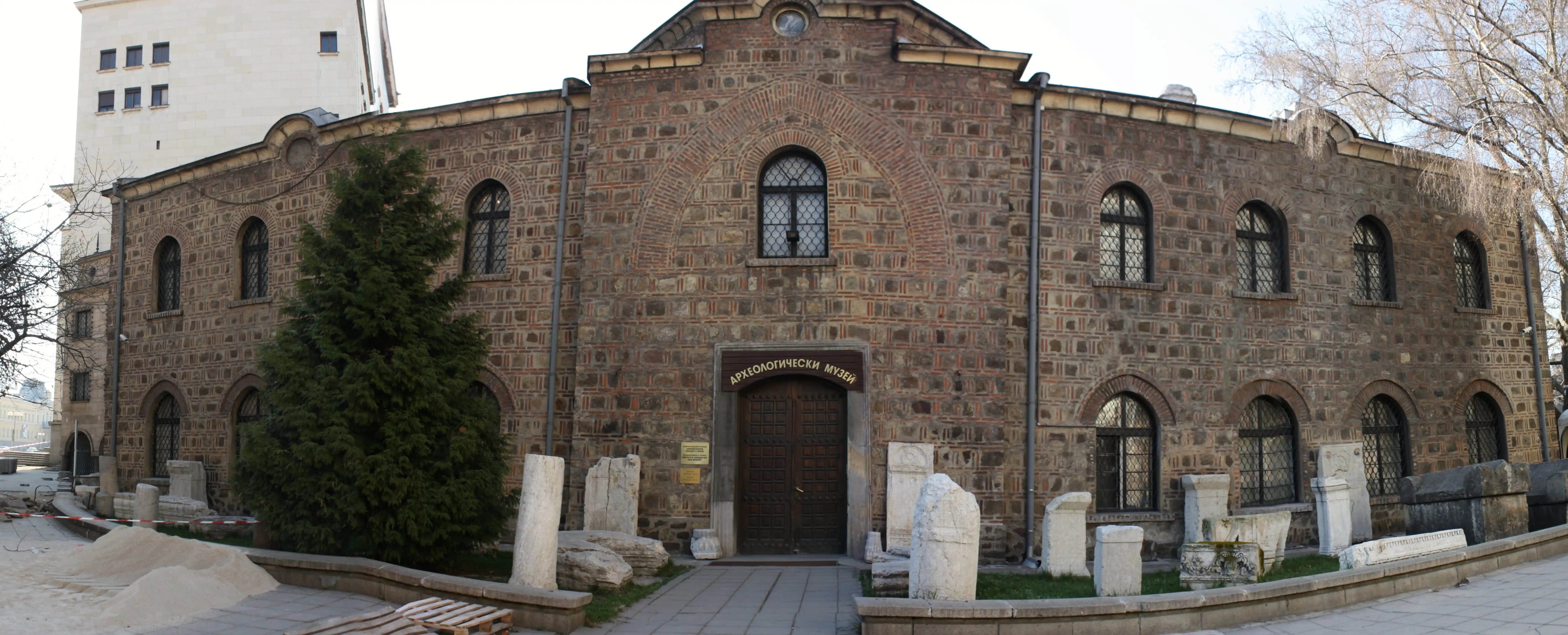
The National Archaeological Institute with Museum in Sofia is Bulgaria’s principal institution for the study and exhibition of archaeological heritage. Established in the late nineteenth century and administered by the Bulgarian Academy of Sciences, the museum houses artifacts spanning prehistoric settlements, Thracian civilizations, Greek colonies, Roman provincial culture, and the medieval Bulgarian states. The museum is located in a former Ottoman mosque, the Büyük Mosque, constructed in the late fifteenth century during Ottoman rule in Sofia. Since the early twentieth century the building has served as an archaeological museum, displaying a wide range of artifacts including Thracian gold treasures, Roman inscriptions, medieval objects, and materials uncovered through archaeological excavations across Bulgaria.
Key Facts
- Materials
- Stone, Brick, Plaster
- Civilization
- Ottoman Empire; modern Bulgarian state
- Accessibility
- Ground-level access to most exhibition areas
- Date(s)
- Original building c. 1474 CE; museum established 1892
- Condition
- Active national archaeological museum
- Original Function
- Ottoman mosque (Büyük Mosque)
- Key Figures
- Prince Ferdinand I of Bulgaria
Construction of the Büyük Mosque
15th centuryThe building that houses the museum was constructed around 1474 during the early Ottoman period in Sofia. Known as the Büyük Mosque, it served as one of the city's principal Islamic religious buildings following the Ottoman conquest of the region in the late fourteenth century.
Transformation into a Museum
19th centuryAfter Bulgaria achieved autonomy from Ottoman rule in 1878, the mosque was repurposed as a cultural institution. In 1892 the Bulgarian government established the National Archaeological Museum to preserve and display artifacts uncovered during archaeological research throughout the country.
Development of Archaeological Research
20th centuryThroughout the twentieth century the museum expanded its collections as systematic archaeological work increased across Bulgaria. Excavations at Thracian tombs, Roman cities, and medieval fortresses contributed significant artifacts, many of which were transferred to the museum for preservation and public display.
Modern Role
Late 20th century – presentToday the museum operates under the National Archaeological Institute of the Bulgarian Academy of Sciences. It functions both as a research center and as a national museum presenting Bulgaria’s archaeological heritage from prehistoric periods through the medieval era.
Cultural Significance
The museum plays a central role in preserving the archaeological heritage of Bulgaria and interpreting the long history of the region. Its collections document the cultural interactions between Thracian communities, Greek colonies along the Black Sea, Roman provincial society, and the medieval Bulgarian states. Because the building itself originated as an Ottoman mosque, the museum also reflects the layered historical transformations of Sofia. The adaptation of the structure into a national museum symbolizes the shift from Ottoman imperial administration to modern Bulgarian state institutions and cultural heritage preservation.
Interpretive Notes
Scholarly debates and areas of uncertainty
Some scholars have debated the interpretation and classification of Thracian artifacts displayed in the museum, particularly regarding the cultural relationships between Thracian elites and neighboring Greek and Persian societies. Differences in interpretation concern whether certain luxury objects represent local production influenced by foreign styles or imports from external workshops. Another area of discussion concerns the preservation and adaptive reuse of Ottoman-era buildings in post-Ottoman Balkan states. The conversion of the Büyük Mosque into a national archaeological museum has been studied as an example of how modern nations reinterpret earlier architectural and religious landscapes.
Visiting Information
Entry Rules
Open daily except Monday. Entry requires a museum ticket purchased on site.
Best Times to Visit
Weekday mornings typically have fewer visitors. Visiting earlier in the day allows more time to explore the galleries before afternoon tour groups arrive.
Photography
Personal photography permitted in most galleries without flash. Tripods and commercial photography require museum permission.
Preservation Notes
Do not touch artifacts or display cases. Follow gallery signage and staff instructions. Some objects are displayed in controlled environments for preservation.
Nearby POIs
11 shown- Church of St. Nicholas of Myra0.1 km
- Church of Saint George0.2 km
- National Art Gallery of Bulgaria0.2 km
- Serdica Archaeological Complex0.2 km
- Church of St. Petka of the Saddlers0.3 km
- Amphitheatre of Serdica0.3 km
- Saint Nedelya Cathedral0.3 km
- Sofia Central Mineral Baths0.3 km
- Church of St Nicholas the Miracle-Maker0.4 km
- Banya Bashi Mosque0.4 km
- Sofia Synagogue0.5 km
Sources & Further Reading
- [1]Thracian Civilization in Bulgaria — Alexander Fol. Bulgarian Academy of Sciences (1972)
- [2]The Archaeology of Bulgaria — Lyudmil Vagalinski. Bulgarian Academy of Sciences (2011)
- [3]
Key Facts
- Materials
- Stone, Brick, Plaster
- Civilization
- Ottoman Empire; modern Bulgarian state
- Accessibility
- Ground-level access to most exhibition areas
- Date(s)
- Original building c. 1474 CE; museum established 1892
- Condition
- Active national archaeological museum
- Original Function
- Ottoman mosque (Büyük Mosque)
- Key Figures
- Prince Ferdinand I of Bulgaria
Nearby POIs
11 shown- Church of St. Nicholas of Myra0.1 km
- Church of Saint George0.2 km
- National Art Gallery of Bulgaria0.2 km
- Serdica Archaeological Complex0.2 km
- Church of St. Petka of the Saddlers0.3 km
- Amphitheatre of Serdica0.3 km
- Saint Nedelya Cathedral0.3 km
- Sofia Central Mineral Baths0.3 km
- Church of St Nicholas the Miracle-Maker0.4 km
- Banya Bashi Mosque0.4 km
- Sofia Synagogue0.5 km