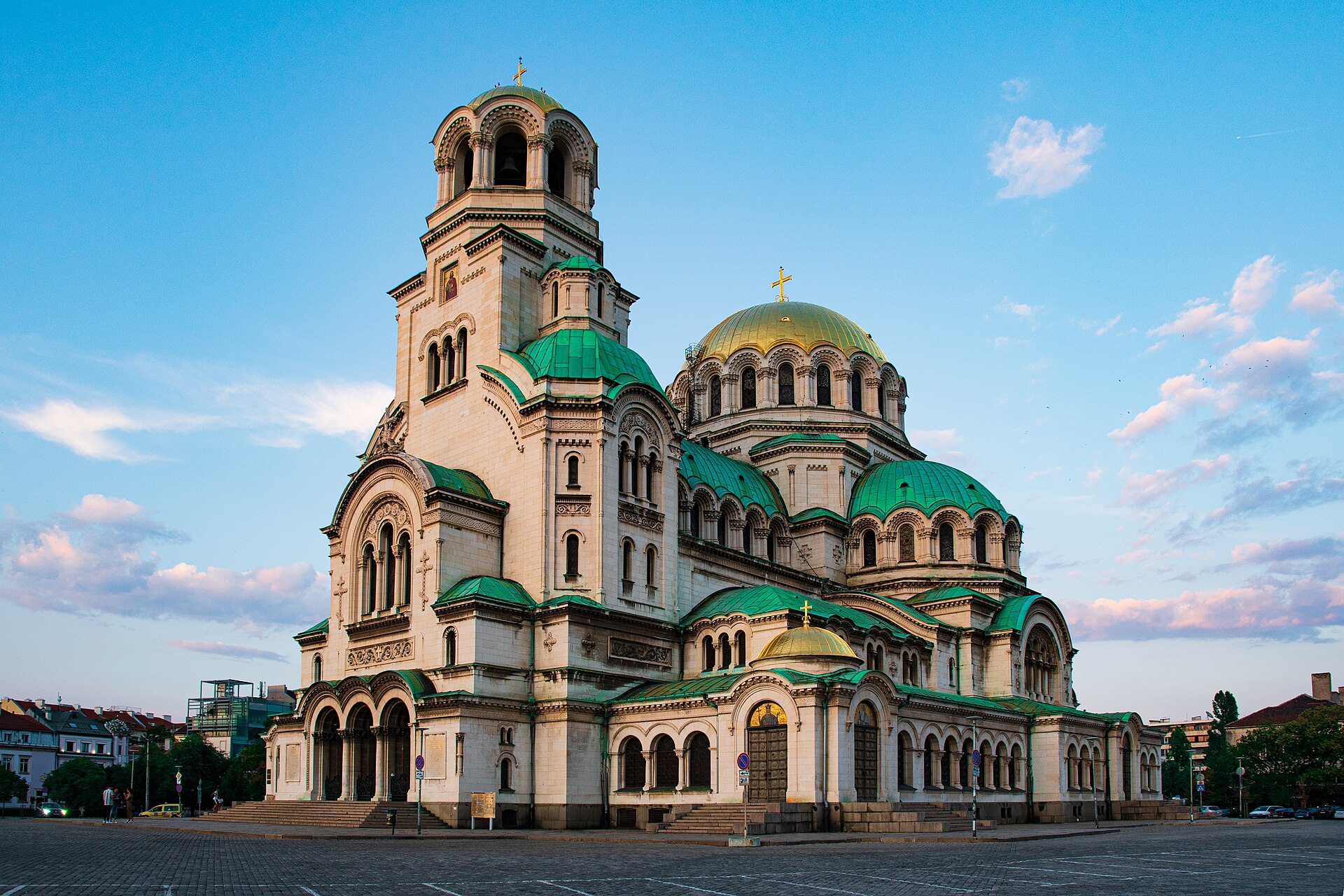
Saint Alexander Nevsky Cathedral is a Bulgarian Orthodox cathedral located in central Sofia, Bulgaria. Constructed between 1882 and 1912, it was built as a memorial to the Russian soldiers who died during the Russo-Turkish War of 1877–1878, which resulted in the liberation of Bulgaria from Ottoman rule. The cathedral is named after the medieval Russian prince and Orthodox saint Alexander Nevsky. The cathedral is one of the largest Eastern Orthodox churches in the world and a major landmark in Sofia. Designed in a Neo-Byzantine style, the building features a large central dome surrounded by smaller domes, richly decorated interiors, and extensive iconography. It serves as the principal cathedral of the Bulgarian Orthodox Church and continues to host major religious ceremonies and national commemorations.
Key Facts
- Materials
- Granite, Marble, Alabaster, Gold-plated domes
- Civilization
- Kingdom of Bulgaria
- Date(s)
- 1882–1912
- Condition
- Active cathedral and major national monument
- Original Function
- Memorial cathedral honoring Russian soldiers of the Russo-Turkish War
- Key Figures
- Alexander Nevsky, Tsar Alexander II, Alexander Pomerantsev
- Architectural Style
- Neo-Byzantine
Liberation of Bulgaria and the Memorial Concept
1878–1880sFollowing the Russo-Turkish War of 1877–1878, Bulgaria regained autonomy after centuries of Ottoman rule. Plans were developed to build a large cathedral in Sofia to commemorate the Russian soldiers who died during the conflict. The project also symbolized the close historical and religious ties between Bulgaria and Russia within the Orthodox Christian world.
Construction of the Cathedral
1882–1912Construction began in 1882 based on designs by Russian architect Alexander Pomerantsev. The building followed Neo-Byzantine architectural principles inspired by medieval Orthodox church architecture. The cathedral’s domes, mosaics, and interior decoration involved artists and craftsmen from several European countries, reflecting the international significance of the project.
Role in the Bulgarian State
1912–1944After its completion, the cathedral became one of the central religious landmarks of the Bulgarian capital. It hosted major religious ceremonies and national events, reinforcing its status as both a place of worship and a monument connected to Bulgaria’s modern statehood.
Modern Era
1945 – presentDuring the socialist period in Bulgaria, the cathedral remained an active religious site despite broader restrictions on religious institutions. Today it serves as the principal cathedral of the Bulgarian Orthodox Church and is one of Sofia’s most recognizable landmarks, attracting both worshippers and visitors.
Cultural Significance
Saint Alexander Nevsky Cathedral is closely connected to Bulgarian national identity and the memory of the country’s liberation from Ottoman rule. The cathedral commemorates the Russian soldiers who died in the Russo-Turkish War and reflects the historical relationship between the Bulgarian and Russian Orthodox traditions. In contemporary Bulgaria the cathedral functions both as a religious center and as a national symbol. It hosts major Orthodox ceremonies, public commemorations, and state events, and the surrounding square serves as an important civic space in the capital.
Interpretive Notes
Scholarly debates and areas of uncertainty
Some scholars have discussed the cathedral’s symbolic role within Bulgarian national identity, particularly regarding the historical relationship between Bulgaria and Russia. While the cathedral was constructed to honor Russian soldiers and reflects strong Russian cultural influence, interpretations of this legacy have evolved alongside changing political relations in the region. Architectural historians also debate the building’s stylistic influences, noting that while it is typically classified as Neo-Byzantine, it incorporates elements from Russian ecclesiastical architecture and late 19th-century European monumental design.
Visiting Information
Entry Rules
Open daily. Entry to the cathedral is free, though donations are accepted. As an active place of worship, certain areas may be restricted during religious services.
Best Times to Visit
Early morning and late afternoon generally offer quieter conditions. Major Orthodox holidays can attract large crowds due to religious services and public ceremonies.
Photography
Photography is allowed inside the cathedral for a small fee. Flash photography, tripods, and commercial filming require permission.
Preservation Notes
Visitors should remain quiet and respectful as the cathedral is an active place of worship. Do not touch icons, frescoes, or liturgical objects.
Nearby POIs
11 shown- Saint Sophia Church0.1 km
- Church of St Nicholas the Miracle-Maker0.3 km
- Amphitheatre of Serdica0.5 km
- National Art Gallery of Bulgaria0.5 km
- National Archaeological Institute0.7 km
- Church of St. Nicholas of Myra0.8 km
- Church of Saint George0.8 km
- Serdica Archaeological Complex0.8 km
- Sofia Central Mineral Baths0.8 km
- Church of St. Petka of the Saddlers0.9 km
- Banya Bashi Mosque0.9 km
Sources & Further Reading
- [1]St. Alexander Nevsky Cathedral — Bulgarian Orthodox Church
- [2]
- [3]Orthodox Architecture in Eastern Europe — Richard Krautheimer. Yale University Press
Key Facts
- Materials
- Granite, Marble, Alabaster, Gold-plated domes
- Civilization
- Kingdom of Bulgaria
- Date(s)
- 1882–1912
- Condition
- Active cathedral and major national monument
- Original Function
- Memorial cathedral honoring Russian soldiers of the Russo-Turkish War
- Key Figures
- Alexander Nevsky, Tsar Alexander II, Alexander Pomerantsev
- Architectural Style
- Neo-Byzantine
Nearby POIs
11 shown- Saint Sophia Church0.1 km
- Church of St Nicholas the Miracle-Maker0.3 km
- Amphitheatre of Serdica0.5 km
- National Art Gallery of Bulgaria0.5 km
- National Archaeological Institute0.7 km
- Church of St. Nicholas of Myra0.8 km
- Church of Saint George0.8 km
- Serdica Archaeological Complex0.8 km
- Sofia Central Mineral Baths0.8 km
- Church of St. Petka of the Saddlers0.9 km
- Banya Bashi Mosque0.9 km