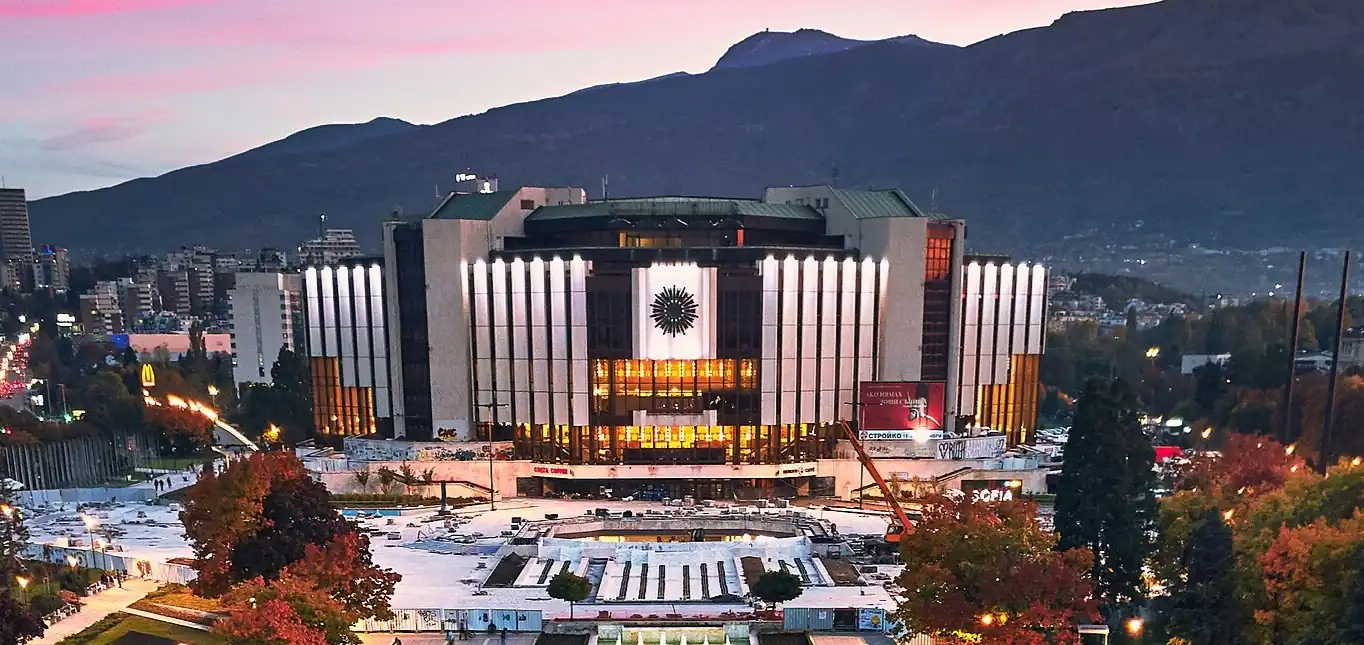
The National Palace of Culture is a large multifunctional cultural and conference complex located in Sofia, Bulgaria. Completed in 1981, it was built during the late socialist period of Bulgaria to commemorate the 1300th anniversary of the Bulgarian state. The complex occupies a prominent position in the city and was designed to host major cultural, political, and international events. The building is one of the largest congress centers in Southeastern Europe. It contains multiple halls for concerts, exhibitions, conferences, and performances. Since the end of the socialist period, the palace has continued to function as a major cultural venue in Sofia, hosting international conferences, concerts, exhibitions, and public events.
Key Facts
- Materials
- Reinforced concrete, Steel, Glass, Stone cladding
- Dimensions
- Approximately 123,000 square meters of total floor space
- Civilization
- People's Republic of Bulgaria
- Date(s)
- 1978–1981
- Condition
- Active cultural and conference venue
- Original Function
- National congress and cultural center
- Key Figures
- Lyudmila Zhivkova, Georgi Stoilov
- Architectural Style
- Late Socialist Modernism
Planning and State Patronage
1970sThe National Palace of Culture was conceived during the 1970s as part of a major urban development project in Sofia. The Bulgarian government sought to construct a large cultural complex capable of hosting congresses, exhibitions, and international events. The project was strongly supported by Lyudmila Zhivkova, the daughter of Bulgarian leader Todor Zhivkov and a prominent cultural official.
Construction
1978–1981Construction began in 1978 under the direction of architect Georgi Stoilov. The complex was completed in 1981 to coincide with celebrations marking the 1300th anniversary of the Bulgarian state. Designed in a monumental modernist style typical of late socialist public architecture, the building incorporated large interior halls and expansive public spaces intended to accommodate large gatherings.
Late Socialist Period Use
1981–1989Following its opening, the palace became the principal venue for state congresses, cultural festivals, and international conferences in Bulgaria. The complex hosted performances, exhibitions, and official political events, serving as a central symbol of cultural policy during the final decade of socialist rule.
Post-Socialist Transformation
1990s – presentAfter the political changes of 1989, the National Palace of Culture transitioned into a multipurpose cultural and commercial venue. It has hosted international concerts, trade fairs, exhibitions, and conferences. Renovations and modernization projects have adapted parts of the complex for contemporary event infrastructure while maintaining the building’s original architectural structure.
Cultural Significance
The National Palace of Culture represents one of the most prominent examples of late socialist cultural infrastructure in Bulgaria. Built to commemorate the long history of the Bulgarian state, the complex embodied the government’s effort to promote national culture through large public institutions and international cultural exchange. In contemporary Sofia the building remains a major cultural hub. Its large halls host concerts, festivals, literary events, exhibitions, and international conferences, making it one of the city’s central venues for public cultural life.
Interpretive Notes
Scholarly debates and areas of uncertainty
Scholars and architectural historians debate how the building should be interpreted within the broader context of socialist-era monumental architecture. Some view the structure primarily as a political symbol of state cultural policy during the late socialist period, while others emphasize its role as a practical civic space that continues to serve public cultural functions after the end of communist rule. There has also been discussion regarding the preservation of socialist-era architecture in Bulgaria. While some consider the building an important historical artifact of late twentieth-century architecture, others have criticized its monumental scale and debated how it should be integrated into Sofia’s evolving urban landscape.
Visiting Information
Entry Rules
Open daily. Entry is generally free to the surrounding public areas, while concerts, exhibitions, and conferences inside the complex require event tickets.
Best Times to Visit
Weekday mornings and early afternoons are typically quieter when no major events are scheduled. Evenings and weekends are busiest due to concerts and public performances.
Photography
Personal photography is permitted in public areas of the complex. Photography rules inside halls depend on event organizers. Tripods, drones, and commercial filming require permission from venue management.
Preservation Notes
Visitors should follow posted event guidelines and remain within designated public areas when exhibitions or conferences are in progress. Large crowds may form during major events, and some interior areas may be temporarily restricted.
Nearby POIs
11 shown- Church of St. Nicholas of Myra1.3 km
- Saint Nedelya Cathedral1.3 km
- National Archaeological Institute1.4 km
- Church of Saint George1.4 km
- National Art Gallery of Bulgaria1.5 km
- Church of St Nicholas the Miracle-Maker1.5 km
- Church of St. Petka of the Saddlers1.5 km
- Serdica Archaeological Complex1.5 km
- Amphitheatre of Serdica1.6 km
- Sofia Central Mineral Baths1.7 km
- Saint Sophia Church1.7 km
Sources & Further Reading
- [1]
- [2]Architecture of Bulgaria in the 20th Century — Elena Kirilova. Bulgarian Academy of Sciences
- [3]Socialist Architecture in Eastern Europe — Owen Hatherley. The New Press (2015)
Key Facts
- Materials
- Reinforced concrete, Steel, Glass, Stone cladding
- Dimensions
- Approximately 123,000 square meters of total floor space
- Civilization
- People's Republic of Bulgaria
- Date(s)
- 1978–1981
- Condition
- Active cultural and conference venue
- Original Function
- National congress and cultural center
- Key Figures
- Lyudmila Zhivkova, Georgi Stoilov
- Architectural Style
- Late Socialist Modernism
Nearby POIs
11 shown- Church of St. Nicholas of Myra1.3 km
- Saint Nedelya Cathedral1.3 km
- National Archaeological Institute1.4 km
- Church of Saint George1.4 km
- National Art Gallery of Bulgaria1.5 km
- Church of St Nicholas the Miracle-Maker1.5 km
- Church of St. Petka of the Saddlers1.5 km
- Serdica Archaeological Complex1.5 km
- Amphitheatre of Serdica1.6 km
- Sofia Central Mineral Baths1.7 km
- Saint Sophia Church1.7 km