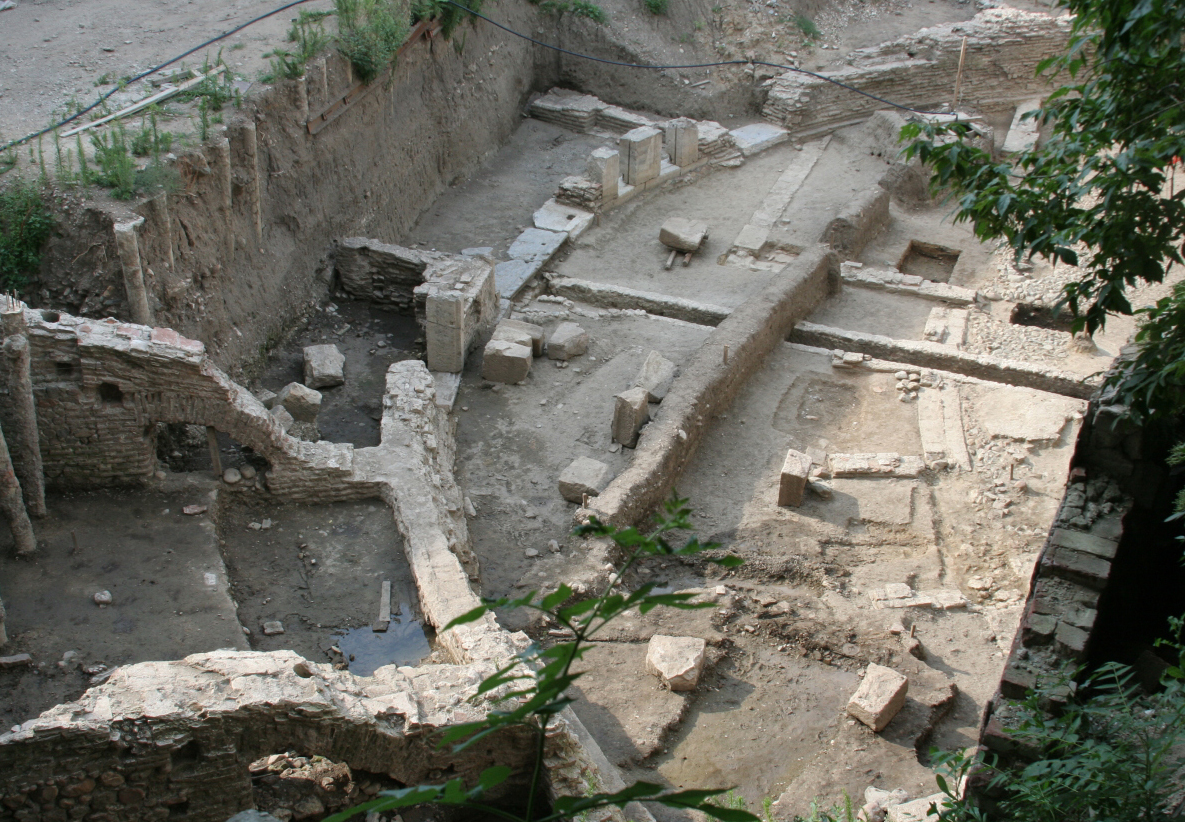
The Amphitheatre of Serdica is a Roman amphitheatre discovered beneath modern buildings in the historic center of Sofia, Bulgaria. Constructed during the Roman Imperial period, the structure formed part of the urban landscape of Serdica, an important administrative and military center of the province of Thrace. Archaeological evidence suggests the amphitheatre was built in the 3rd or early 4th century CE and was capable of hosting public spectacles such as gladiatorial contests and animal hunts. The remains of the amphitheatre were uncovered during construction work in 2004 near the Arena di Serdica Hotel. Portions of the structure, including seating tiers, arena walls, and underground passageways, have been preserved within the modern complex and integrated into a publicly accessible archaeological display. Although only part of the amphitheatre survives, it represents one of the most significant Roman public entertainment structures discovered in Bulgaria.
Key Facts
- Materials
- Stone, Brick, Mortar
- Dimensions
- Approx. 60 m x 43 m arena area
- Civilization
- Roman
- Capacity Estimate
- Several thousand spectators
- Date(s)
- Late 3rd – early 4th century CE
- Condition
- Partially preserved archaeological remains integrated into modern buildings
- Original Function
- Roman amphitheatre for gladiatorial games and public spectacles
- Key Figures
- Emperor Diocletian, Emperor Constantine I
Roman Serdica and Urban Development
1st–3rd centuries CESerdica developed into a significant Roman administrative and commercial center in the province of Thrace. The city contained defensive walls, bath complexes, streets, and public buildings that reflected its importance within the imperial road network connecting the Balkans to Constantinople.
Construction of the Amphitheatre
Late 3rd – early 4th century CEThe amphitheatre was constructed during a period of urban expansion in Serdica. Archaeological analysis indicates it may have been built over the remains of an earlier Roman theatre. Like other amphitheatres across the Roman Empire, the structure hosted gladiatorial combats, animal hunts, and other forms of public entertainment that reinforced imperial cultural practices.
Decline and Abandonment
5th centuryThe decline of large-scale gladiatorial spectacles across the late Roman world, combined with political instability and shifting cultural attitudes toward such entertainments, contributed to the abandonment of the amphitheatre. Over time the structure fell into ruin and was gradually buried beneath later urban layers.
Archaeological Discovery
2004The remains of the amphitheatre were discovered during construction work in central Sofia. Excavations revealed sections of seating rows, the arena wall, and parts of the underlying structural system. Archaeologists determined that the structure was among the largest Roman amphitheatres discovered in the eastern Balkans.
Integration into the Modern City
21st centuryAfter excavation, the surviving sections of the amphitheatre were incorporated into the Arena di Serdica complex, allowing visitors to view the archaeological remains within a protected indoor environment. Interpretive displays provide context about Roman Serdica and the role of amphitheatres in Roman urban life.
Cultural Significance
The Amphitheatre of Serdica illustrates the integration of Roman cultural institutions into provincial cities across the empire. Public spectacles such as gladiatorial contests and animal hunts played an important role in reinforcing Roman civic identity and imperial authority in urban centers like Serdica. The discovery of the amphitheatre also highlights the layered nature of Sofia’s historical landscape. Much of the Roman city remains buried beneath modern streets and buildings, and ongoing archaeological work continues to reveal aspects of Serdica’s urban infrastructure and public life.
Interpretive Notes
Scholarly debates and areas of uncertainty
Scholars continue to debate the exact relationship between the amphitheatre and a previously known Roman theatre discovered nearby. Some researchers argue that the amphitheatre was constructed directly over the earlier theatre structure, while others believe the two buildings coexisted within the entertainment district of Roman Serdica. There is also ongoing discussion regarding the amphitheatre’s full dimensions and seating capacity, as large portions of the structure remain unexcavated beneath surrounding modern buildings.
Visiting Information
Entry Rules
Access is limited because the remains are located inside the Arena di Serdica complex. Visitors can view sections of the amphitheatre within the building during opening hours.
Best Times to Visit
Weekday daytime hours generally provide easier access, as the site is located within a hotel and office complex in central Sofia.
Photography
Personal photography of the archaeological remains is generally permitted. Tripods or commercial photography may require permission from the building management.
Preservation Notes
Visitors should remain on designated walkways and avoid touching exposed masonry. The archaeological remains are preserved within a controlled environment to prevent further deterioration.
Nearby POIs
11 shown- National Art Gallery of Bulgaria0.1 km
- Church of St Nicholas the Miracle-Maker0.2 km
- National Archaeological Institute0.3 km
- Saint Sophia Church0.3 km
- Sofia Central Mineral Baths0.4 km
- Serdica Archaeological Complex0.4 km
- Church of Saint George0.4 km
- Church of St. Nicholas of Myra0.4 km
- Church of St. Petka of the Saddlers0.4 km
- Banya Bashi Mosque0.5 km
- Saint Alexander Nevsky Cathedral0.5 km
Sources & Further Reading
- [1]The Roman City of Serdica — Ludmil Vagalinski. Bulgarian Academy of Sciences (2013)
- [2]Amphitheatres of the Roman World — Jean-Claude Golvin. CNRS Editions (2008)
- [3]Archaeological Discoveries in Sofia. National Institute of Archaeology with Museum, Bulgarian Academy of Sciences
Key Facts
- Materials
- Stone, Brick, Mortar
- Dimensions
- Approx. 60 m x 43 m arena area
- Civilization
- Roman
- Capacity Estimate
- Several thousand spectators
- Date(s)
- Late 3rd – early 4th century CE
- Condition
- Partially preserved archaeological remains integrated into modern buildings
- Original Function
- Roman amphitheatre for gladiatorial games and public spectacles
- Key Figures
- Emperor Diocletian, Emperor Constantine I
Nearby POIs
11 shown- National Art Gallery of Bulgaria0.1 km
- Church of St Nicholas the Miracle-Maker0.2 km
- National Archaeological Institute0.3 km
- Saint Sophia Church0.3 km
- Sofia Central Mineral Baths0.4 km
- Serdica Archaeological Complex0.4 km
- Church of Saint George0.4 km
- Church of St. Nicholas of Myra0.4 km
- Church of St. Petka of the Saddlers0.4 km
- Banya Bashi Mosque0.5 km
- Saint Alexander Nevsky Cathedral0.5 km