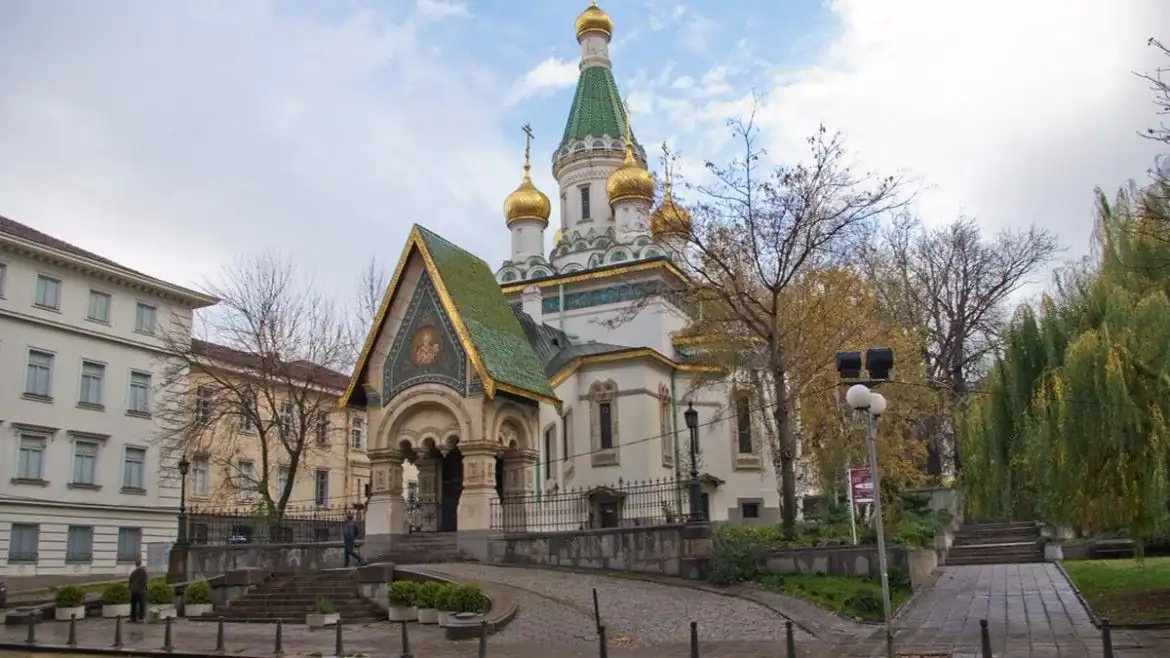
The Church of St. Nicholas the Miracle-Maker, commonly known as the Russian Church, is an Eastern Orthodox church in Sofia, Bulgaria, built in the early 20th century to serve the Russian diplomatic community. It was constructed between 1907 and 1914 on the site of a former Ottoman mosque, following Bulgaria’s liberation and the establishment of closer ties with the Russian Empire. Designed in a Russian Revival style, the church is distinguished by its ornate exterior, featuring gilded onion domes and richly decorated façades. It continues to function as an active place of worship under the jurisdiction of the Russian Orthodox Church and remains a notable example of Russian ecclesiastical architecture outside Russia.
Key Facts
- Materials
- Brick, Stone, Ceramic tiles
- Civilization
- Russian / Bulgarian
- Current Function
- Active Orthodox church
- Date(s)
- 1907–1914 CE
- Condition
- Well-preserved
- Original Function
- Orthodox church serving Russian diplomatic community
- Key Figures
- Mikhail Preobrazhensky, Archbishop Seraphim Sobolev
- Architectural Style
- Russian Revival
Construction and Design
1907–1914 CEThe church was designed by Russian architect Mikhail Preobrazhensky and built to serve the needs of the Russian embassy and expatriate community in Sofia. Its construction followed the demolition of an Ottoman-era mosque that previously occupied the site. The design reflects traditional Russian ecclesiastical architecture, particularly the use of onion domes and decorative tilework.
Early 20th Century Use
1914–1944The church functioned as a center of Russian Orthodox religious life in Sofia. It maintained close ties with the Russian diplomatic mission and served both clergy and lay members of the Russian community in Bulgaria.
Communist Period
1944–1989During Bulgaria’s communist era, the church remained open but operated under state supervision. Despite political pressures, it continued to function as a religious institution and retained its association with the Russian Orthodox Church.
Modern Period
1990–presentFollowing the fall of communism, the church experienced renewed religious activity and restoration efforts. It remains an active place of worship and a site of pilgrimage, particularly associated with Archbishop Seraphim Sobolev, whose tomb is located within the church.
Cultural Significance
The church reflects the historical and cultural connections between Bulgaria and Russia in the early 20th century, particularly following Bulgaria’s liberation from Ottoman rule. It served not only as a religious center but also as a symbol of diplomatic and cultural presence in the Bulgarian capital. Today, it is an important site for Orthodox Christians and is especially associated with Archbishop Seraphim Sobolev, whose grave attracts visitors who leave written prayers. The practice reflects ongoing devotional traditions tied to the site.
Interpretive Notes
Scholarly debates and areas of uncertainty
Some discussion exists regarding the interpretation of its role during the communist period, particularly the extent of state influence over its religious functions. Additionally, historians examine the symbolic significance of the church within the context of Russian-Bulgarian relations, especially in light of shifting political dynamics in the 20th century.
Visiting Information
Entry Rules
Open daily. Free entry as an active Orthodox church.
Best Times to Visit
Early morning or late afternoon for quieter visits. Religious holidays may attract larger crowds.
Photography
Photography inside may be restricted. Always follow posted guidelines and avoid flash.
Preservation Notes
Visitors should maintain quiet behavior and respect active worship. Writing and leaving notes at Archbishop Seraphim’s tomb is a common practice.
Nearby POIs
11 shown- National Art Gallery of Bulgaria0.2 km
- Saint Sophia Church0.2 km
- Amphitheatre of Serdica0.2 km
- Saint Alexander Nevsky Cathedral0.3 km
- National Archaeological Institute0.4 km
- Church of St. Nicholas of Myra0.5 km
- Church of Saint George0.5 km
- Serdica Archaeological Complex0.5 km
- Sofia Central Mineral Baths0.6 km
- Church of St. Petka of the Saddlers0.6 km
- Saint Nedelya Cathedral0.6 km
Sources & Further Reading
- [1]Russian Orthodox Church in Sofia — Bulgarian National Institute for Cultural Heritage (2015)
- [2]Architecture of the Russian Revival — William Craft Brumfield. Cambridge University Press (1993)
- [3]Orthodox Christianity in Bulgaria — Victor Roudometof. Routledge (2014)
Key Facts
- Materials
- Brick, Stone, Ceramic tiles
- Civilization
- Russian / Bulgarian
- Current Function
- Active Orthodox church
- Date(s)
- 1907–1914 CE
- Condition
- Well-preserved
- Original Function
- Orthodox church serving Russian diplomatic community
- Key Figures
- Mikhail Preobrazhensky, Archbishop Seraphim Sobolev
- Architectural Style
- Russian Revival
Nearby POIs
11 shown- National Art Gallery of Bulgaria0.2 km
- Saint Sophia Church0.2 km
- Amphitheatre of Serdica0.2 km
- Saint Alexander Nevsky Cathedral0.3 km
- National Archaeological Institute0.4 km
- Church of St. Nicholas of Myra0.5 km
- Church of Saint George0.5 km
- Serdica Archaeological Complex0.5 km
- Sofia Central Mineral Baths0.6 km
- Church of St. Petka of the Saddlers0.6 km
- Saint Nedelya Cathedral0.6 km