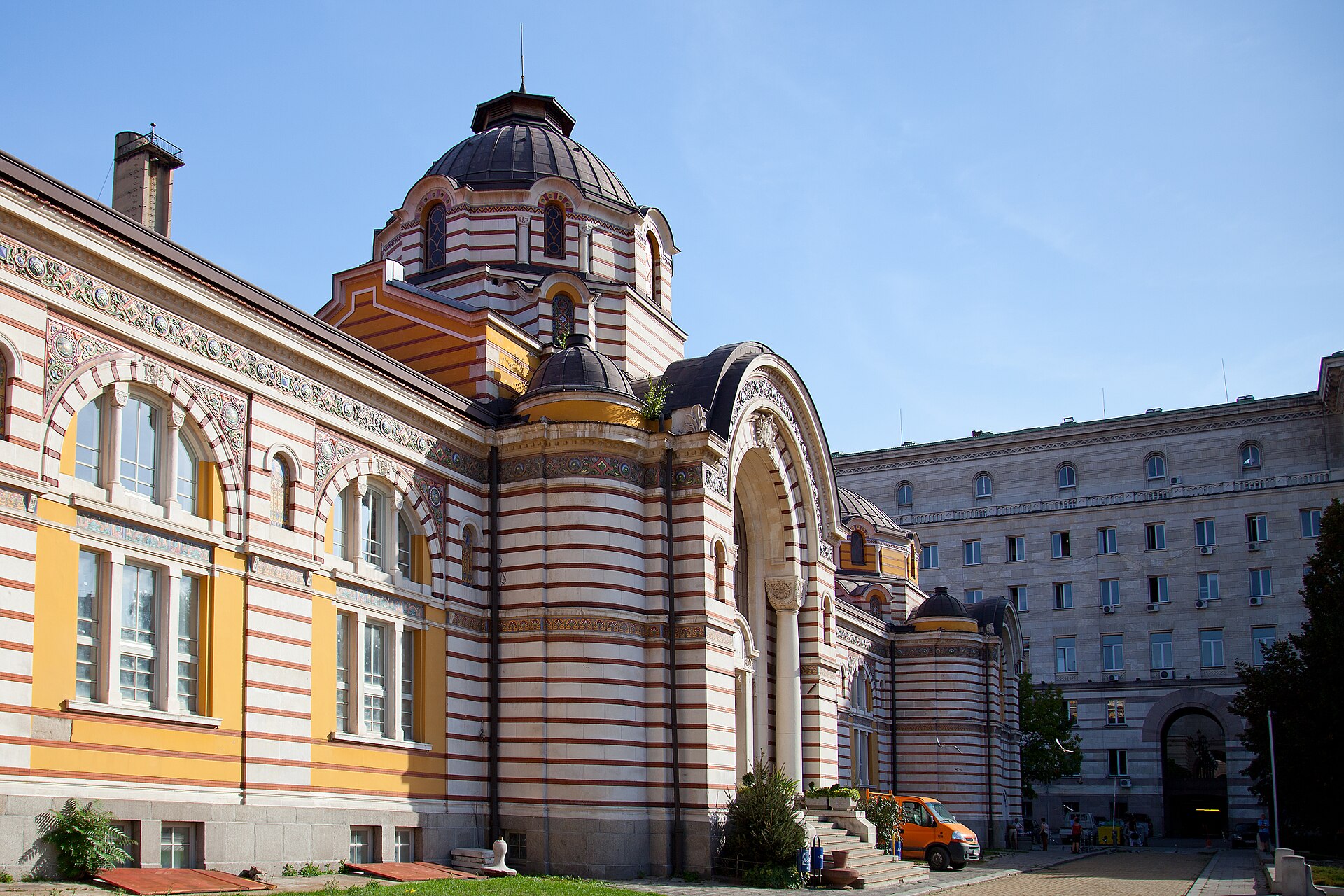
The Sofia Central Mineral Baths is a historic bathhouse complex in the center of Sofia, Bulgaria, built over natural thermal mineral springs that have been used since Roman antiquity. The present building was constructed between 1906 and 1913 during a period of rapid modernization following Bulgaria’s independence. It was designed by architects Petko Momchilov and Friedrich Grünanger in a style combining Vienna Secession, Neo-Byzantine, and Bulgarian National Revival elements. The building originally served as the city’s primary public bath facility, providing access to the mineral waters long associated with the ancient settlement of Serdica. After closing as a bathhouse in the late 20th century, the structure was restored and repurposed as the Regional History Museum of Sofia. The site remains closely tied to the city's identity through its architecture and the continuing presence of public mineral water fountains nearby.
Key Facts
- Materials
- Brick, Stone, Ceramic tile, Colored majolica tiles
- Civilization
- Kingdom of Bulgaria
- Accessibility
- Museum areas are wheelchair accessible; exterior mineral fountains accessible at street level
- Date(s)
- 1906–1913
- Condition
- Restored historic building housing the Regional History Museum of Sofia
- Original Function
- Public mineral bathhouse
- Key Figures
- Petko Momchilov, Friedrich Grünanger
- Architectural Style
- Vienna Secession with Neo-Byzantine and Bulgarian National Revival elements
Thermal Springs in Roman Serdica
Roman Imperial periodThe site of the Sofia Central Mineral Baths lies above natural geothermal springs that were already used during the Roman period when the city was known as Serdica. Archaeological evidence shows that Roman bath complexes operated in the area, taking advantage of the mineral-rich hot water. The springs contributed to the settlement’s reputation as a health destination within the Roman province of Thrace.
Modern Bathhouse Construction
1906–1913Following Bulgaria’s independence and the modernization of Sofia as a national capital, city authorities commissioned a new municipal bath complex above the historic springs. Architects Petko Momchilov and Friedrich Grünanger designed the building with a symmetrical façade, domed roofs, and decorative ceramic tile ornamentation. The project reflected contemporary European spa architecture while incorporating national decorative motifs.
Public Bath Era
1913–1986After opening in 1913, the bathhouse functioned as the main municipal bathing facility for Sofia residents. Separate bathing areas for men and women included pools, private bath rooms, and therapeutic mineral water treatments. The complex became a central social institution in the city, particularly during the early and mid-20th century.
Closure and Restoration
1986–2015The bathhouse ceased operation in 1986 due to structural deterioration and maintenance challenges. The building remained closed for decades while plans for restoration and reuse were debated. A major conservation project began in the early 21st century, stabilizing the historic structure and preserving its architectural features.
Regional History Museum of Sofia
2015–presentThe restored building reopened in 2015 as the Regional History Museum of Sofia. Exhibitions now present the history of the city from prehistoric settlements through the Roman, medieval, and modern periods. The mineral springs remain active, and public fountains outside the building continue to provide free access to the thermal water.
Cultural Significance
The Sofia Central Mineral Baths reflects the long tradition of thermal bathing in the city dating back to Roman Serdica. The continued use of the mineral springs connects modern Sofia with ancient practices of public bathing, health treatments, and communal gathering around natural thermal resources. Architecturally, the building represents an important example of early 20th-century civic architecture in Bulgaria. Its combination of Secessionist design and national decorative motifs symbolized Sofia’s aspirations as a modern European capital while drawing on local cultural identity. Today the building remains a landmark in the city center and a key institution for interpreting Sofia’s urban history.
Visiting Information
Entry Rules
Open Tuesday through Sunday. Entry to the Regional History Museum requires a ticket. The outdoor mineral water fountains beside the building are free to use and open daily.
Best Times to Visit
Weekday mornings tend to be quieter for museum visits. The surrounding square and public fountains are busiest in the afternoon when locals collect mineral water.
Photography
Personal photography is permitted inside the museum without flash. Tripods and professional filming equipment require prior authorization.
Preservation Notes
Visitors should avoid touching historic tile surfaces and decorative ceramic elements. Some areas of the building remain protected as part of ongoing conservation work.
Nearby POIs
11 shown- Banya Bashi Mosque0.1 km
- Serdica Archaeological Complex0.2 km
- Church of St. Petka of the Saddlers0.2 km
- Sofia Synagogue0.3 km
- Church of Saint George0.3 km
- National Archaeological Institute0.3 km
- Saint Nedelya Cathedral0.3 km
- Amphitheatre of Serdica0.4 km
- Church of St. Nicholas of Myra0.4 km
- National Art Gallery of Bulgaria0.4 km
- Church of St Nicholas the Miracle-Maker0.6 km
Sources & Further Reading
- [1]
- [2]Architecture of Sofia 1878–1940 — Lazar Donkov. Bulgarian Academy of Sciences (1998)
- [3]Mineral Springs of Sofia and Their Historical Use — Dimitar Dimitrov. Bulgarian Geological Society (2005)
Key Facts
- Materials
- Brick, Stone, Ceramic tile, Colored majolica tiles
- Civilization
- Kingdom of Bulgaria
- Accessibility
- Museum areas are wheelchair accessible; exterior mineral fountains accessible at street level
- Date(s)
- 1906–1913
- Condition
- Restored historic building housing the Regional History Museum of Sofia
- Original Function
- Public mineral bathhouse
- Key Figures
- Petko Momchilov, Friedrich Grünanger
- Architectural Style
- Vienna Secession with Neo-Byzantine and Bulgarian National Revival elements
Nearby POIs
11 shown- Banya Bashi Mosque0.1 km
- Serdica Archaeological Complex0.2 km
- Church of St. Petka of the Saddlers0.2 km
- Sofia Synagogue0.3 km
- Church of Saint George0.3 km
- National Archaeological Institute0.3 km
- Saint Nedelya Cathedral0.3 km
- Amphitheatre of Serdica0.4 km
- Church of St. Nicholas of Myra0.4 km
- National Art Gallery of Bulgaria0.4 km
- Church of St Nicholas the Miracle-Maker0.6 km