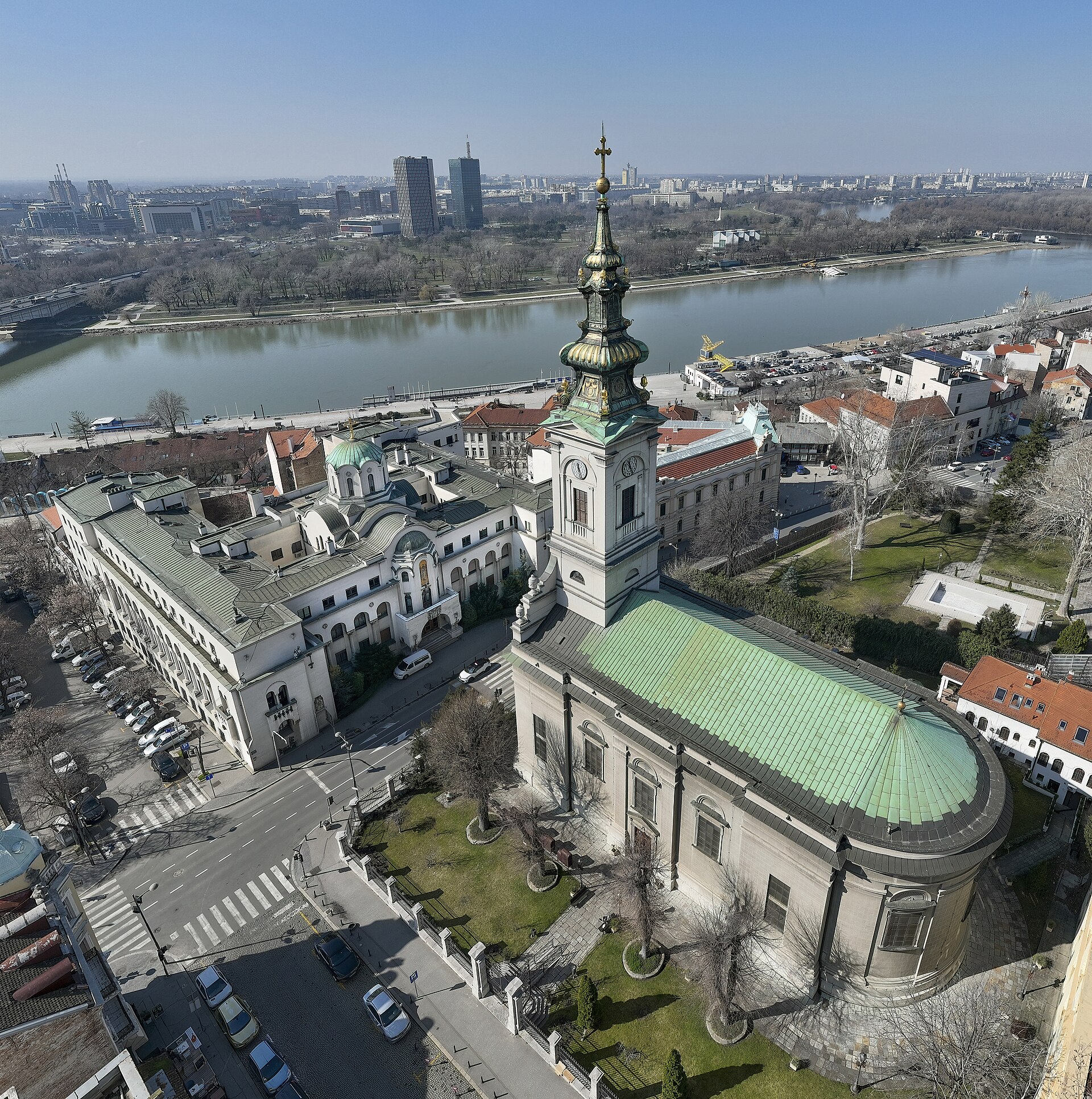
The Cathedral Church of St. Michael the Archangel in Belgrade was constructed between 1837 and 1840 as the principal church of the Serbian Orthodox Church in the city. Commissioned during the reign of Prince Miloš Obrenović, it reflects the consolidation of Serbian autonomy and the development of national religious institutions following centuries of Ottoman rule. The cathedral is located near the Residence of Princess Ljubica and forms part of the historic administrative and religious center of Belgrade. Architecturally, the cathedral is designed in a Neoclassical style with Baroque influences, departing from traditional medieval Serbian ecclesiastical forms. Its interior contains an iconostasis painted by Dimitrije Avramović, as well as the relics and tombs of important Serbian figures, including Dositej Obradović and Vuk Karadžić. The church continues to function as an active cathedral and a central site for religious ceremonies.
Key Facts
- Materials
- Stone, Brick, Plaster
- Civilization
- Principality of Serbia
- Date(s)
- 1837–1840
- Condition
- Active cathedral, well-preserved
- Original Function
- Serbian Orthodox cathedral
- Key Figures
- Prince Miloš Obrenović, Dimitrije Avramović, Vuk Karadžić, Dositej Obradović
- Architectural Style
- Neoclassical with Baroque elements
Construction and Patronage
1837–1840The cathedral was built under the patronage of Prince Miloš Obrenović as part of efforts to establish key national institutions in Belgrade. Its construction marked a significant moment in the cultural and political development of the Principality of Serbia.
19th-Century Religious Center
19th centuryThroughout the 19th century, the cathedral served as the central place of worship for the Serbian Orthodox community in Belgrade. It hosted major religious ceremonies and became closely associated with the leadership of the Serbian Church.
Burial Site of Cultural Figures
19th centuryThe cathedral became the burial place of significant Serbian intellectuals and reformers, including Dositej Obradović and Vuk Karadžić. Their presence reinforced the church’s connection to national cultural identity and education.
20th Century and Yugoslav Period
20th centuryDuring the 20th century, the cathedral continued to function as an important religious institution despite political changes, including the establishment of socialist Yugoslavia. It maintained its liturgical role and symbolic significance.
Present-Day Role
21st centuryToday, the cathedral remains one of the most important religious sites in Belgrade. It serves as the seat of the Serbian Orthodox Church in the city and continues to host major ceremonies and public gatherings.
Cultural Significance
The cathedral represents the reestablishment of Serbian religious and cultural institutions in the 19th century following Ottoman decline. Its construction in a European architectural style reflects broader efforts to align Serbia with contemporary European cultural and political models. As the burial site of key linguistic and educational reformers, the church also plays a role in national identity formation, linking religious tradition with the development of modern Serbian language and culture.
Visiting Information
Entry Rules
Open daily. Entry is free. As an active cathedral, access may be limited during services and religious ceremonies.
Best Times to Visit
Weekday mornings are typically quieter. Religious holidays and major Orthodox celebrations see increased attendance.
Photography
Photography permitted outside. Interior photography may be restricted during services.
Preservation Notes
Maintain quiet and respectful behavior during services. Do not disturb worshippers or approach restricted areas near the altar.
Nearby POIs
11 shown- Residence of Princess Ljubica0.1 km
- Military Museum of Belgrade0.5 km
- National Museum of Serbia0.6 km
- Belgrade Fortress0.6 km
- Pobednik0.7 km
- Ruzica0.8 km
- Historical Museum of Serbia1.1 km
- House of the National Assembly of Serbia1.3 km
- Church of Saint Mark1.6 km
- Church of the Holy Trinity1.6 km
- Nikola Tesla Museum2.1 km
Sources & Further Reading
- [1]Cathedral Church in Belgrade Official Information. Serbian Orthodox Church
- [2]Serbia: The Emergence of the Modern State — Misha Glenny. Penguin Books (2012)
- [3]Architecture in Serbia in the 19th Century — Aleksandar Kadijević. University of Belgrade (2005)
Key Facts
- Materials
- Stone, Brick, Plaster
- Civilization
- Principality of Serbia
- Date(s)
- 1837–1840
- Condition
- Active cathedral, well-preserved
- Original Function
- Serbian Orthodox cathedral
- Key Figures
- Prince Miloš Obrenović, Dimitrije Avramović, Vuk Karadžić, Dositej Obradović
- Architectural Style
- Neoclassical with Baroque elements
Nearby POIs
11 shown- Residence of Princess Ljubica0.1 km
- Military Museum of Belgrade0.5 km
- National Museum of Serbia0.6 km
- Belgrade Fortress0.6 km
- Pobednik0.7 km
- Ruzica0.8 km
- Historical Museum of Serbia1.1 km
- House of the National Assembly of Serbia1.3 km
- Church of Saint Mark1.6 km
- Church of the Holy Trinity1.6 km
- Nikola Tesla Museum2.1 km