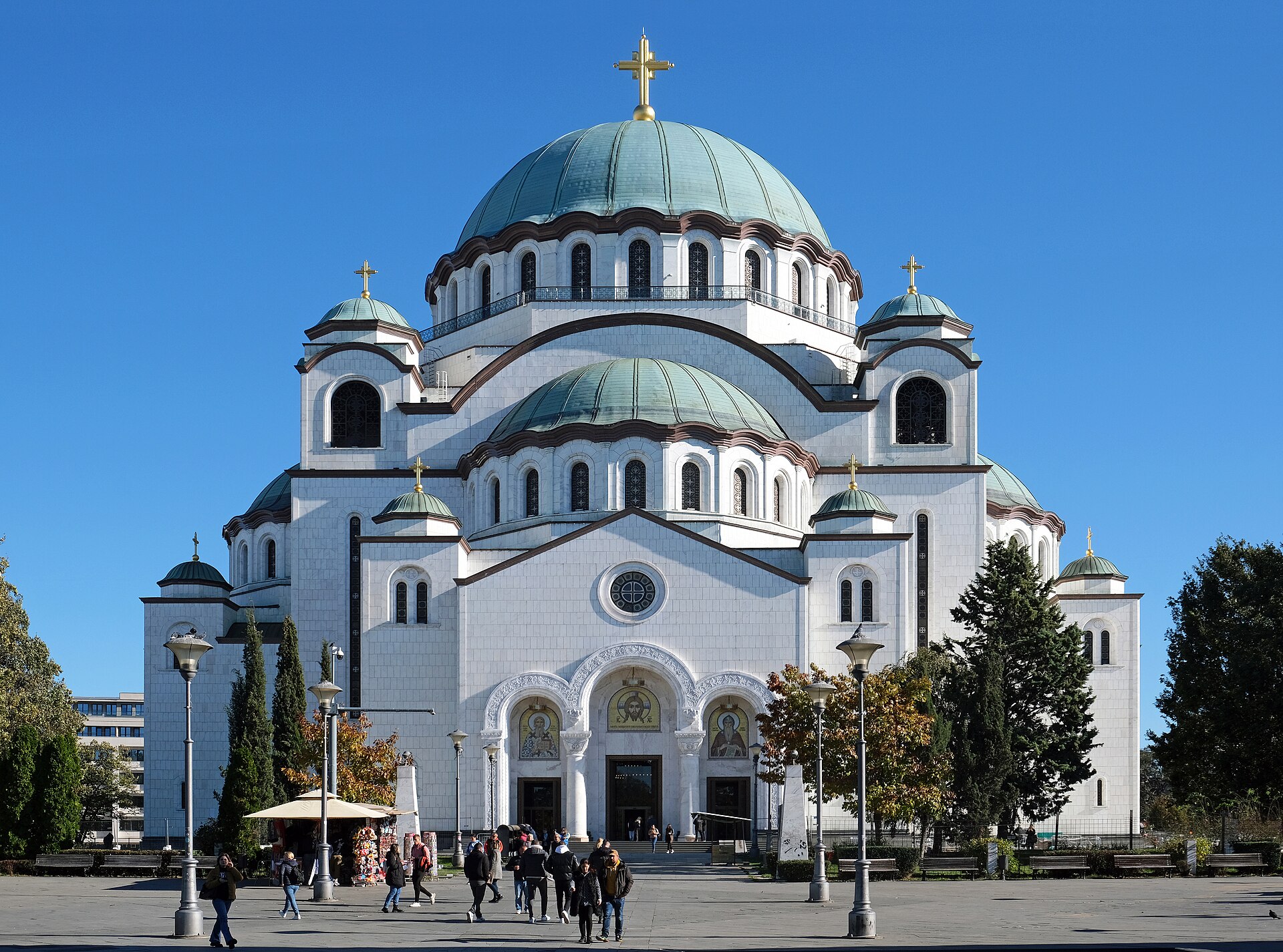
The Church of Saint Sava in Belgrade is one of the largest Orthodox Christian churches in the world, dedicated to Saint Sava, the founder of the Serbian Orthodox Church. Built on the Vračar plateau, the site is traditionally believed to be where the Ottoman authorities burned Saint Sava’s relics in 1595, making it a place of long-standing religious and national significance. Construction began in 1935 but was interrupted multiple times due to World War II and the socialist period in Yugoslavia. Work resumed in the late 20th century, with the church largely completed in the 2000s. Its design draws heavily on Byzantine architectural traditions, particularly the Hagia Sophia, and the interior continues to be developed with extensive mosaic decoration.
Key Facts
- Height
- 79 m (including dome)
- Materials
- Concrete, Marble, Granite
- Civilization
- Serbian
- Accessibility
- Wheelchair accessible in main areas
- Date(s)
- 1935 - 2020 (largely completed)
- Condition
- Active church, largely completed with ongoing interior decoration
- Original Function
- Orthodox Christian church
- Key Figures
- Saint Sava, Aleksandar Deroko, Bogdan Nestorović
- Architectural Style
- Serbian-Byzantine Revival
Historical Significance of the Site
1595The site is traditionally associated with the burning of the relics of Saint Sava by Ottoman authorities, an act intended to suppress Serbian resistance and religious identity. This event gave the location lasting symbolic importance in Serbian cultural and religious memory.
Early Plans and Construction
1895 - 1941Plans to construct a monumental church on the site emerged in the late 19th century, with a design competition held in 1926. Construction officially began in 1935 under architects Bogdan Nestorović and Aleksandar Deroko, but progress was halted with the outbreak of World War II.
Interruption During Socialist Yugoslavia
1945 - 1985Following the war, construction was suspended under the socialist government of Yugoslavia, which limited religious building projects. The unfinished structure remained dormant for decades, symbolizing both political change and interrupted cultural continuity.
Resumption and Completion
1985 - 2020Construction resumed in 1985 with state approval, and the massive central dome was completed in 1989. Work continued through the late 20th and early 21st centuries, with significant progress on the exterior and structural elements. Interior decoration, particularly mosaics, advanced rapidly after 2000.
Modern Role
21st centuryThe Church of Saint Sava functions as a major religious center for the Serbian Orthodox Church and a national symbol. It hosts religious ceremonies, state events, and attracts visitors as one of Belgrade’s most prominent landmarks.
Cultural Significance
The Church of Saint Sava holds a central place in Serbian national identity, representing both religious continuity and historical resilience. Its dedication to Saint Sava, the founder of the Serbian Orthodox Church, ties it directly to the formation of Serbian spiritual and cultural institutions in the medieval period. The site’s association with the burning of Saint Sava’s relics transformed it into a symbolic location of resistance during Ottoman rule. In the modern era, the church serves not only as a place of worship but also as a national monument, frequently used for state ceremonies and public gatherings that reinforce its role in collective memory.
Interpretive Notes
Scholarly debates and areas of uncertainty
Debate has occasionally focused on the architectural scale and funding of the church, particularly during the late 20th century when construction resumed. Some scholars and commentators questioned the appropriateness of allocating significant resources to a monumental religious structure during periods of economic difficulty. There is also discussion regarding the interpretation of the site of Saint Sava’s relic burning, as historical documentation is limited and partly based on tradition rather than definitive archaeological evidence.
Visiting Information
Entry Rules
Open daily. Entry is free. As an active church, access may be limited during liturgical services and major religious events.
Best Times to Visit
Morning hours and late afternoon for fewer visitors. Major Orthodox holidays draw large crowds due to active religious use.
Photography
Photography permitted inside and outside. Flash and tripods may be restricted in interior areas. Commercial filming requires permission.
Preservation Notes
Visitors should remain in designated areas and avoid disturbing religious services. Some interior sections may still be under ongoing decorative work.
Nearby POIs
11 shown- Nikola Tesla Museum0.8 km
- Church of Saint Mark1.4 km
- Church of the Holy Trinity1.4 km
- House of the National Assembly of Serbia1.5 km
- Historical Museum of Serbia1.7 km
- Museum of Yugoslavia1.7 km
- House of Flowers1.9 km
- National Museum of Serbia2.2 km
- Residence of Princess Ljubica2.5 km
- Cathedral Church of St. Michael the Archangel2.6 km
- Military Museum of Belgrade3.1 km
Sources & Further Reading
- [1]The Church of Saint Sava — Serbian Orthodox Church. Official Church Publications
- [2]Architecture of the Balkans — Robert G. Ousterhout. Yale University Press (2019)
- [3]
Key Facts
- Height
- 79 m (including dome)
- Materials
- Concrete, Marble, Granite
- Civilization
- Serbian
- Accessibility
- Wheelchair accessible in main areas
- Date(s)
- 1935 - 2020 (largely completed)
- Condition
- Active church, largely completed with ongoing interior decoration
- Original Function
- Orthodox Christian church
- Key Figures
- Saint Sava, Aleksandar Deroko, Bogdan Nestorović
- Architectural Style
- Serbian-Byzantine Revival
Nearby POIs
11 shown- Nikola Tesla Museum0.8 km
- Church of Saint Mark1.4 km
- Church of the Holy Trinity1.4 km
- House of the National Assembly of Serbia1.5 km
- Historical Museum of Serbia1.7 km
- Museum of Yugoslavia1.7 km
- House of Flowers1.9 km
- National Museum of Serbia2.2 km
- Residence of Princess Ljubica2.5 km
- Cathedral Church of St. Michael the Archangel2.6 km
- Military Museum of Belgrade3.1 km