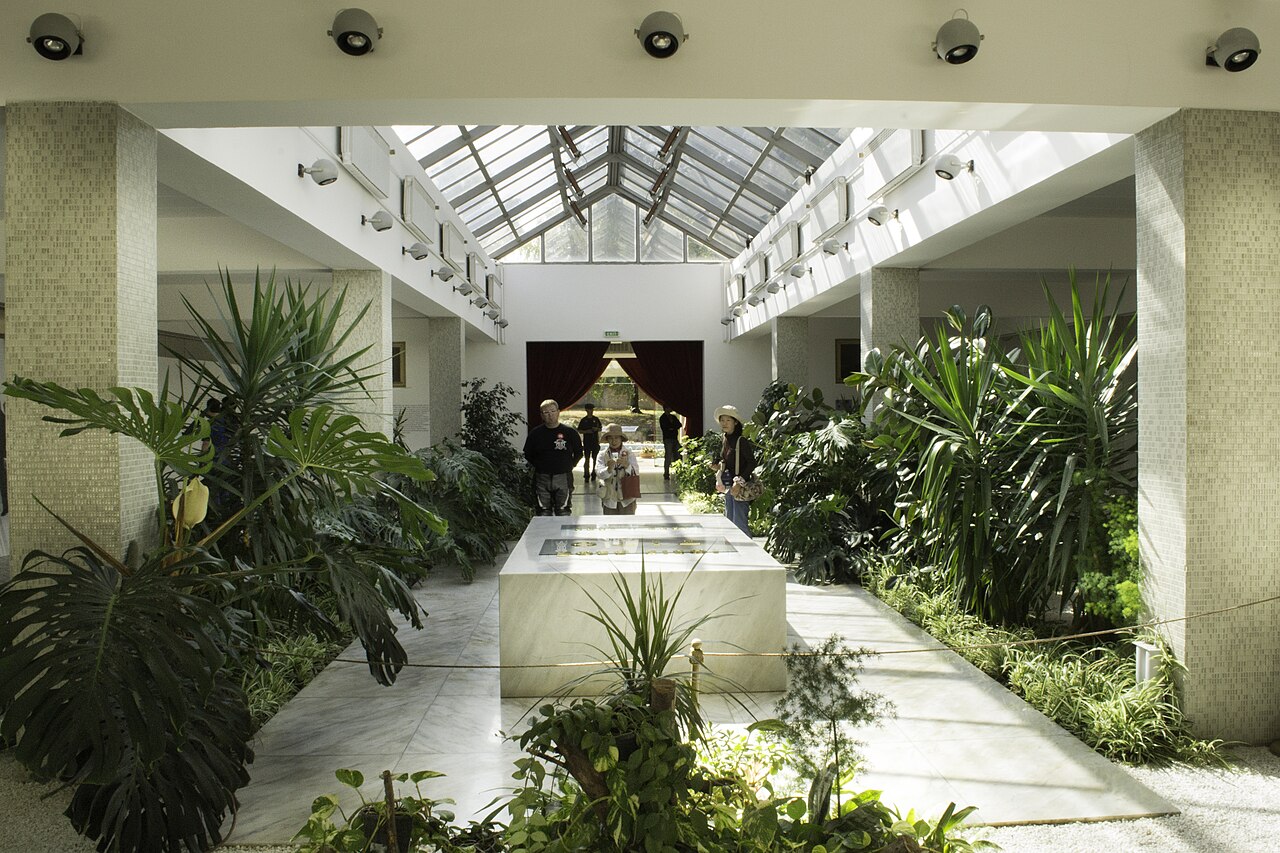
The House of Flowers (Kuća cveća) in Belgrade is a mausoleum and museum complex that serves as the final resting place of Josip Broz Tito, the longtime leader of socialist Yugoslavia, and his wife Jovanka Broz. Located within the grounds of the Museum of Yugoslavia in the Dedinje district, the site combines commemorative, political, and historical functions tied to the Yugoslav state of the 20th century. :contentReference[oaicite:0]{index=0} Originally constructed in 1975 as a winter garden and auxiliary residence for Tito, the structure was adapted into a mausoleum following his death in 1980. Today, it includes exhibitions related to Yugoslav political culture, including artifacts from the Relay of Youth celebrations, and remains one of the most visited historical sites associated with the former Yugoslavia. :contentReference[oaicite:1]{index=1}
Key Facts
- Materials
- Concrete, Glass, Stone
- Site Area
- 902 m²
- Civilization
- Yugoslav
- Accessibility
- Accessible via museum complex; some interior constraints
- Date(s)
- 1975
- Condition
- Preserved mausoleum and museum
- Original Function
- Winter garden and auxiliary residence
- Key Figures
- Josip Broz Tito, Jovanka Broz, Stjepan Kralj
- Architectural Style
- Modernist
Construction as Presidential Retreat
1975The structure was designed by architect Stjepan Kralj and built in 1975 as a winter garden for Josip Broz Tito. It functioned as a semi-private space for work and rest, located near his residence in Belgrade and incorporating landscaped interior garden elements.
Transformation into Mausoleum
1980Following Tito’s death in May 1980, the building was converted into his burial site in accordance with his wishes. The central garden space was adapted to accommodate his tomb, transforming the structure into a memorial complex.
Role in Socialist Yugoslavia
1980 - 1991During the final decade of Yugoslavia, the site became a focal point for state commemorations and public visits. It formed part of a broader memorial center celebrating Tito’s leadership and Yugoslav unity.
Post-Yugoslav Period
1990sAfter the breakup of Yugoslavia, the complex was closed for several years and state ceremonial functions ceased. The site lost its official political role but retained symbolic importance for many visitors from across the former Yugoslav republics.
Contemporary Museum Use
2000s - presentReopened to the public, the House of Flowers now operates as part of the Museum of Yugoslavia. It includes exhibitions on the Relay of Youth and other artifacts of socialist-era political culture, while continuing to function as a memorial visited by thousands annually.
Cultural Significance
The House of Flowers occupies a complex position in the cultural memory of the Balkans. During the socialist period, it symbolized the unity and identity of Yugoslavia under Tito’s leadership, serving as a site of official commemoration and public pilgrimage. In the post-Yugoslav era, its meaning has diversified. For some, it remains a place of remembrance tied to a shared Yugoslav identity, while for others it represents a contested legacy associated with socialist governance. The continued visitation from across former Yugoslav states reflects its enduring role as a transnational historical site.
Interpretive Notes
Scholarly debates and areas of uncertainty
Scholarly debate often centers on the interpretation of Tito’s legacy and how the site should be contextualized within modern Serbian and regional history. Some historians emphasize its importance as a preserved artifact of socialist political culture, while others argue for reframing it within a broader national historical narrative. There is also discussion regarding the preservation and presentation of Yugoslav-era material culture, particularly how exhibitions balance commemoration with critical historical analysis.
Visiting Information
Entry Rules
Open Tuesday to Sunday. Closed Monday. Entry is ticketed as part of the Museum of Yugoslavia complex.
Best Times to Visit
Late morning and early afternoon provide steady access through scheduled museum hours. Visits around 25 May (historically Youth Day) attract higher attendance due to commemorative interest.
Photography
Photography permitted in most areas without flash. Restrictions may apply in specific exhibition sections.
Preservation Notes
Visitors should remain respectful within the mausoleum space. Do not touch the tomb or exhibit materials. Follow posted museum guidelines.
Nearby POIs
11 shown- Museum of Yugoslavia0.1 km
- Church of Saint Sava1.9 km
- Nikola Tesla Museum2.5 km
- Church of Saint Mark3 km
- House of the National Assembly of Serbia3 km
- Church of the Holy Trinity3 km
- Historical Museum of Serbia3 km
- Residence of Princess Ljubica3.4 km
- National Museum of Serbia3.4 km
- Cathedral Church of St. Michael the Archangel3.5 km
- Military Museum of Belgrade3.9 km
Key Facts
- Materials
- Concrete, Glass, Stone
- Site Area
- 902 m²
- Civilization
- Yugoslav
- Accessibility
- Accessible via museum complex; some interior constraints
- Date(s)
- 1975
- Condition
- Preserved mausoleum and museum
- Original Function
- Winter garden and auxiliary residence
- Key Figures
- Josip Broz Tito, Jovanka Broz, Stjepan Kralj
- Architectural Style
- Modernist
Nearby POIs
11 shown- Museum of Yugoslavia0.1 km
- Church of Saint Sava1.9 km
- Nikola Tesla Museum2.5 km
- Church of Saint Mark3 km
- House of the National Assembly of Serbia3 km
- Church of the Holy Trinity3 km
- Historical Museum of Serbia3 km
- Residence of Princess Ljubica3.4 km
- National Museum of Serbia3.4 km
- Cathedral Church of St. Michael the Archangel3.5 km
- Military Museum of Belgrade3.9 km