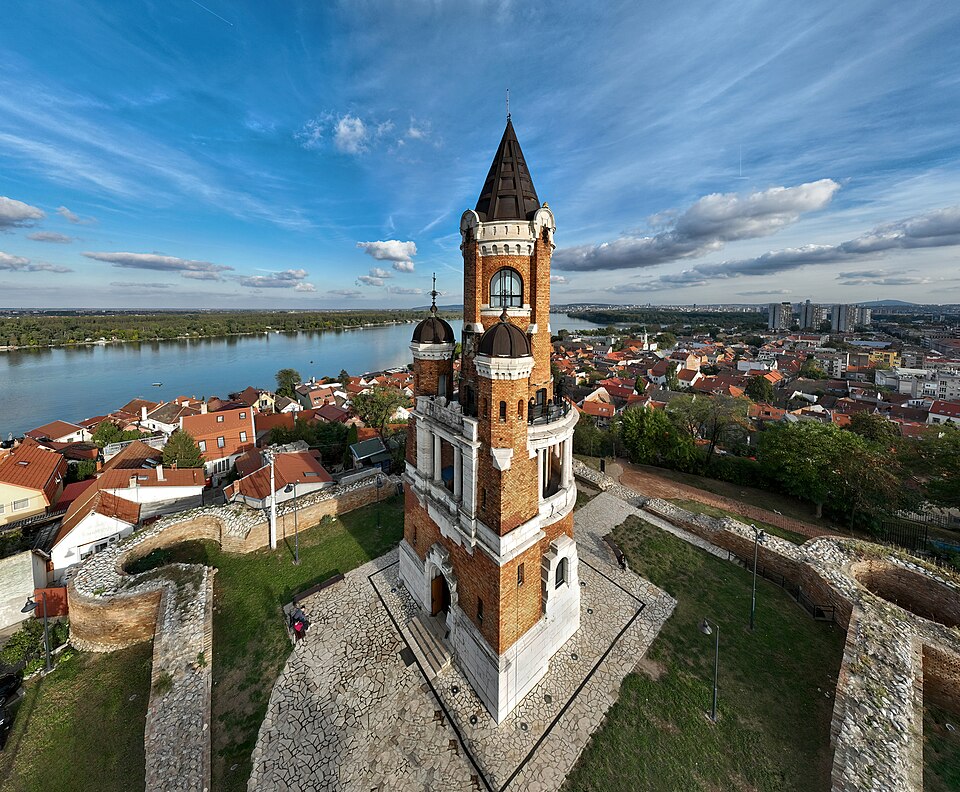
Gardoš Tower, also known as the Millennium Tower, is a commemorative structure located in the Zemun district of Belgrade, Serbia. It was constructed in 1896 as part of celebrations marking 1,000 years of Hungarian settlement in the Carpathian Basin. The tower stands on Gardoš Hill, an elevated area overlooking the Danube, and occupies the site of earlier fortifications associated with the medieval town of Zemun. Designed in a historicist style with elements reminiscent of medieval architecture, the tower was intended as both a symbolic monument and a visual landmark. Today, it functions as a cultural site and viewpoint, offering insight into the Austro-Hungarian period of the region and the layered history of Zemun within the broader urban context of Belgrade.
Key Facts
- Materials
- Stone, Brick
- Civilization
- Austro-Hungarian
- Accessibility
- Accessible to the base; interior access involves stairs
- Date(s)
- 1896 CE
- Condition
- Restored, open to visitors
- Original Function
- Commemorative tower marking Hungarian millennium
- Key Figures
- Emperor Franz Joseph I
Pre-existing Site
Medieval periodBefore the construction of the tower, Gardoš Hill was the location of earlier fortifications forming part of the defensive system of medieval Zemun. Its elevated position made it a strategic lookout point over the Danube.
Construction for Millennium Celebrations
1896The tower was built by Austro-Hungarian authorities to commemorate 1,000 years since the Magyar conquest of the Carpathian Basin. It was one of several millennium monuments erected across the Kingdom of Hungary.
20th Century Changes
20th centuryFollowing the dissolution of the Austro-Hungarian Empire, the tower remained as a historical structure within the evolving city of Belgrade. It underwent periods of neglect and partial damage but retained its symbolic presence.
Restoration and Modern Use
21st centuryThe tower has been restored and repurposed as a cultural and tourist site. It now serves as a viewpoint and occasionally hosts exhibitions and events, contributing to the cultural life of the Zemun district.
Cultural Significance
Gardoš Tower reflects the political and cultural landscape of the late 19th century, when Zemun was part of the Austro-Hungarian Empire. Its construction as a millennium monument illustrates the use of architecture to assert historical narratives and imperial identity in multi-ethnic regions. In contemporary Belgrade, the tower is associated with the distinct identity of Zemun, a district with a different historical trajectory from the rest of the city. It serves as a reminder of shifting borders and cultural influences in the region, while also functioning as a local landmark and gathering point.
Visiting Information
Entry Rules
Open daily. Ticketed entry required for access to the tower interior and viewing platform.
Best Times to Visit
Late afternoon for fewer visitors. Clear weather provides the best visibility over the Danube and surrounding area.
Photography
Photography permitted. Tripods may be restricted inside the tower.
Preservation Notes
Interior staircases are narrow; use caution when ascending. Do not climb on exterior stonework. Follow posted preservation guidelines.
Nearby POIs
11 shown- Pobednik4.1 km
- Ruzica4.2 km
- Belgrade Fortress4.2 km
- Military Museum of Belgrade4.3 km
- Cathedral Church of St. Michael the Archangel4.8 km
- Residence of Princess Ljubica4.8 km
- National Museum of Serbia5.3 km
- Historical Museum of Serbia5.8 km
- House of the National Assembly of Serbia6 km
- Church of Saint Mark6.3 km
- Church of the Holy Trinity6.3 km
Sources & Further Reading
- [1]Zemun Through the Centuries — Branislav Krstić. Belgrade Cultural Institute (2005)
- [2]Austro-Hungarian Architecture in the Balkans — Dragan Damjanović. Central European University Press (2013)
- [3]Millennium Monuments of Hungary — László Kontler. Hungarian Historical Review (2010)
Key Facts
- Materials
- Stone, Brick
- Civilization
- Austro-Hungarian
- Accessibility
- Accessible to the base; interior access involves stairs
- Date(s)
- 1896 CE
- Condition
- Restored, open to visitors
- Original Function
- Commemorative tower marking Hungarian millennium
- Key Figures
- Emperor Franz Joseph I
Nearby POIs
11 shown- Pobednik4.1 km
- Ruzica4.2 km
- Belgrade Fortress4.2 km
- Military Museum of Belgrade4.3 km
- Cathedral Church of St. Michael the Archangel4.8 km
- Residence of Princess Ljubica4.8 km
- National Museum of Serbia5.3 km
- Historical Museum of Serbia5.8 km
- House of the National Assembly of Serbia6 km
- Church of Saint Mark6.3 km
- Church of the Holy Trinity6.3 km