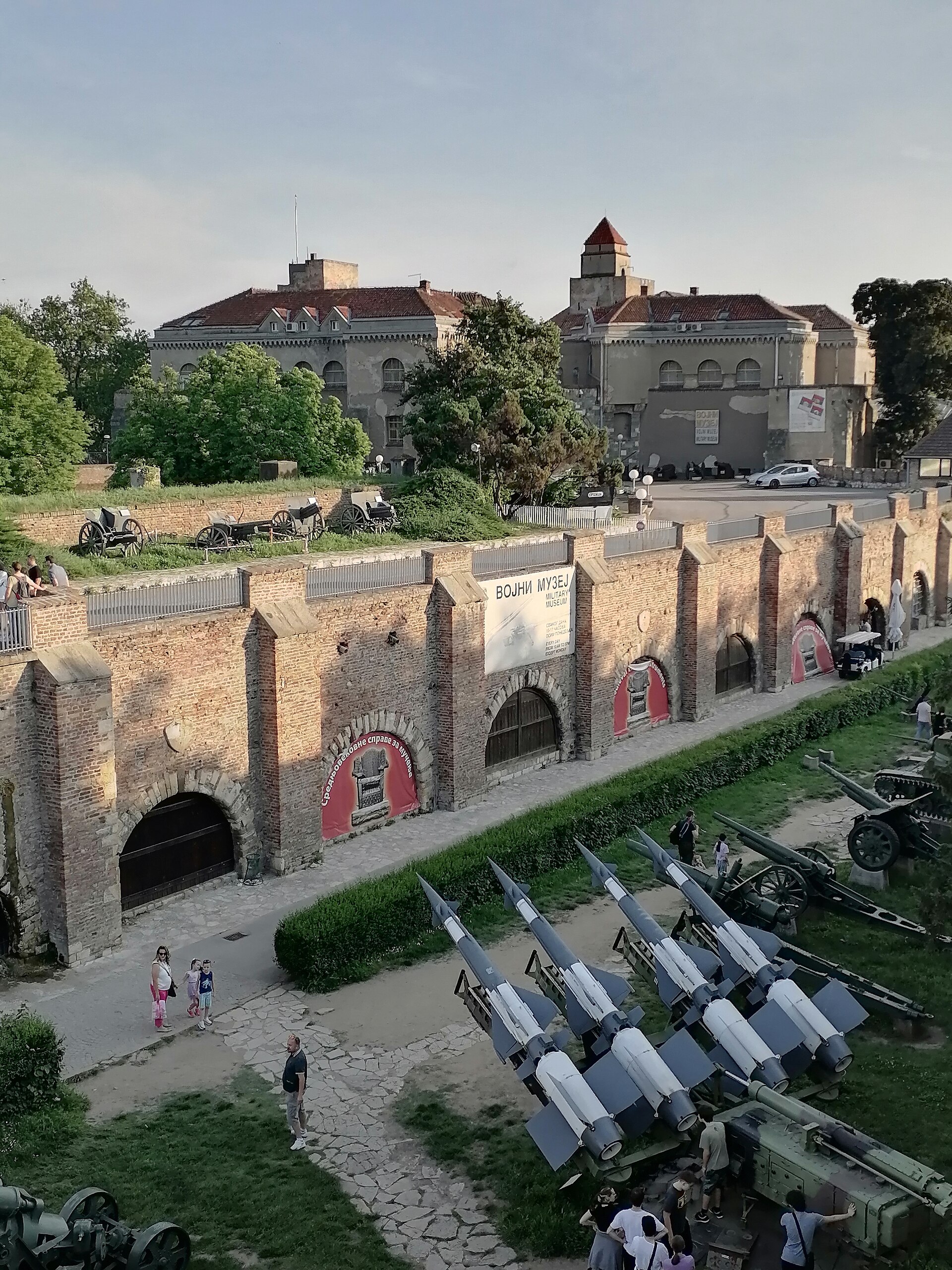
The Military Museum of Belgrade is located within the Belgrade Fortress and presents the military history of Serbia and the broader Balkan region from antiquity to the modern era. Established in 1878, shortly after Serbia gained independence from the Ottoman Empire, the museum was created to preserve weapons, uniforms, and artifacts related to the country’s military past. The museum includes both indoor exhibitions and an extensive outdoor display featuring artillery, armored vehicles, and other military equipment. Its collections cover multiple periods, including medieval Serbian states, Ottoman and Habsburg conflicts, the Balkan Wars, both World Wars, and the conflicts of the late 20th century.
Key Facts
- Materials
- Stone, Concrete
- Civilization
- Principality/Kingdom of Serbia; later Yugoslavia
- Notable Exhibits
- Artillery pieces, Armored vehicles, Historical weapons and uniforms
- Date(s)
- Established 1878
- Condition
- Active museum
- Original Function
- Military museum
Foundation after Independence
1878The museum was established following the Congress of Berlin, which recognized Serbia’s independence. It was intended to collect and preserve military artifacts that documented the country’s struggles for autonomy and statehood.
Expansion of Collections
Late 19th – early 20th centuryThe museum expanded its holdings through acquisitions from the Serbian army and donations. Its collections grew to include items from earlier historical periods as well as contemporary military equipment.
World Wars and Yugoslav Period
1914–1990sDuring the 20th century, the museum incorporated artifacts from both World Wars and the period of socialist Yugoslavia. These additions reflected the changing political and military landscape of the region.
Late 20th Century Conflicts
1990sThe museum added exhibits related to the conflicts of the 1990s, including the breakup of Yugoslavia and NATO intervention. These displays contribute to ongoing interpretations of recent history.
Current Role
2000s–presentToday, the Military Museum functions as a central institution for the study and presentation of military history in Serbia. Its location within the Belgrade Fortress reinforces the connection between the site and the city’s long-standing defensive role.
Cultural Significance
The Military Museum of Belgrade reflects the central role of military history in Serbian national identity, particularly narratives of resistance, independence, and state formation. Its collections span multiple empires and political systems, illustrating the region’s position as a contested frontier. By presenting artifacts from both distant and recent conflicts, the museum also contributes to public memory and historical interpretation, shaping how military events are understood within contemporary Serbian society.
Interpretive Notes
Scholarly debates and areas of uncertainty
The interpretation of late 20th-century conflicts within the museum has been subject to differing perspectives, particularly regarding the framing of the Yugoslav Wars and NATO intervention. Scholars debate the balance between national narrative and broader international context in these exhibits. There is also ongoing discussion about the representation of earlier periods, especially the extent to which the museum integrates archaeological evidence with later historical narratives.
Visiting Information
Entry Rules
Open Tuesday–Sunday. Ticketed entry.
Best Times to Visit
Weekday mornings are typically less crowded. Outdoor exhibits are best viewed in clear weather conditions.
Photography
Photography permitted in outdoor areas. Indoor photography may be restricted in certain exhibition halls.
Preservation Notes
Do not climb on outdoor military equipment. Follow marked paths and respect barriers around exhibits.
Nearby POIs
11 shown- Belgrade Fortress0.2 km
- Pobednik0.2 km
- Ruzica0.4 km
- Cathedral Church of St. Michael the Archangel0.5 km
- Residence of Princess Ljubica0.6 km
- National Museum of Serbia1 km
- Historical Museum of Serbia1.5 km
- House of the National Assembly of Serbia1.7 km
- Church of Saint Mark2 km
- Church of the Holy Trinity2 km
- Nikola Tesla Museum2.5 km
Sources & Further Reading
- [1]
- [2]Serbia and the Balkans: Military History — Marko Attila Hoare. Oxford University Press (2007)
- [3]War and Society in the Balkans — Antonis Liakos. Hurst & Company (2012)
Key Facts
- Materials
- Stone, Concrete
- Civilization
- Principality/Kingdom of Serbia; later Yugoslavia
- Notable Exhibits
- Artillery pieces, Armored vehicles, Historical weapons and uniforms
- Date(s)
- Established 1878
- Condition
- Active museum
- Original Function
- Military museum
Nearby POIs
11 shown- Belgrade Fortress0.2 km
- Pobednik0.2 km
- Ruzica0.4 km
- Cathedral Church of St. Michael the Archangel0.5 km
- Residence of Princess Ljubica0.6 km
- National Museum of Serbia1 km
- Historical Museum of Serbia1.5 km
- House of the National Assembly of Serbia1.7 km
- Church of Saint Mark2 km
- Church of the Holy Trinity2 km
- Nikola Tesla Museum2.5 km