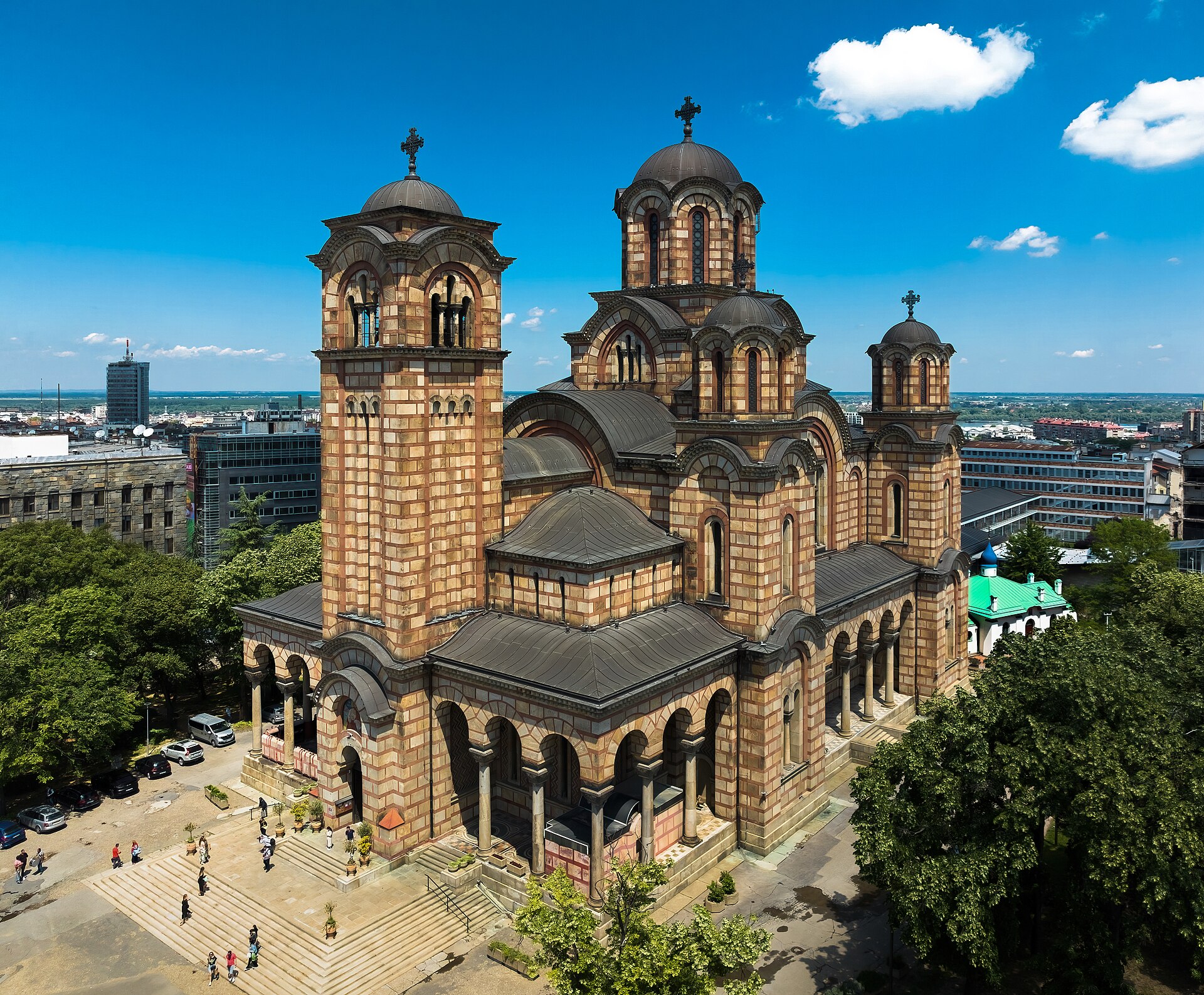
The Church of Saint Mark in Belgrade is a Serbian Orthodox church located in Tašmajdan Park, known for its monumental scale and distinctive architectural style inspired by medieval Serbian monasteries. Dedicated to Saint Mark the Evangelist, the church serves as one of the largest places of worship in Serbia and an important religious site within the capital. Constructed between 1931 and 1940, the church was designed in the Serbian-Byzantine Revival style, drawing direct inspiration from the medieval Gračanica Monastery. It replaced an earlier 19th-century church on the same site. The interior houses significant religious artworks and the tombs of notable historical figures, including members of the Serbian royal family.
Key Facts
- Materials
- Brick, Stone
- Civilization
- Serbian
- Accessibility
- Accessible at ground level
- Notable Burials
- Tsar Stefan Dušan (reinterred remains), Patriarch German
- Date(s)
- 1931 - 1940
- Condition
- Active church
- Original Function
- Orthodox Christian church
- Key Figures
- Saint Mark the Evangelist, Petar and Branko Krstić
- Architectural Style
- Serbian-Byzantine Revival
Earlier Church on the Site
1835 - 1941An earlier Church of Saint Mark was constructed in 1835 near the present location. It served as an important religious center in Belgrade but was damaged and ultimately destroyed during World War II.
Construction of the Current Church
1931 - 1940The current church was built between 1931 and 1940, designed by architects Petar and Branko Krstić. Its architectural model was the medieval Gračanica Monastery, reflecting a revival of Serbian medieval forms in modern ecclesiastical architecture.
World War II and Aftermath
1941 - 1945The church sustained damage during the bombing of Belgrade in World War II but remained standing. Post-war repairs allowed it to continue functioning as a place of worship.
Role in Socialist Yugoslavia
1945 - 1990sDuring the socialist period, religious institutions faced limitations, but the church remained active. It continued to serve the local Orthodox community while also maintaining historical and cultural significance.
Contemporary Use
2000s - presentToday, the Church of Saint Mark is an important religious and cultural site in Belgrade. It hosts regular liturgical services and attracts visitors for both its architecture and its historical associations.
Cultural Significance
The Church of Saint Mark represents a continuation of Serbian Orthodox religious tradition in an urban, modern context. Its architectural design consciously references medieval Serbian heritage, reinforcing a connection between contemporary religious life and historical identity. The church also serves as a site of national memory due to the presence of important burials, including that of Tsar Stefan Dušan. As a prominent landmark in Belgrade, it functions both as an active place of worship and as a cultural symbol tied to Serbian history and identity.
Visiting Information
Entry Rules
Open daily. Entry is free. As an active church, access may be limited during services and religious ceremonies.
Best Times to Visit
Morning and late afternoon for quieter visits. Major Orthodox holidays draw large congregations.
Photography
Photography permitted inside and outside. Flash may be discouraged during services.
Preservation Notes
Visitors should remain quiet and respectful during services. Avoid entering restricted areas near the altar.
Nearby POIs
11 shown- Church of the Holy Trinity0.1 km
- House of the National Assembly of Serbia0.3 km
- Historical Museum of Serbia0.5 km
- Nikola Tesla Museum0.6 km
- National Museum of Serbia1 km
- Church of Saint Sava1.4 km
- Residence of Princess Ljubica1.5 km
- Cathedral Church of St. Michael the Archangel1.6 km
- Military Museum of Belgrade2 km
- Belgrade Fortress2.1 km
- Ruzica2.2 km
Sources & Further Reading
- [1]Church of Saint Mark, Belgrade. Serbian Orthodox Church
- [2]Architecture of Eastern Europe in the 20th Century — Adrian Forty. Thames & Hudson
Key Facts
- Materials
- Brick, Stone
- Civilization
- Serbian
- Accessibility
- Accessible at ground level
- Notable Burials
- Tsar Stefan Dušan (reinterred remains), Patriarch German
- Date(s)
- 1931 - 1940
- Condition
- Active church
- Original Function
- Orthodox Christian church
- Key Figures
- Saint Mark the Evangelist, Petar and Branko Krstić
- Architectural Style
- Serbian-Byzantine Revival
Nearby POIs
11 shown- Church of the Holy Trinity0.1 km
- House of the National Assembly of Serbia0.3 km
- Historical Museum of Serbia0.5 km
- Nikola Tesla Museum0.6 km
- National Museum of Serbia1 km
- Church of Saint Sava1.4 km
- Residence of Princess Ljubica1.5 km
- Cathedral Church of St. Michael the Archangel1.6 km
- Military Museum of Belgrade2 km
- Belgrade Fortress2.1 km
- Ruzica2.2 km