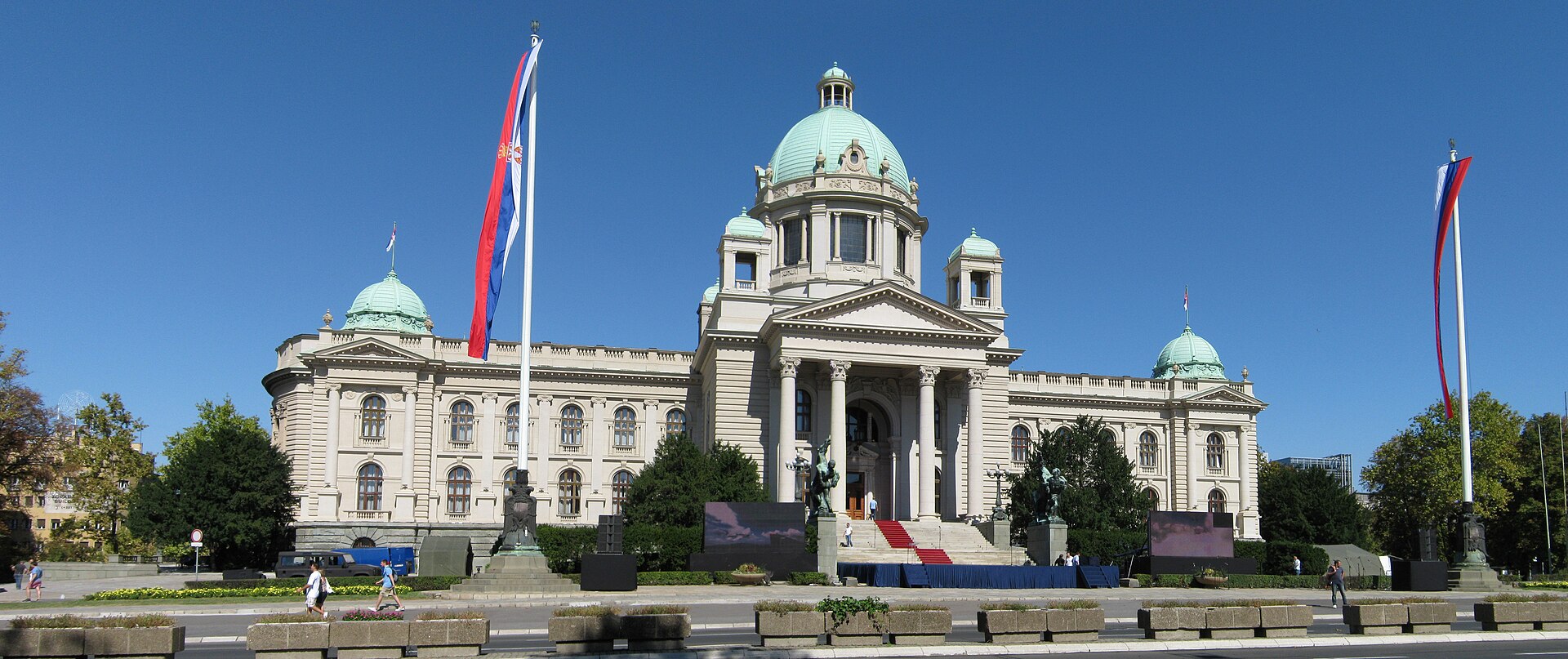
The House of the National Assembly of Serbia is the seat of the country’s parliament and a central institution in Serbia’s political life. Located in central Belgrade, the building was constructed between 1907 and 1936, reflecting a long and complex development shaped by political changes in the region. It was originally intended as the seat of the National Assembly of the Kingdom of Serbia and later served successive Yugoslav and Serbian legislative bodies. Architecturally, the structure is designed in an academic style with neoclassical influences, featuring a prominent central dome and symmetrical façade. The building has been the site of significant political events, including parliamentary sessions, state ceremonies, and public demonstrations, making it a focal point of modern Serbian governance and history.
Key Facts
- Materials
- Stone, Marble
- Civilization
- Kingdom of Serbia / Yugoslav / Modern Serbian
- Date(s)
- 1907–1936 CE
- Condition
- Active government building
- Original Function
- Parliament building
- Key Figures
- Jovan Ilkić, Petar I Karađorđević, Alexander I of Yugoslavia
Planning and Early Construction
1907-1914Construction began in 1907 based on designs by architect Jovan Ilkić. The building was intended to serve as the parliamentary seat of the Kingdom of Serbia, reflecting the state’s growing political institutions. Work progressed until the outbreak of World War I interrupted construction.
Interwar Completion
1918-1936After the formation of the Kingdom of Serbs, Croats, and Slovenes (later Yugoslavia), construction resumed with modifications to the original plans. The building was completed in 1936, incorporating elements of academic and neoclassical architecture.
Yugoslav Period
1945-1990sDuring the socialist Yugoslav period, the building served as the seat of the federal and republican assemblies. It was a central site for legislative activity and political administration in the country.
Modern Serbian State
2000s - presentToday, the building houses the National Assembly of Serbia. It continues to function as the country’s legislative center and has been the location of major political events, including protests and governmental transitions.
Cultural Significance
The House of the National Assembly of Serbia is a key symbol of state authority and political continuity. It represents the development of parliamentary governance in Serbia from the early 20th century through the Yugoslav period to the present day. Its location and architectural prominence reinforce its role as a center of political power. The building has also been a focal point for civic engagement, including public demonstrations and political movements. As such, it embodies both institutional governance and the broader relationship between the state and its citizens.
Visiting Information
Entry Rules
Not open for general public entry. Access is restricted; guided tours are organized through official channels.
Best Times to Visit
Weekdays during official tour times if available. The exterior can be viewed at any time.
Photography
Photography of the exterior is permitted. Interior photography is restricted and typically only allowed during authorized visits.
Preservation Notes
Do not attempt to enter restricted areas. Follow security protocols. Public gatherings and demonstrations may affect access to the surrounding area.
Nearby POIs
11 shown- Historical Museum of Serbia0.2 km
- Church of Saint Mark0.3 km
- Church of the Holy Trinity0.3 km
- National Museum of Serbia0.8 km
- Nikola Tesla Museum0.8 km
- Residence of Princess Ljubica1.2 km
- Cathedral Church of St. Michael the Archangel1.3 km
- Church of Saint Sava1.5 km
- Military Museum of Belgrade1.7 km
- Belgrade Fortress1.8 km
- Pobednik1.9 km
Sources & Further Reading
- [1]The National Assembly of Serbia: Architecture and History. National Assembly of the Republic of Serbia
- [2]Belgrade: Cultural and Historical Guide — Branislav Krstić. Belgrade Cultural Institute (2008)
- [3]Architecture of Serbia in the 20th Century — Milan Zloković. Serbian Academy of Sciences and Arts (1995)
Key Facts
- Materials
- Stone, Marble
- Civilization
- Kingdom of Serbia / Yugoslav / Modern Serbian
- Date(s)
- 1907–1936 CE
- Condition
- Active government building
- Original Function
- Parliament building
- Key Figures
- Jovan Ilkić, Petar I Karađorđević, Alexander I of Yugoslavia
Nearby POIs
11 shown- Historical Museum of Serbia0.2 km
- Church of Saint Mark0.3 km
- Church of the Holy Trinity0.3 km
- National Museum of Serbia0.8 km
- Nikola Tesla Museum0.8 km
- Residence of Princess Ljubica1.2 km
- Cathedral Church of St. Michael the Archangel1.3 km
- Church of Saint Sava1.5 km
- Military Museum of Belgrade1.7 km
- Belgrade Fortress1.8 km
- Pobednik1.9 km