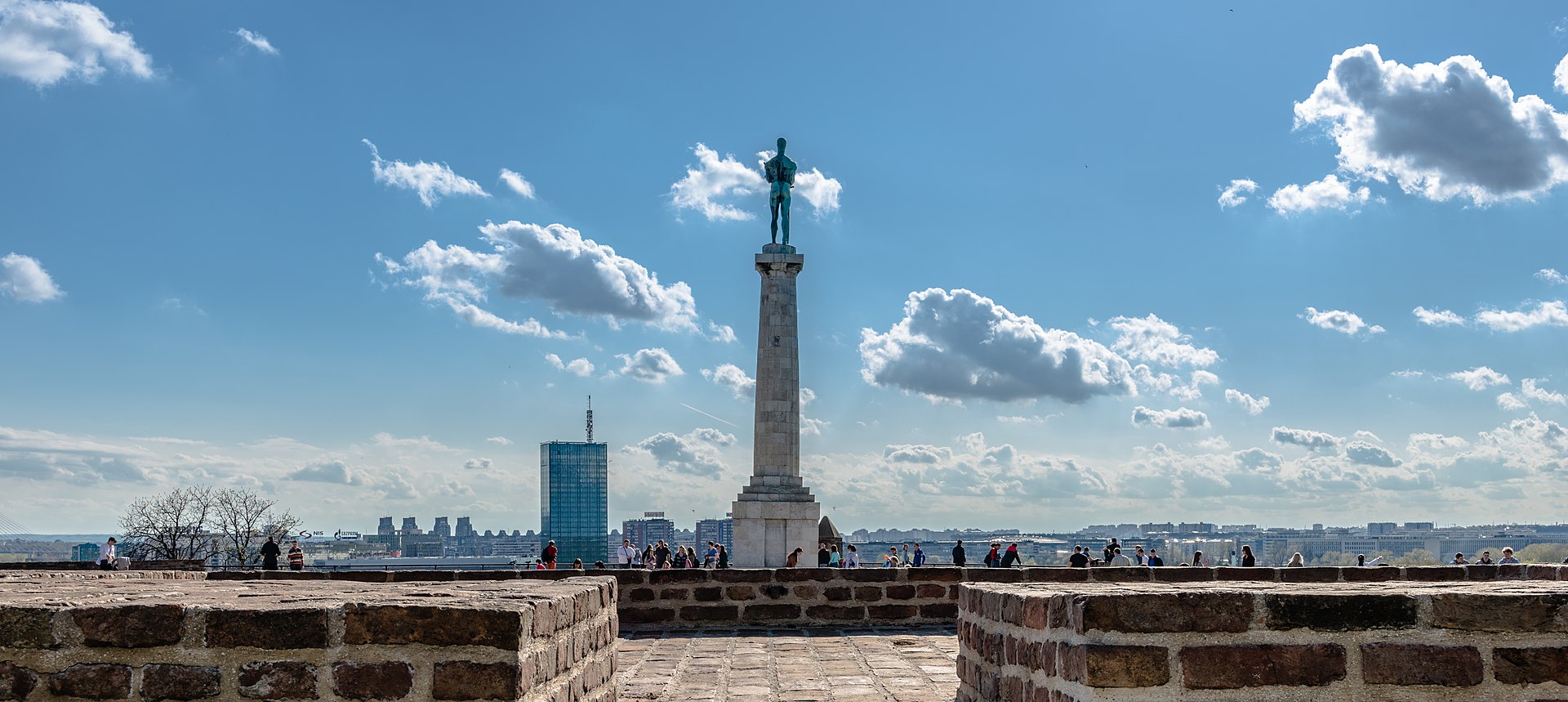
Pobednik is a monument located within the Belgrade Fortress, overlooking the confluence of the Sava and Danube rivers. Designed by sculptor Ivan Meštrović, it was completed in 1928 to commemorate Serbia’s victories in the Balkan Wars (1912–1913) and World War I. The monument stands on a high column, with a nude male figure holding a falcon in one hand and a sword in the other, symbolizing vigilance and readiness. Originally intended to be placed in a more central urban location, the statue was relocated to the fortress due to public controversy over its nudity. Its elevated position at Kalemegdan has since made it one of Belgrade’s most recognizable landmarks, visually and symbolically marking the city’s historical role as a frontier between empires.
Key Facts
- Materials
- Bronze, Stone
- Dimensions
- Column height approx. 14 m; statue height approx. 4.5 m
- Civilization
- Kingdom of Yugoslavia
- Date(s)
- 1928
- Condition
- Restored, standing monument
- Original Function
- War memorial monument
- Key Figures
- Ivan Meštrović
Concept and Commission
Post-World War IThe monument was conceived after World War I to commemorate Serbia’s military victories and sacrifices during the Balkan Wars and the war itself. Sculptor Ivan Meštrović was commissioned to create a symbolic representation of triumph and national resilience.
Design and Controversy
1920sMeštrović designed a nude male figure embodying victory, drawing on classical artistic traditions. However, the proposed installation in a central square sparked public debate and criticism over the figure’s nudity, leading authorities to reconsider its placement.
Installation at Belgrade Fortress
1928Due to the controversy, the monument was installed at the Belgrade Fortress, positioned on a high column overlooking the rivers. This location provided both symbolic significance and a degree of spatial separation from the city center.
Symbolic Role in the 20th Century
20th centuryThroughout the 20th century, Pobednik became a key visual symbol of Belgrade and Serbian resilience. Its placement at the confluence reinforced its meaning as a guardian figure facing outward toward historical frontiers.
Restoration and Present-Day Status
21st centuryThe monument has undergone conservation efforts to address weathering and structural concerns. It remains a central landmark within the Belgrade Fortress complex and a focal point for historical interpretation and tourism.
Cultural Significance
Pobednik functions as a national symbol of victory, resilience, and statehood in Serbian historical memory. Its dedication to the Balkan Wars and World War I situates it within a broader narrative of liberation and territorial consolidation in the early 20th century. The monument’s prominent placement at the confluence of major rivers reinforces its symbolic role as a sentinel figure, representing both defense and observation. Over time, it has become one of the defining visual icons of Belgrade, frequently used in cultural and civic imagery.
Interpretive Notes
Scholarly debates and areas of uncertainty
The interpretation of the monument’s symbolism has been subject to discussion, particularly regarding the balance between classical artistic influence and national narrative. Some scholars emphasize its universalized depiction of victory, while others view it as a specifically Serbian political statement tied to early 20th-century state formation. Debate has also addressed the impact of its relocation from the planned central site, with differing views on whether the fortress setting enhances or diminishes its intended civic visibility.
Visiting Information
Entry Rules
Open daily. Located within Belgrade Fortress. Entry is free.
Best Times to Visit
Sunset and early evening provide contextual visibility of the river confluence. Weekday mornings are typically less crowded.
Photography
Photography permitted without restriction.
Preservation Notes
Do not climb on the monument or its base. Remain on designated viewing areas to prevent erosion of surrounding grounds.
Nearby POIs
11 shown- Belgrade Fortress0.2 km
- Military Museum of Belgrade0.2 km
- Ruzica0.4 km
- Cathedral Church of St. Michael the Archangel0.7 km
- Residence of Princess Ljubica0.7 km
- National Museum of Serbia1.2 km
- Historical Museum of Serbia1.7 km
- House of the National Assembly of Serbia1.9 km
- Church of Saint Mark2.2 km
- Church of the Holy Trinity2.2 km
- Nikola Tesla Museum2.7 km
Sources & Further Reading
- [1]Ivan Meštrović and the Pobednik Monument. Serbian Academy of Sciences and Arts (1989)
- [2]Belgrade Fortress: History and Architecture — Marko Popović. Institute for the Protection of Cultural Monuments of Serbia (2013)
- [3]National Identity and Public Monuments in Serbia — Dubravka Stojanović. University of Belgrade (2010)
Key Facts
- Materials
- Bronze, Stone
- Dimensions
- Column height approx. 14 m; statue height approx. 4.5 m
- Civilization
- Kingdom of Yugoslavia
- Date(s)
- 1928
- Condition
- Restored, standing monument
- Original Function
- War memorial monument
- Key Figures
- Ivan Meštrović
Nearby POIs
11 shown- Belgrade Fortress0.2 km
- Military Museum of Belgrade0.2 km
- Ruzica0.4 km
- Cathedral Church of St. Michael the Archangel0.7 km
- Residence of Princess Ljubica0.7 km
- National Museum of Serbia1.2 km
- Historical Museum of Serbia1.7 km
- House of the National Assembly of Serbia1.9 km
- Church of Saint Mark2.2 km
- Church of the Holy Trinity2.2 km
- Nikola Tesla Museum2.7 km