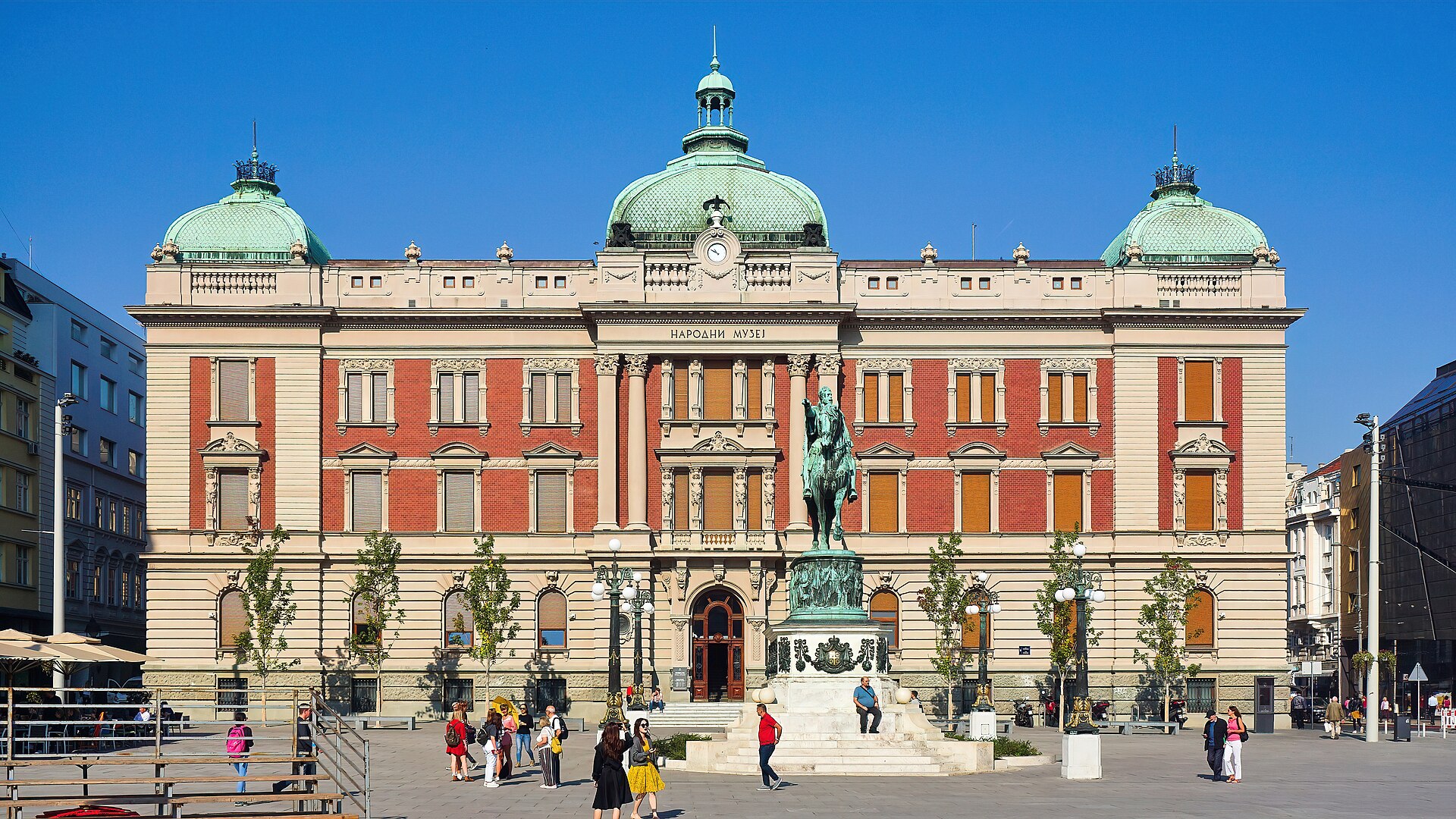
The National Museum of Serbia in Belgrade is the country’s oldest and most comprehensive museum, dedicated to preserving and presenting art and historical artifacts from prehistory to the modern era. Founded in 1844, it holds extensive collections spanning archaeology, medieval heritage, and fine art, reflecting the cultural development of the region and its connections to broader European history. Located on Republic Square, the museum’s current building dates to the early 20th century and has undergone multiple reconstructions, most recently reopening in 2018 after a major renovation. Its collections include works by Serbian and international artists, as well as artifacts from ancient civilizations, making it a central institution for cultural and historical scholarship in Serbia.
Key Facts
- Materials
- Stone, Concrete, Glass
- Civilization
- Serbian
- Accessibility
- Wheelchair accessible
- Collection Size
- Over 400,000 items
- Date(s)
- 1844 (institution); current building early 20th century, renovated 2018
- Condition
- Fully restored, active museum
- Original Function
- National museum and cultural institution
- Key Figures
- Jovan Sterija Popović, Mihailo Obrenović III
- Architectural Style
- Academic historicism
Foundation and Early Development
1844 - late 19th centuryThe museum was established in 1844 as part of broader efforts to develop national cultural institutions in the Principality of Serbia. Early collections focused on archaeology and historical artifacts, reflecting an emerging interest in national heritage and identity.
Expansion of Collections
Late 19th - early 20th centuryDuring this period, the museum expanded significantly, acquiring works of art and artifacts from across Europe and the Balkans. Its scope broadened to include fine art, with important contributions from Serbian painters and international masters.
20th Century and Institutional Growth
20th centuryThe museum continued to grow under different political regimes, including the Kingdom of Yugoslavia and socialist Yugoslavia. Its collections were reorganized and expanded to reflect changing historical narratives and scholarly priorities.
Closure and Renovation
2003 - 2018The museum was closed for over a decade due to structural and administrative challenges. A comprehensive renovation project modernized the building and exhibition spaces, aiming to meet contemporary museum standards.
Reopening and Contemporary Role
2018 - presentReopened in 2018, the museum now operates with updated exhibitions and infrastructure. It continues to function as Serbia’s primary repository of cultural heritage, hosting permanent collections and temporary exhibitions.
Cultural Significance
The National Museum of Serbia is a central institution in the country’s cultural landscape, shaping how national history and artistic heritage are preserved and presented. Its collections contribute to the construction of Serbian cultural identity by linking archaeological findings, medieval traditions, and modern artistic developments. The museum also plays a broader regional role, highlighting cultural exchanges between the Balkans and other parts of Europe. Its exhibitions reflect the historical intersections of empires, religions, and artistic movements that have influenced the region over centuries.
Interpretive Notes
Scholarly debates and areas of uncertainty
Scholarly discussions often focus on how national museums construct historical narratives, particularly in regions with complex political histories. Debates include how to balance national identity with broader regional and global contexts. There has also been discussion regarding the long closure of the museum prior to its 2018 reopening, with attention to issues of funding, preservation standards, and institutional management.
Visiting Information
Entry Rules
Open Tuesday to Sunday. Closed Monday. Entry is ticketed, with occasional free admission days.Sundays are always free.
Best Times to Visit
Late morning and early afternoon for full access to galleries. Weekdays are generally less crowded than weekends.
Photography
Photography permitted without flash in most areas. Some temporary exhibitions may restrict photography.
Preservation Notes
Do not touch exhibits. Follow gallery guidelines and staff instructions. Large bags may need to be checked at entry.
Nearby POIs
11 shown- Historical Museum of Serbia0.6 km
- Residence of Princess Ljubica0.6 km
- Cathedral Church of St. Michael the Archangel0.6 km
- House of the National Assembly of Serbia0.8 km
- Military Museum of Belgrade1 km
- Church of Saint Mark1 km
- Church of the Holy Trinity1 km
- Belgrade Fortress1.1 km
- Pobednik1.2 km
- Ruzica1.2 km
- Nikola Tesla Museum1.6 km
Sources & Further Reading
- [1]National Museum of Serbia Official WebsiteView
- [2]Cultural Heritage of Serbia — Various Authors. Serbian Academy of Sciences and Arts
- [3]Museums in Serbia: History and Development. Ministry of Culture of Serbia
Key Facts
- Materials
- Stone, Concrete, Glass
- Civilization
- Serbian
- Accessibility
- Wheelchair accessible
- Collection Size
- Over 400,000 items
- Date(s)
- 1844 (institution); current building early 20th century, renovated 2018
- Condition
- Fully restored, active museum
- Original Function
- National museum and cultural institution
- Key Figures
- Jovan Sterija Popović, Mihailo Obrenović III
- Architectural Style
- Academic historicism
Nearby POIs
11 shown- Historical Museum of Serbia0.6 km
- Residence of Princess Ljubica0.6 km
- Cathedral Church of St. Michael the Archangel0.6 km
- House of the National Assembly of Serbia0.8 km
- Military Museum of Belgrade1 km
- Church of Saint Mark1 km
- Church of the Holy Trinity1 km
- Belgrade Fortress1.1 km
- Pobednik1.2 km
- Ruzica1.2 km
- Nikola Tesla Museum1.6 km