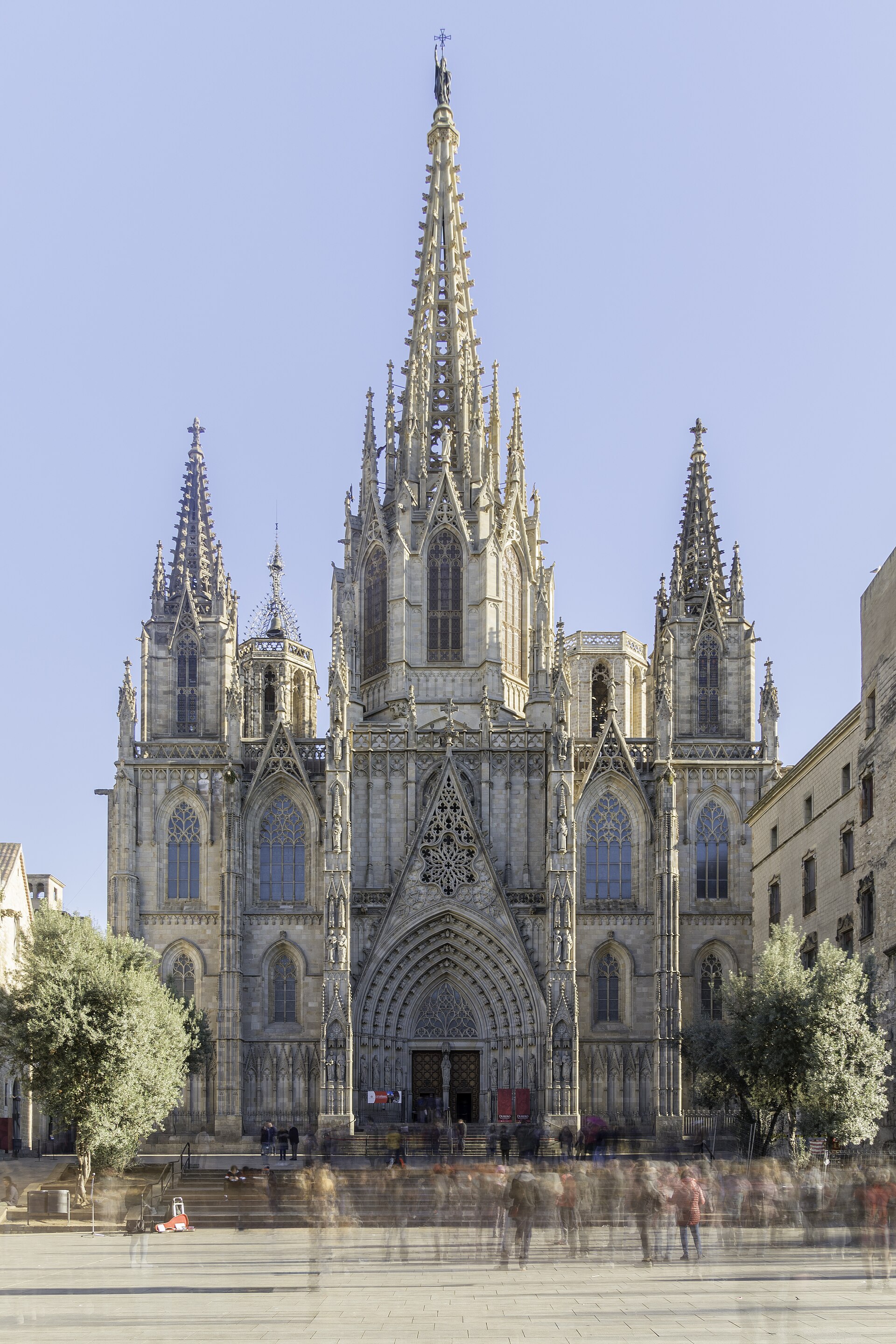
The Cathedral of the Holy Cross and Saint Eulalia, commonly known as Barcelona Cathedral, is the principal church of the Archdiocese of Barcelona. Located in the Gothic Quarter, the cathedral was constructed between the 13th and 15th centuries on the site of earlier Christian and Visigothic churches. The structure is a prominent example of Catalan Gothic architecture, characterized by a high nave, ribbed vaulting, and a cloister containing the tomb of Saint Eulalia, co-patron saint of Barcelona. Its neo-Gothic façade, completed in the 19th century, reflects later restoration efforts.
Key Facts
- Materials
- Stone, Limestone
- Civilization
- Medieval Catalan
- Accessibility
- Wheelchair accessible in main nave; limited access to upper levels
- Date(s)
- 1298-1448 (facade completed 1887-1890)
- Condition
- Well-preserved, active cathedral
- Original Function
- Cathedral dedicated to the Holy Cross and Saint Eulalia
- Key Figures
- Saint Eulalia, Jaume II of Aragon
Early Christian Foundations
4th-10th centuryThe cathedral stands on the site of earlier Christian basilicas dating to the Late Roman and Visigothic periods. These early structures were replaced following Islamic incursions and later Christian reconquest.
Gothic Construction
1298-1448Construction of the present Gothic cathedral began under the reign of King Jaume II of Aragon. The project unfolded over more than a century, resulting in a unified Catalan Gothic design with a wide nave and side chapels integrated between buttresses.
Façade and 19th-Century Completion
1887-1890Although the medieval structure was largely complete by the 15th century, the elaborate neo-Gothic façade was not finalized until the late 19th century, based on earlier medieval plans and Romantic-era restoration principles.
Modern Role
20th century - presentThe cathedral remains the seat of the Archbishop of Barcelona and an active place of worship. It functions as both a religious center and a major historical landmark within the city.
Cultural Significance
The Cathedral of the Holy Cross and Saint Eulalia serves as the spiritual center of Barcelona and reflects the political and religious consolidation of medieval Catalonia. Its dedication to Saint Eulalia commemorates a young Christian martyr whose story forms part of the city's historical identity. Beyond its religious function, the cathedral anchors the Gothic Quarter and represents the architectural ambitions of the Crown of Aragon during the late medieval period. It remains central to civic ceremonies and major religious festivals.
Interpretive Notes
Scholarly debates and areas of uncertainty
Scholars discuss the extent to which the 19th-century neo-Gothic façade accurately reflects medieval design intentions. While based on archival drawings, some historians argue that Romantic restoration ideals influenced its final appearance more than strictly medieval precedents.
Visiting Information
Entry Rules
Open daily. Free entry during worship hours; ticket required for tourist visits to the nave, choir, rooftop, and cloister outside service times. Modest dress required.
Best Times to Visit
Early morning before major tour groups arrive. Weekdays outside peak summer months provide quieter access. Religious feast days may limit general visitation.
Photography
Personal photography permitted without flash. Tripods and commercial photography require prior authorization. Photography may be restricted during services.
Preservation Notes
Maintain silence during worship. Do not touch artworks or tomb monuments. Follow staff instructions and respect restricted areas.
Nearby POIs
11 shownSources & Further Reading
- [1]
- [2]Catalan Gothic Architecture — Robert Branner. Princeton University Press (1961)
- [3]The Crown of Aragon in the Middle Ages — Thomas N. Bisson. Oxford University Press (1986)
Key Facts
- Materials
- Stone, Limestone
- Civilization
- Medieval Catalan
- Accessibility
- Wheelchair accessible in main nave; limited access to upper levels
- Date(s)
- 1298-1448 (facade completed 1887-1890)
- Condition
- Well-preserved, active cathedral
- Original Function
- Cathedral dedicated to the Holy Cross and Saint Eulalia
- Key Figures
- Saint Eulalia, Jaume II of Aragon