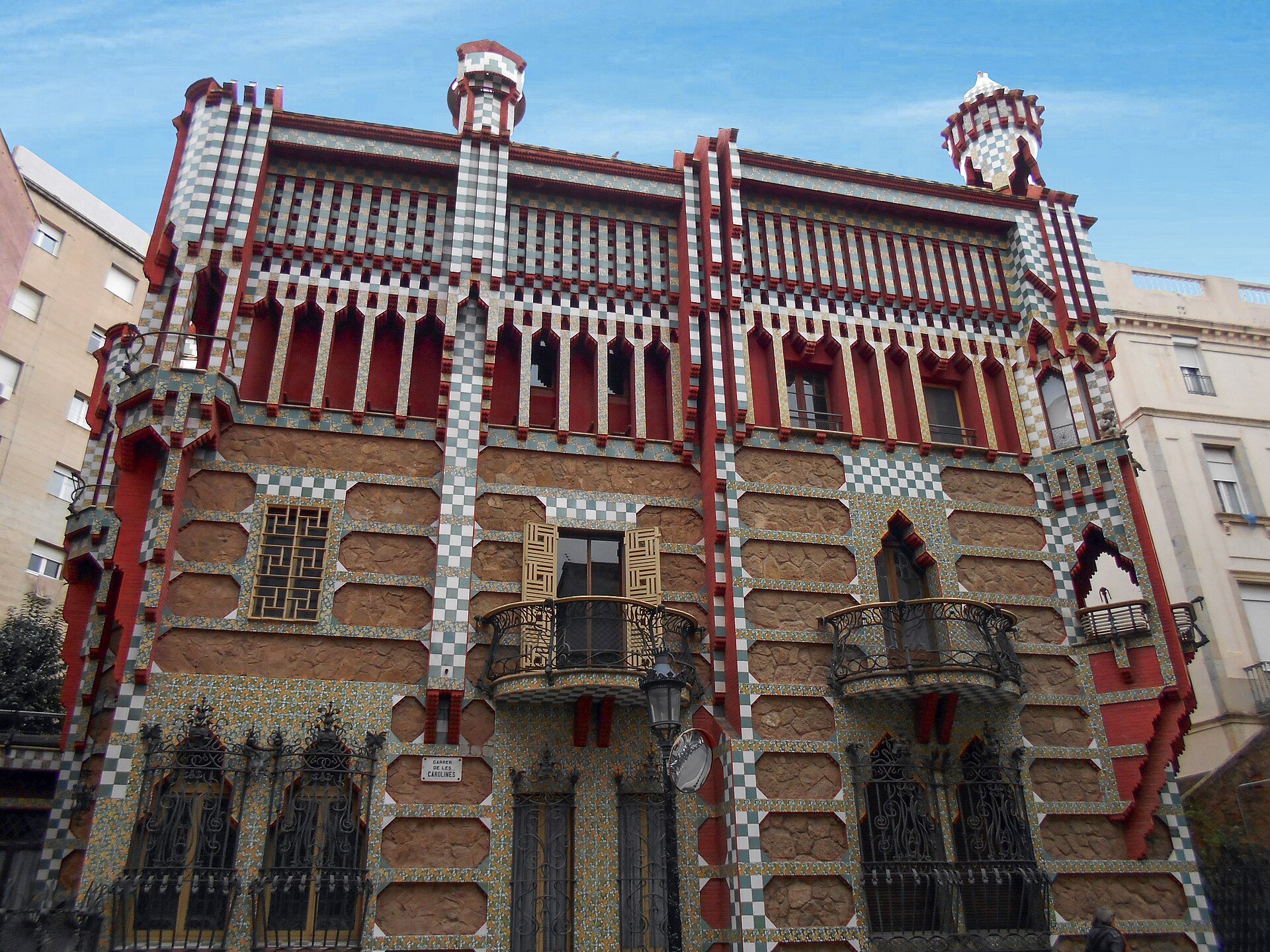
Casa Vicens was the first house designed by Antoni Gaudí, constructed between 1883 and 1885 in the Gràcia district of Barcelona. Commissioned by Manuel Vicens i Montaner, a stockbroker, the residence serves as a foundational example of Gaudí's early architectural style, which heavily incorporates Mudéjar influences, intricate brickwork, and vibrant polychrome ceramic tiles.
The structure is notable for its rejection of traditional domestic layouts, instead utilizing an open floor plan that integrates interior spaces with the surrounding garden. The facade features a distinct pattern of floral motifs, specifically the French marigold, which Gaudí observed on the site before construction began. Following extensive restoration, the house opened as a public museum in 2017, providing insight into the genesis of Catalan Modernism.
Key Facts
- Materials
- Rough-hewn stone, Red brick, Glazed ceramic tiles, Iron, Wood
- Civilization
- Catalan
- Accessibility
- Wheelchair accessible with elevator access to all floors
- Date(s)
- 1883-1885
- Condition
- Restored and operating as a house museum
- Original Function
- Private residence
- Key Figures
- Antoni Gaudí, Manuel Vicens i Montaner
Commission and Design
1883Manuel Vicens i Montaner commissioned the young architect Antoni Gaudí to design a summer residence. This project provided Gaudí with his first opportunity to apply his unique vision, blending traditional construction techniques with the ornamental aesthetics of the Orient.
Construction Phase
1883-1885The house was built using a combination of exposed brick and colorful ceramic tiles. Gaudí's design emphasized the relationship between the building and nature, incorporating the existing flora of the plot into the architectural ornamentation.
Expansions and Ownership
1925Architect Joan Baptista Serra de Martínez expanded the house, adding a new bay that respected Gaudí's original style. The property remained a private residence for over a century, passing through several owners.
Restoration and Museum Opening
2014-2017The property was acquired by MoraBanc in 2014. A comprehensive restoration project was undertaken to return the house to its original state, leading to its public opening as a museum in November 2017.
Cultural Significance
Casa Vicens is recognized as the manifesto of Gaudí's architectural career. It represents the transition from historicism to the unique, nature-inspired language that would define Catalan Modernism. Its inclusion as a UNESCO World Heritage site underscores its importance in the history of 19th-century European architecture.
Locally, the house is a landmark of the Gràcia neighborhood, reflecting the transition of the area from a rural village to an urban district of Barcelona. It serves as a critical site for understanding the evolution of Gaudí's design philosophy before his later, more structuralist works.
Interpretive Notes
Scholarly debates and areas of uncertainty
Scholars often debate the extent to which the 1925 expansion by Joan Baptista Serra de Martínez successfully integrated with Gaudí's original intent. While the expansion is generally praised for its sensitivity, some purists argue that the loss of the original garden space altered the intended dialogue between the architecture and its natural environment.
Visiting Information
Entry Rules
Open daily from 10:00 to 20:00. Tickets can be purchased online or at the entrance. Visitors are requested to follow marked paths and refrain from touching the decorative surfaces.
Best Times to Visit
Weekday mornings are generally less crowded. Spring and autumn offer the best weather for viewing the exterior facade and the garden.
Photography
Personal photography is permitted for non-commercial use. Tripods and professional lighting equipment are prohibited without prior authorization.
Preservation Notes
The house is a protected monument. Visitors must avoid touching the ceramic tiles and woodwork. Restoration is ongoing to maintain the integrity of the original materials.
Nearby POIs
11 shown- Gaudi House Museum1.2 km
- Casa Mila1.3 km
- Casa Batllo1.8 km
- CosmoCaixa Barcelona1.9 km
- Basilica de la Sagrada Familia2 km
- Barcelona Museum of Contemporary Art2.6 km
- Arc de Triomf2.9 km
- Cathedral of the Holy Cross and Saint Eulalia3.1 km
- Basilica de Santa Maria del Pi3.1 km
- Design Museum of Barcelona3.1 km
- Museu Picasso3.3 km
Sources & Further Reading
- [1]Casa Vicens: The First Gaudí — Daniel Giralt-Miracle. Triangle Postals (2017)
- [2]Gaudí: The Complete Works — Rainer Zerbst. Taschen (2002)
Key Facts
- Materials
- Rough-hewn stone, Red brick, Glazed ceramic tiles, Iron, Wood
- Civilization
- Catalan
- Accessibility
- Wheelchair accessible with elevator access to all floors
- Date(s)
- 1883-1885
- Condition
- Restored and operating as a house museum
- Original Function
- Private residence
- Key Figures
- Antoni Gaudí, Manuel Vicens i Montaner
Nearby POIs
11 shown- Gaudi House Museum1.2 km
- Casa Mila1.3 km
- Casa Batllo1.8 km
- CosmoCaixa Barcelona1.9 km
- Basilica de la Sagrada Familia2 km
- Barcelona Museum of Contemporary Art2.6 km
- Arc de Triomf2.9 km
- Cathedral of the Holy Cross and Saint Eulalia3.1 km
- Basilica de Santa Maria del Pi3.1 km
- Design Museum of Barcelona3.1 km
- Museu Picasso3.3 km