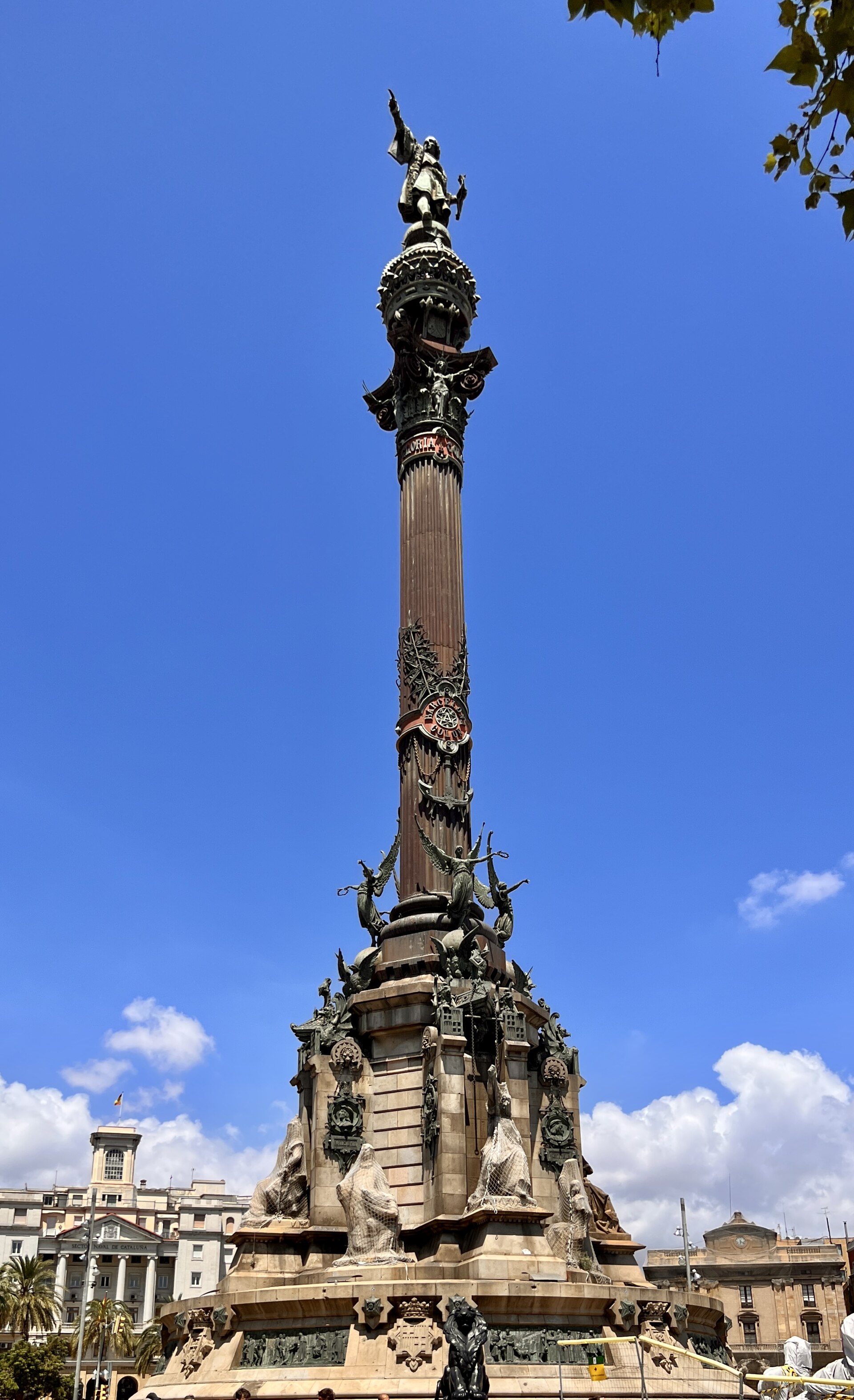
The Columbus Monument is a 60-meter tall column located at the lower end of La Rambla in Barcelona, Spain. Constructed for the 1888 Universal Exposition, it commemorates Christopher Columbus's first voyage to the Americas and his arrival in Barcelona to report his findings to the Catholic Monarchs.
The monument consists of a Corinthian column topped by a bronze statue of Columbus pointing toward the sea. The base is decorated with eight bronze lions and various allegorical figures representing the provinces of Spain and scenes from the explorer's life. An internal elevator allows visitors to reach a small observation gallery located just below the statue, offering panoramic views of the city and the port.
Key Facts
- Materials
- Cast iron, Bronze, Stone
- Civilization
- Spanish
- Accessibility
- Limited; small elevator access to the top
- Date(s)
- 1881-1888
- Condition
- Well-preserved, active tourist attraction
- Original Function
- Commemorative monument for the 1888 Universal Exposition
- Key Figures
- Christopher Columbus, Gaietà Buïgas i Monravà, Rafael Atché
Conception and Design
1881The project was initiated in 1881 following a public competition to honor the explorer. The design by architect Gaietà Buïgas i Monravà was selected for its grand scale and integration of sculptural elements representing Spanish history.
Construction for the Exposition
1882-1888Construction began in 1882 and faced significant delays due to financial issues and the complexity of the iron structure. It was completed just in time for the opening of the 1888 Universal Exposition, serving as a landmark for the event.
Modern Status
20th Century - PresentThe monument has undergone several restorations to address the oxidation of the bronze elements and the structural integrity of the column. It remains one of the most recognizable symbols of Barcelona's maritime heritage.
Cultural Significance
The monument serves as a focal point for Barcelona's connection to the sea and its historical role in the Age of Discovery. It reflects the late 19th-century trend of monumental urban planning intended to project national identity and prestige during international events.
In recent years, the monument has become a site of debate regarding the legacy of colonialism. Discussions often center on the appropriateness of the statue's placement and the historical narrative it promotes, reflecting broader contemporary shifts in how public monuments are interpreted.
Interpretive Notes
Scholarly debates and areas of uncertainty
There is ongoing academic debate regarding the orientation of the statue. While popular legend suggests Columbus is pointing toward the Americas, the statue actually points toward the Mediterranean Sea, leading to various theories about the sculptor's original intent or potential navigational errors.
Visiting Information
Entry Rules
The observation deck is accessible via a small elevator for a fee. Tickets can be purchased at the base. Access may be restricted during high winds or maintenance.
Best Times to Visit
Early morning or late afternoon to avoid the heat and peak crowds at the base of La Rambla.
Photography
Personal photography is permitted. Commercial use requires authorization from the city council.
Preservation Notes
The monument is subject to regular cleaning and structural monitoring due to its proximity to the sea and exposure to salt air.
Nearby POIs
11 shown- Maritime Museum of Barcelona0.2 km
- Palau Guell0.4 km
- Basilica de Santa Maria del Pi0.8 km
- Cathedral of the Holy Cross and Saint Eulalia0.9 km
- Santa Maria del Mar1 km
- Museu Picasso1.1 km
- Barcelona Museum of Contemporary Art1.2 km
- Arc de Triomf1.7 km
- Casa Batllo2.1 km
- Museu Nacional d'Art de Catalunya2.2 km
- Magic Fountain of Montjuic2.2 km
Sources & Further Reading
- [1]Barcelona: A Thousand Years of History — Felipe Fernández-Armesto. University of Chicago Press (1992)
- [2]The 1888 Universal Exposition and the Transformation of Barcelona — Jordi Artigas. Barcelona City Council Archives (2015)
Key Facts
- Materials
- Cast iron, Bronze, Stone
- Civilization
- Spanish
- Accessibility
- Limited; small elevator access to the top
- Date(s)
- 1881-1888
- Condition
- Well-preserved, active tourist attraction
- Original Function
- Commemorative monument for the 1888 Universal Exposition
- Key Figures
- Christopher Columbus, Gaietà Buïgas i Monravà, Rafael Atché
Nearby POIs
11 shown- Maritime Museum of Barcelona0.2 km
- Palau Guell0.4 km
- Basilica de Santa Maria del Pi0.8 km
- Cathedral of the Holy Cross and Saint Eulalia0.9 km
- Santa Maria del Mar1 km
- Museu Picasso1.1 km
- Barcelona Museum of Contemporary Art1.2 km
- Arc de Triomf1.7 km
- Casa Batllo2.1 km
- Museu Nacional d'Art de Catalunya2.2 km
- Magic Fountain of Montjuic2.2 km