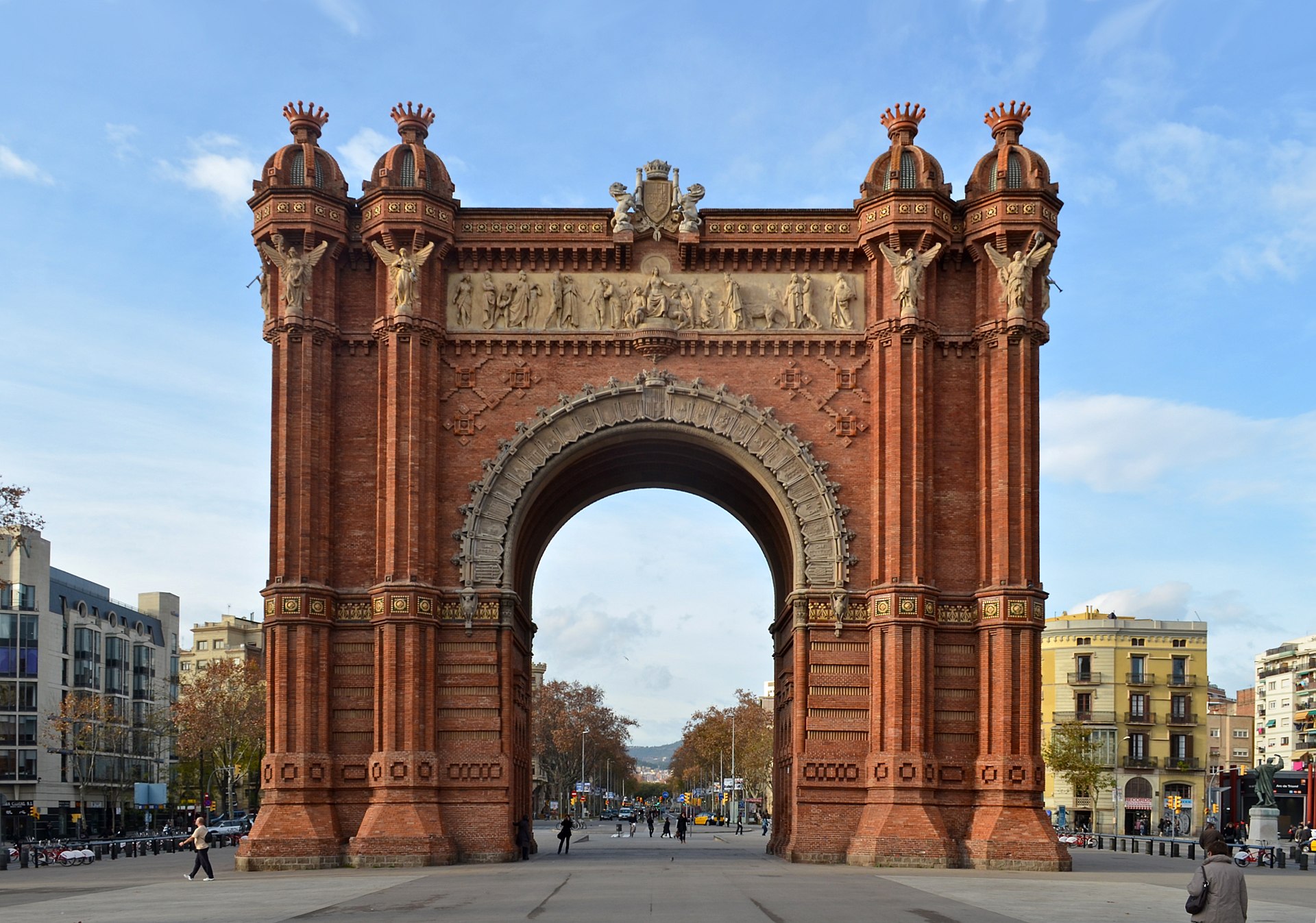
The Arc de Triomf is a monumental arch located in Barcelona, Spain, designed by the architect Josep Vilaseca i Casanovas. It was constructed as the main access gate for the 1888 Barcelona Universal Exposition, serving as a grand entrance to the fairgrounds located in the Parc de la Ciutadella.
Unlike many other triumphal arches which are built to commemorate military victories, the Arc de Triomf was designed to celebrate scientific, artistic, and economic progress. The structure is built of red brick in the Neo-Mudéjar style, featuring intricate friezes and sculptures that depict allegorical representations of the city welcoming the nations of the world.
Key Facts
- Materials
- Red brick, Stone
- Civilization
- Spanish
- Accessibility
- Fully accessible at ground level
- Date(s)
- 1888
- Condition
- Well-preserved, public monument
- Original Function
- Entrance gate for the 1888 Universal Exposition
- Key Figures
- Josep Vilaseca i Casanovas, Josep Reynés, Josep Llimona
Design and Construction
1888The arch was commissioned as the gateway to the Universal Exposition of 1888. Architect Josep Vilaseca i Casanovas chose a Neo-Mudéjar style, which was highly fashionable in Spain at the time, utilizing red brick to distinguish the structure from the classical stone arches of the Roman tradition.
Universal Exposition
1888During the fair, the arch served as the primary ceremonial entrance for visitors arriving from the city center. It symbolized Barcelona's emergence as a modern, industrial, and cosmopolitan city on the international stage.
Post-Exposition Legacy
20th century - presentFollowing the conclusion of the fair, the arch remained a permanent fixture of the city's urban landscape. It has since become a central landmark for public gatherings, cultural events, and the popular promenade leading to the Parc de la Ciutadella.
Cultural Significance
The Arc de Triomf represents a pivotal moment in Barcelona's history, marking its transition into a modern European capital. Its architectural style reflects the Catalan interest in historical revivalism, specifically the influence of Islamic-inspired design, which became a hallmark of the city's unique aesthetic identity during the late 19th century.
Today, the monument serves as a symbol of civic pride and is a focal point for the city's social life. It is frequently used as a backdrop for major city festivals, marathons, and public demonstrations, maintaining its role as a gateway to the city's most prominent public park.
Interpretive Notes
Scholarly debates and areas of uncertainty
There is occasional academic discussion regarding the classification of the arch's style. While widely accepted as Neo-Mudéjar, some scholars argue that the integration of classical proportions and sculptural allegories creates a hybrid style that challenges strict categorization within the 19th-century revivalist movements.
Visiting Information
Entry Rules
The monument is located in a public pedestrian area and is accessible 24 hours a day. No tickets or entry fees are required.
Best Times to Visit
Early morning or late afternoon to avoid the midday sun and to capture the best light on the red brick facade. The area is particularly vibrant during weekend mornings when local residents gather for leisure activities.
Photography
None. The site is a public monument and photography is permitted.
Preservation Notes
The structure is maintained by the Barcelona City Council. Visitors are asked to respect the integrity of the brickwork and not to climb on the base or sculptures.
Nearby POIs
11 shown- Museu Picasso0.7 km
- Santa Maria del Mar0.8 km
- Cathedral of the Holy Cross and Saint Eulalia0.9 km
- Basilica de Santa Maria del Pi1.1 km
- Casa Batllo1.3 km
- Design Museum of Barcelona1.4 km
- Palau Guell1.5 km
- Barcelona Museum of Contemporary Art1.5 km
- Basilica de la Sagrada Familia1.5 km
- Casa Mila1.7 km
- Columbus Monument1.7 km
Sources & Further Reading
- [1]Barcelona: A Thousand Years of Urban History — Manuel de Solà-Morales. Gustavo Gili (2008)
- [2]Modernisme in Catalonia — Teresa M. Sala. Edicions de la Universitat de Barcelona (2013)
Key Facts
- Materials
- Red brick, Stone
- Civilization
- Spanish
- Accessibility
- Fully accessible at ground level
- Date(s)
- 1888
- Condition
- Well-preserved, public monument
- Original Function
- Entrance gate for the 1888 Universal Exposition
- Key Figures
- Josep Vilaseca i Casanovas, Josep Reynés, Josep Llimona
Nearby POIs
11 shown- Museu Picasso0.7 km
- Santa Maria del Mar0.8 km
- Cathedral of the Holy Cross and Saint Eulalia0.9 km
- Basilica de Santa Maria del Pi1.1 km
- Casa Batllo1.3 km
- Design Museum of Barcelona1.4 km
- Palau Guell1.5 km
- Barcelona Museum of Contemporary Art1.5 km
- Basilica de la Sagrada Familia1.5 km
- Casa Mila1.7 km
- Columbus Monument1.7 km