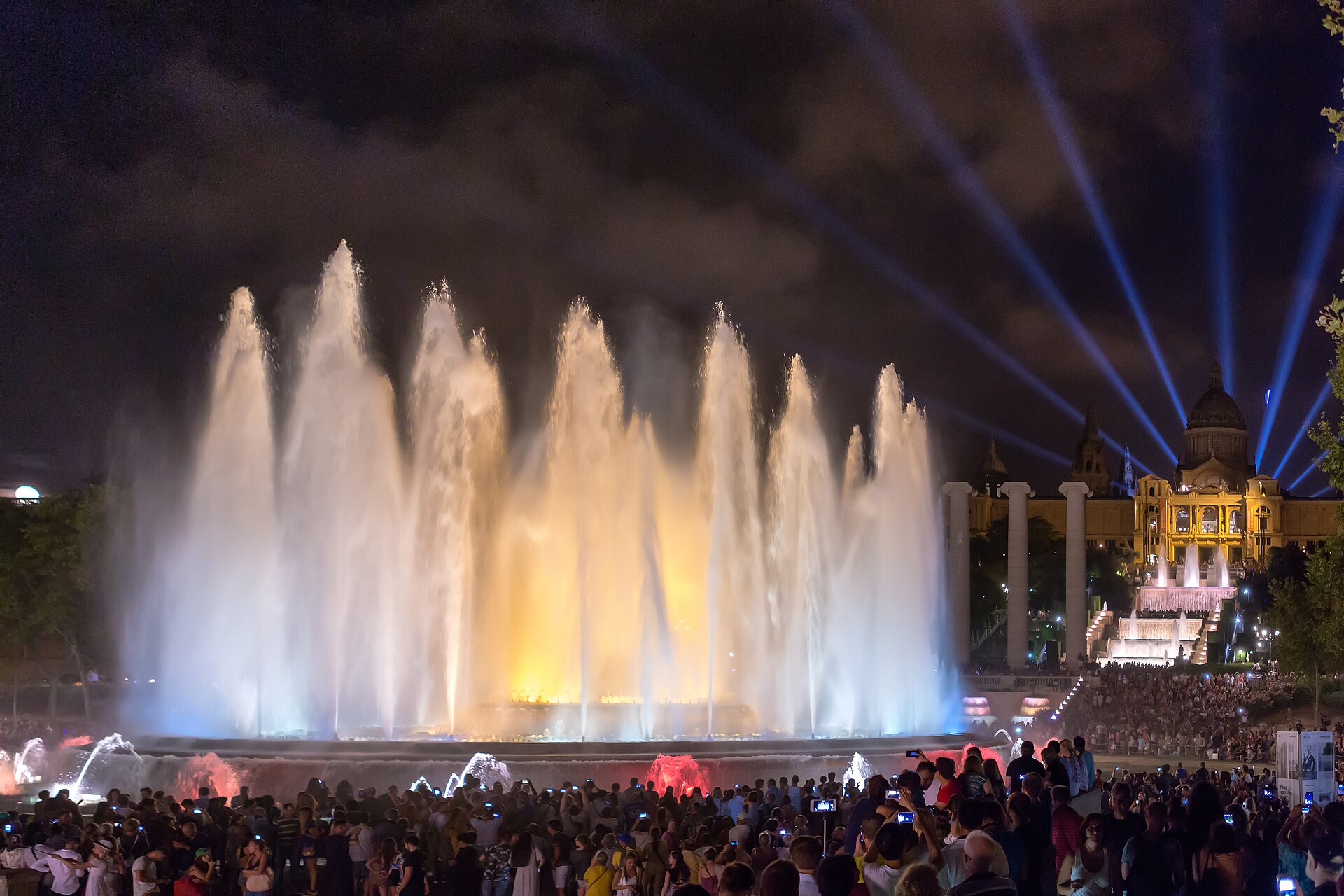
The Magic Fountain of Montjuïc is a monumental fountain located at the head of the Avinguda de la Reina Maria Cristina in the Montjuïc neighborhood of Barcelona. Designed by engineer Carles Buïgas for the 1929 Barcelona International Exposition, it was constructed on the site where the 'Four Columns' of Josep Puig i Cadafalch previously stood.
The fountain is renowned for its elaborate displays that combine water acrobatics, synchronized lighting, and musical accompaniment. It utilizes a complex system of pumps and valves to create various water shapes and movements, which are illuminated by thousands of lights to produce a dynamic visual performance.
Key Facts
- Materials
- Stone, Steel, Hydraulic systems
- Civilization
- Spanish
- Accessibility
- Wheelchair accessible via surrounding plazas
- Date(s)
- 1929
- Condition
- Active, subject to periodic maintenance and drought-related restrictions
- Original Function
- Centerpiece for the 1929 International Exposition
- Key Figures
- Carles Buïgas
Conception and Construction
1929Carles Buïgas designed the fountain as the primary attraction for the 1929 International Exposition. The project was completed in less than a year by a team of over 3,000 workers, showcasing advanced hydraulic engineering for the era.
Post-War Restoration
1940s-1950sFollowing the Spanish Civil War, the fountain suffered from neglect and damage. It underwent significant restoration in the 1950s to return the hydraulic and lighting systems to operational status.
Olympic Modernization
1992In preparation for the 1992 Summer Olympics, the fountain was fully restored and modernized. Computerized control systems were integrated to allow for more complex choreography of water and light.
Contemporary Operations
21st CenturyThe fountain remains a major tourist attraction. In recent years, operations have been occasionally suspended during severe drought conditions in Catalonia to conserve water resources.
Cultural Significance
The Magic Fountain serves as a symbol of Barcelona's ability to blend industrial engineering with artistic spectacle. It remains a focal point for major city celebrations, including the La Mercè festival, and represents the legacy of the 1929 Exposition in shaping the urban landscape of Montjuïc.
Interpretive Notes
Scholarly debates and areas of uncertainty
There is ongoing discussion regarding the balance between maintaining the fountain as a historic tourist attraction and the environmental impact of its water and energy consumption during periods of regional water scarcity.
Visiting Information
Entry Rules
Public access is free. Shows occur on a seasonal schedule; visitors are advised to check the official Barcelona City Council website for current performance times and potential drought-related closures.
Best Times to Visit
Evening hours after sunset are required to view the light and music displays. Weekdays generally offer smaller crowds than weekends.
Photography
Personal photography is permitted. Commercial filming or professional equipment setups require a permit from the city authorities.
Preservation Notes
The site is a protected monument. Visitors should remain behind safety barriers during shows and avoid entering the fountain basin.
Nearby POIs
11 shown- Museu Nacional d'Art de Catalunya0.3 km
- Poble Espanyol0.4 km
- Barcelona Museum of Contemporary Art1.8 km
- Palau Guell2.1 km
- Maritime Museum of Barcelona2.1 km
- Basilica de Santa Maria del Pi2.2 km
- Columbus Monument2.2 km
- Casa Batllo2.5 km
- Cathedral of the Holy Cross and Saint Eulalia2.5 km
- FC Barcelona Museum2.8 km
- Casa Mila2.8 km
Sources & Further Reading
- [1]Carles Buïgas: L'enginyer de la llum i l'aigua — Miquel Carandell. Barcelona City Council (2012)View
- [2]The 1929 Barcelona International Exposition: Urban Transformation — Joan Ramon Triadó. Universitat de Barcelona (2005)
Key Facts
- Materials
- Stone, Steel, Hydraulic systems
- Civilization
- Spanish
- Accessibility
- Wheelchair accessible via surrounding plazas
- Date(s)
- 1929
- Condition
- Active, subject to periodic maintenance and drought-related restrictions
- Original Function
- Centerpiece for the 1929 International Exposition
- Key Figures
- Carles Buïgas
Nearby POIs
11 shown- Museu Nacional d'Art de Catalunya0.3 km
- Poble Espanyol0.4 km
- Barcelona Museum of Contemporary Art1.8 km
- Palau Guell2.1 km
- Maritime Museum of Barcelona2.1 km
- Basilica de Santa Maria del Pi2.2 km
- Columbus Monument2.2 km
- Casa Batllo2.5 km
- Cathedral of the Holy Cross and Saint Eulalia2.5 km
- FC Barcelona Museum2.8 km
- Casa Mila2.8 km