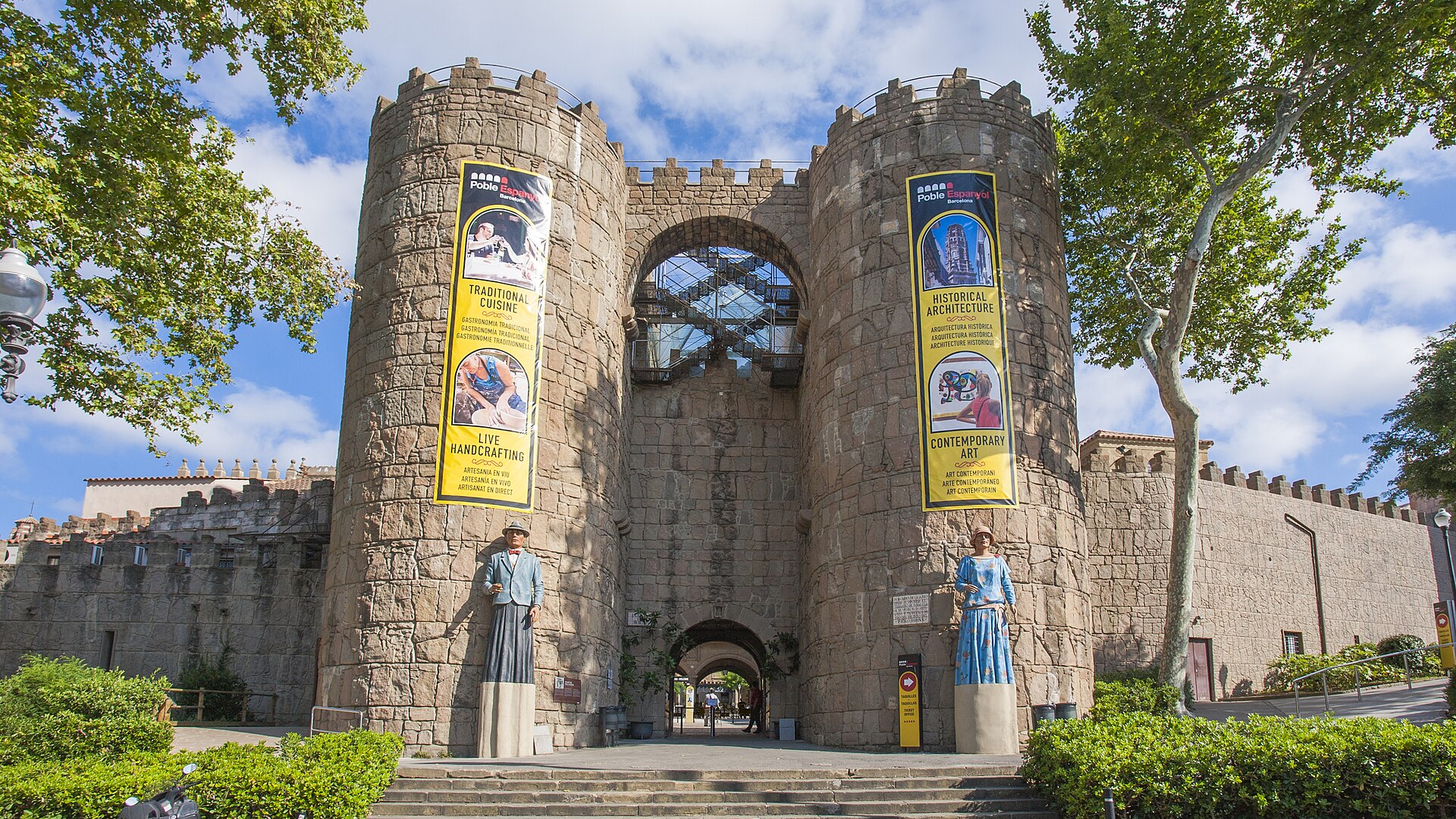
Poble Espanyol is an open-air architectural museum located on the Montjuïc hill in Barcelona. Constructed for the 1929 International Exposition, the site was designed to showcase the diversity of Spanish architectural styles within a single, cohesive urban environment. It features 117 full-scale replicas of buildings, squares, and streets from various regions of Spain, creating a simulated village atmosphere.
The complex was intended to be a temporary exhibit but was preserved due to its popularity. Today, it functions as a cultural and commercial center, housing numerous artisan workshops, craft shops, restaurants, and event spaces. It serves as a permanent exhibition of traditional Spanish construction techniques and regional aesthetics.
Key Facts
- Materials
- Stone, Brick, Wood, Stucco
- Civilization
- Spanish
- Accessibility
- Partially accessible; some cobblestone streets and inclines
- Date(s)
- 1929
- Condition
- Well-maintained, active cultural center
- Original Function
- Exhibition pavilion for the 1929 International Exposition
- Key Figures
- Josep Puig i Cadafalch, Francesc Folguera, Ramon Reventós
Conception and Design
1927-1929The project was commissioned by the Barcelona City Council for the 1929 International Exposition. Architects Francesc Folguera and Ramon Reventós, along with artist Xavier Nogués and architect Miquel Utrillo, traveled across Spain to document and select representative architectural examples to replicate.
Construction
1929Construction was completed in just 13 months. The team aimed to capture the 'soul' of Spanish architecture by creating a synthesis of styles, including Romanesque, Gothic, Renaissance, and Mudéjar, arranged to mimic the layout of a traditional Iberian town.
Post-Exposition Preservation
1930-1980sAlthough originally slated for demolition after the Exposition, the site's success led to its preservation. Throughout the mid-20th century, it evolved from a static exhibition into a hub for local artisans, preserving traditional crafts that were otherwise in decline.
Modern Era
1990s-PresentThe site has undergone several renovations to modernize its facilities while maintaining its historical aesthetic. It currently hosts a mix of contemporary art galleries, including the Fran Daurel Foundation, and remains a significant venue for concerts and cultural festivals in Barcelona.
Cultural Significance
Poble Espanyol represents a unique attempt to consolidate the architectural heritage of a nation into a single, walkable space. It serves as a physical archive of regional styles that might otherwise be geographically inaccessible to the average visitor.
Culturally, the site has become a vital center for the preservation of traditional Spanish craftsmanship. By providing space for glassblowers, leatherworkers, and jewelers, it bridges the gap between historical architecture and living, contemporary artistic practice.
Interpretive Notes
Scholarly debates and areas of uncertainty
The site is occasionally discussed in the context of 'invented tradition' and the political climate of the 1920s, with some scholars debating whether the selection of buildings promoted a monolithic view of Spanish identity at the expense of regional nuance.
Visiting Information
Entry Rules
Ticketed entry required. Open daily with varying hours depending on the season and scheduled events. No specific dress code, though comfortable footwear is recommended due to the cobblestone surfaces.
Best Times to Visit
Weekday mornings to avoid large tour groups. Late afternoon is ideal for experiencing the lighting of the squares and the transition into evening dining.
Photography
Personal photography is permitted. Commercial photography or professional filming requires prior authorization from the site management.
Preservation Notes
The site is a protected architectural complex. Visitors are asked to respect the artisan workshops and refrain from climbing on building facades or historical structures.
Nearby POIs
11 shown- Magic Fountain of Montjuic0.4 km
- Museu Nacional d'Art de Catalunya0.4 km
- Barcelona Museum of Contemporary Art2.2 km
- Maritime Museum of Barcelona2.4 km
- Palau Guell2.5 km
- Columbus Monument2.6 km
- Basilica de Santa Maria del Pi2.6 km
- FC Barcelona Museum2.7 km
- Casa Batllo2.9 km
- Cathedral of the Holy Cross and Saint Eulalia2.9 km
- Casa Mila3.2 km
Sources & Further Reading
- [1]Poble Espanyol de Barcelona: Guía de arquitectura — Miquel Utrillo. Barcelona City Council Archives (1929)
- [2]The 1929 Barcelona International Exposition: Architecture and Urbanism — Josep Maria Montaner. Editorial Gustavo Gili (2005)
Key Facts
- Materials
- Stone, Brick, Wood, Stucco
- Civilization
- Spanish
- Accessibility
- Partially accessible; some cobblestone streets and inclines
- Date(s)
- 1929
- Condition
- Well-maintained, active cultural center
- Original Function
- Exhibition pavilion for the 1929 International Exposition
- Key Figures
- Josep Puig i Cadafalch, Francesc Folguera, Ramon Reventós
Nearby POIs
11 shown- Magic Fountain of Montjuic0.4 km
- Museu Nacional d'Art de Catalunya0.4 km
- Barcelona Museum of Contemporary Art2.2 km
- Maritime Museum of Barcelona2.4 km
- Palau Guell2.5 km
- Columbus Monument2.6 km
- Basilica de Santa Maria del Pi2.6 km
- FC Barcelona Museum2.7 km
- Casa Batllo2.9 km
- Cathedral of the Holy Cross and Saint Eulalia2.9 km
- Casa Mila3.2 km