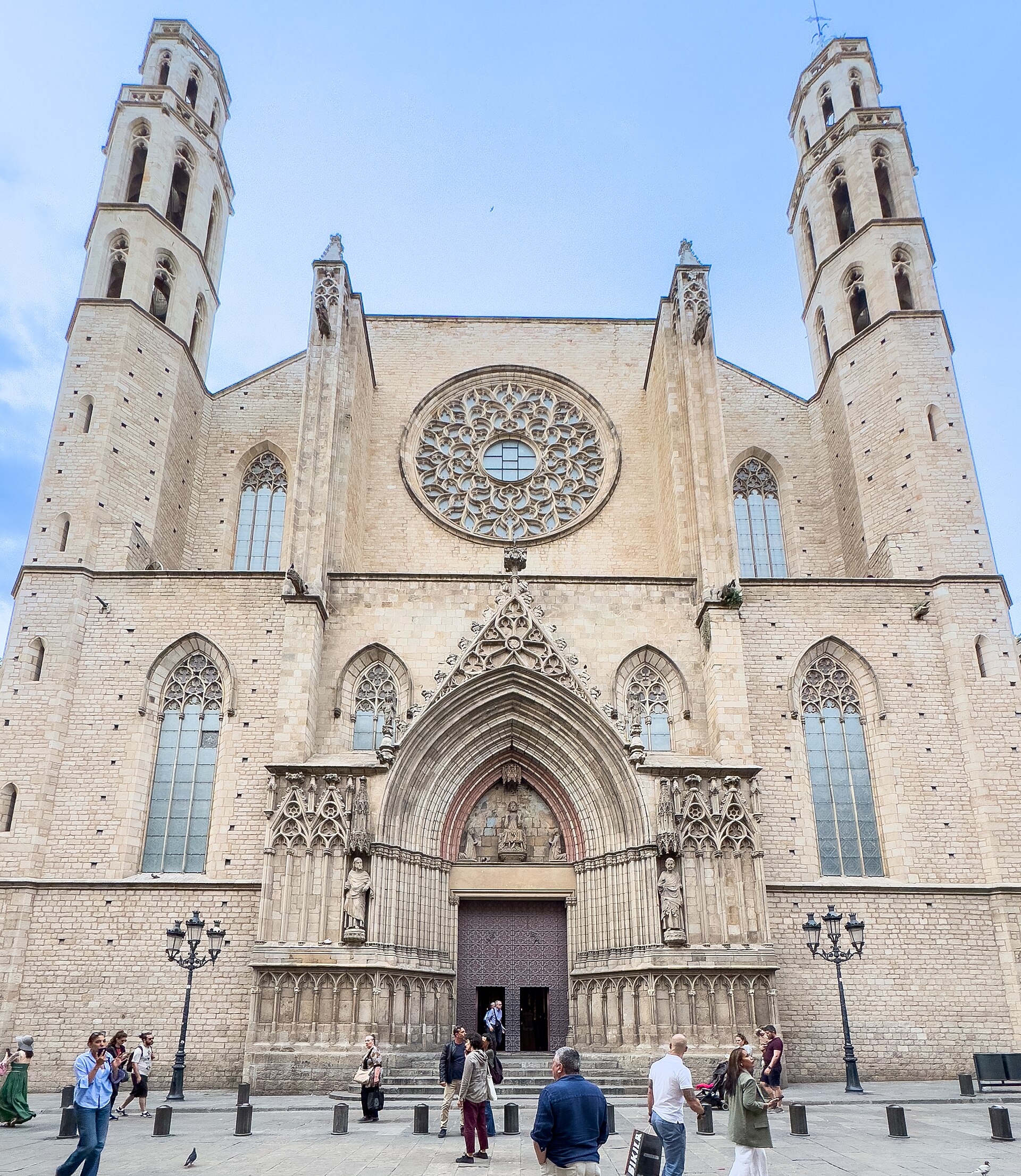
Santa Maria del Mar is a prominent example of Catalan Gothic architecture, located in the Ribera district of Barcelona. Constructed between 1329 and 1383, the church is celebrated for its architectural purity and structural unity, a rarity among large-scale medieval religious buildings. It was built primarily through the contributions of the local maritime community, reflecting the wealth and influence of the medieval port district.
The interior is characterized by a wide nave and slender, soaring columns that create a sense of expansive, unified space. Unlike many other Gothic structures of the era, the church lacks a transept and features a relatively simple exterior, emphasizing the geometric harmony of its design. It remains a significant cultural landmark and a testament to the craftsmanship of the 14th-century Catalan builders.
Key Facts
- Materials
- Montjuïc stone
- Civilization
- Catalan
- Accessibility
- Ground level accessible, limited access to upper galleries
- Date(s)
- 1329-1383
- Condition
- Well-preserved, active place of worship
- Original Function
- Parish church for the maritime and merchant guilds
- Key Figures
- Berenguer de Montagut, Ramon Despuig
Origins and Construction
14th CenturyThe church was built on the site of an earlier chapel dedicated to the Virgin Mary. Construction began in 1329 under the direction of architect Berenguer de Montagut. The project was funded largely by the local sailors and merchants of the Ribera district, who provided both financial support and manual labor to transport stone from the Montjuïc quarries.
Completion and Interior
1383The final stone was laid in 1383, marking the completion of the structure in a remarkably short period for a building of its size. The interior design, characterized by its wide central nave and lack of a transept, was completed with a focus on spatial unity and light, distinguishing it from the more complex French Gothic style.
Civil War and Restoration
20th CenturyDuring the Spanish Civil War in 1936, the church suffered significant damage, including the destruction of its original 18th-century Baroque altar and the loss of many interior furnishings due to fire. Subsequent restoration efforts in the mid-20th century focused on cleaning the stone and repairing the structural integrity of the vaults.
Cultural Significance
Santa Maria del Mar is deeply tied to the identity of the Ribera district and the maritime history of Barcelona. Historically, it served as the parish church for the sailors and dockworkers, symbolizing the economic prosperity of the city during the Middle Ages.
In contemporary culture, the church gained international recognition as the setting for Ildefonso Falcones' novel 'Cathedral of the Sea,' which dramatized the construction of the building. It remains a focal point for local community life and a primary example of the 'Catalan Gothic' style, which emphasizes horizontal lines and spatial breadth over the verticality typical of Northern European Gothic.
Interpretive Notes
Scholarly debates and areas of uncertainty
Scholars often debate the extent to which the church's design was influenced by the specific socio-economic conditions of the 14th-century merchant class versus purely aesthetic architectural trends. Additionally, there is ongoing discussion regarding the original polychromy of the interior and the extent to which the current 'stripped' stone appearance reflects the medieval intent.
Visiting Information
Entry Rules
Open daily for visitors. Entry is free for worship, but a ticket is required for tourist visits and access to the rooftop terraces. Modest dress is requested.
Best Times to Visit
Early morning or late afternoon to avoid peak tourist crowds. The interior lighting is particularly striking during the golden hour.
Photography
Personal photography is permitted without flash or tripods. Professional photography requires prior authorization.
Preservation Notes
The stone is sensitive to environmental pollutants. Visitors are asked to refrain from touching the columns and to remain within designated visitor areas.
Nearby POIs
11 shown- Museu Picasso0.2 km
- Cathedral of the Holy Cross and Saint Eulalia0.5 km
- Basilica de Santa Maria del Pi0.7 km
- Arc de Triomf0.8 km
- Palau Guell0.9 km
- Columbus Monument1 km
- Maritime Museum of Barcelona1.1 km
- Barcelona Museum of Contemporary Art1.3 km
- Casa Batllo1.7 km
- Casa Mila2.1 km
- Design Museum of Barcelona2.1 km
Sources & Further Reading
- [1]The Catalan Gothic: Architecture and Society — Joan Ainaud de Lasarte. Edicions 62 (1990)
- [2]Santa Maria del Mar: History and Architecture — Antoni Pladevall i Font. Editorial Mediterrània (2005)
Key Facts
- Materials
- Montjuïc stone
- Civilization
- Catalan
- Accessibility
- Ground level accessible, limited access to upper galleries
- Date(s)
- 1329-1383
- Condition
- Well-preserved, active place of worship
- Original Function
- Parish church for the maritime and merchant guilds
- Key Figures
- Berenguer de Montagut, Ramon Despuig
Nearby POIs
11 shown- Museu Picasso0.2 km
- Cathedral of the Holy Cross and Saint Eulalia0.5 km
- Basilica de Santa Maria del Pi0.7 km
- Arc de Triomf0.8 km
- Palau Guell0.9 km
- Columbus Monument1 km
- Maritime Museum of Barcelona1.1 km
- Barcelona Museum of Contemporary Art1.3 km
- Casa Batllo1.7 km
- Casa Mila2.1 km
- Design Museum of Barcelona2.1 km