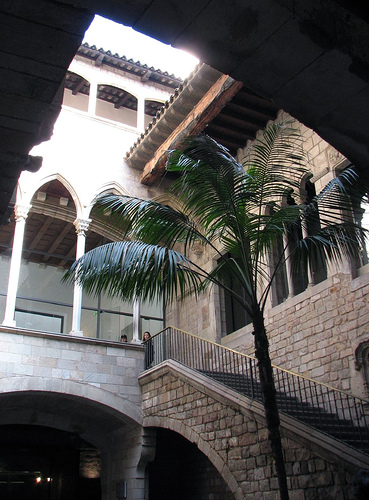
The Museu Picasso in Barcelona is a world-renowned art museum that houses one of the most extensive collections of artworks by the 20th-century Spanish artist Pablo Picasso. Located in the La Ribera district, the museum is housed within five adjoining medieval palaces, which provide a unique architectural backdrop for the display of the artist's formative years and his relationship with the city of Barcelona.
The collection comprises 4,251 works by Picasso, with a particular focus on his early life, his academic training, and his formative periods, including the Blue Period. The museum serves as a critical institution for understanding the development of Picasso's artistic style and his deep-rooted connection to Catalonia.
Key Facts
- Materials
- Stone, Brick, Wood
- Civilization
- Spanish
- Accessibility
- Fully accessible with elevators and ramps
- Date(s)
- 13th-15th century (palaces); 1963 (museum opening)
- Condition
- Well-preserved and active
- Original Function
- Private aristocratic residences
- Key Figures
- Pablo Picasso, Jaume Sabartés
The Palaces
13th-15th centuryThe museum occupies five large townhouses or palaces in the Montcada street, a historic area of Barcelona. These buildings, such as the Palau Aguilar and Palau Baró de Castellet, represent the Catalan Gothic style and were originally built for the city's merchant and noble classes.
Foundation of the Museum
1963The museum was established following the initiative of Jaume Sabartés, Picasso's close friend and personal secretary, who donated his personal collection to the city of Barcelona. Picasso himself supported the project and later donated significant works to the collection.
Expansion and Growth
1970s-2000sFollowing Picasso's death in 1973, the museum received further donations from his widow, Jacqueline Roque. The museum underwent several expansions, incorporating adjacent palaces to accommodate the growing collection and to provide space for temporary exhibitions and research.
Cultural Significance
The Museu Picasso is a cornerstone of Barcelona's cultural landscape, symbolizing the city's role in the development of modern art. It highlights the formative years of one of the most influential artists of the 20th century, grounding his global legacy in the specific social and artistic context of Barcelona.
Beyond its collection, the museum acts as a center for research and education, fostering a deeper understanding of Picasso's creative process. It remains a primary site for scholars and art enthusiasts to study the evolution of modernism and the artist's lifelong dialogue with traditional and avant-garde forms.
Interpretive Notes
Scholarly debates and areas of uncertainty
Debates often center on the museum's focus on Picasso's early works versus his later, more radical periods. Some scholars argue that the collection's heavy emphasis on his formative years provides a limited view of his total artistic output, while others maintain that these works are essential for understanding the foundations of his later innovations.
Visiting Information
Entry Rules
Open Tuesday to Sunday. Tickets should be booked online in advance to ensure entry, as time slots frequently sell out. Free entry is available during specific weekly time windows and on the first Sunday of every month.
Best Times to Visit
Weekday mornings are generally less crowded. Avoid weekends and public holidays if possible to ensure a more comfortable viewing experience.
Photography
Photography is permitted for personal use without flash or tripods. Professional photography or filming requires prior authorization from the museum administration.
Preservation Notes
Maintain a respectful distance from all artworks. Large bags and backpacks must be stored in the provided lockers. Flash photography is strictly prohibited to prevent light damage to the canvases.
Nearby POIs
11 shown- Santa Maria del Mar0.2 km
- Cathedral of the Holy Cross and Saint Eulalia0.4 km
- Arc de Triomf0.7 km
- Basilica de Santa Maria del Pi0.7 km
- Palau Guell0.9 km
- Columbus Monument1.1 km
- Maritime Museum of Barcelona1.2 km
- Barcelona Museum of Contemporary Art1.2 km
- Casa Batllo1.6 km
- Casa Mila2 km
- Design Museum of Barcelona2 km
Sources & Further Reading
- [1]
- [2]Picasso and Barcelona — Claustre Rafart i Planas. Editorial Mediterrània (2003)
Key Facts
- Materials
- Stone, Brick, Wood
- Civilization
- Spanish
- Accessibility
- Fully accessible with elevators and ramps
- Date(s)
- 13th-15th century (palaces); 1963 (museum opening)
- Condition
- Well-preserved and active
- Original Function
- Private aristocratic residences
- Key Figures
- Pablo Picasso, Jaume Sabartés
Nearby POIs
11 shown- Santa Maria del Mar0.2 km
- Cathedral of the Holy Cross and Saint Eulalia0.4 km
- Arc de Triomf0.7 km
- Basilica de Santa Maria del Pi0.7 km
- Palau Guell0.9 km
- Columbus Monument1.1 km
- Maritime Museum of Barcelona1.2 km
- Barcelona Museum of Contemporary Art1.2 km
- Casa Batllo1.6 km
- Casa Mila2 km
- Design Museum of Barcelona2 km