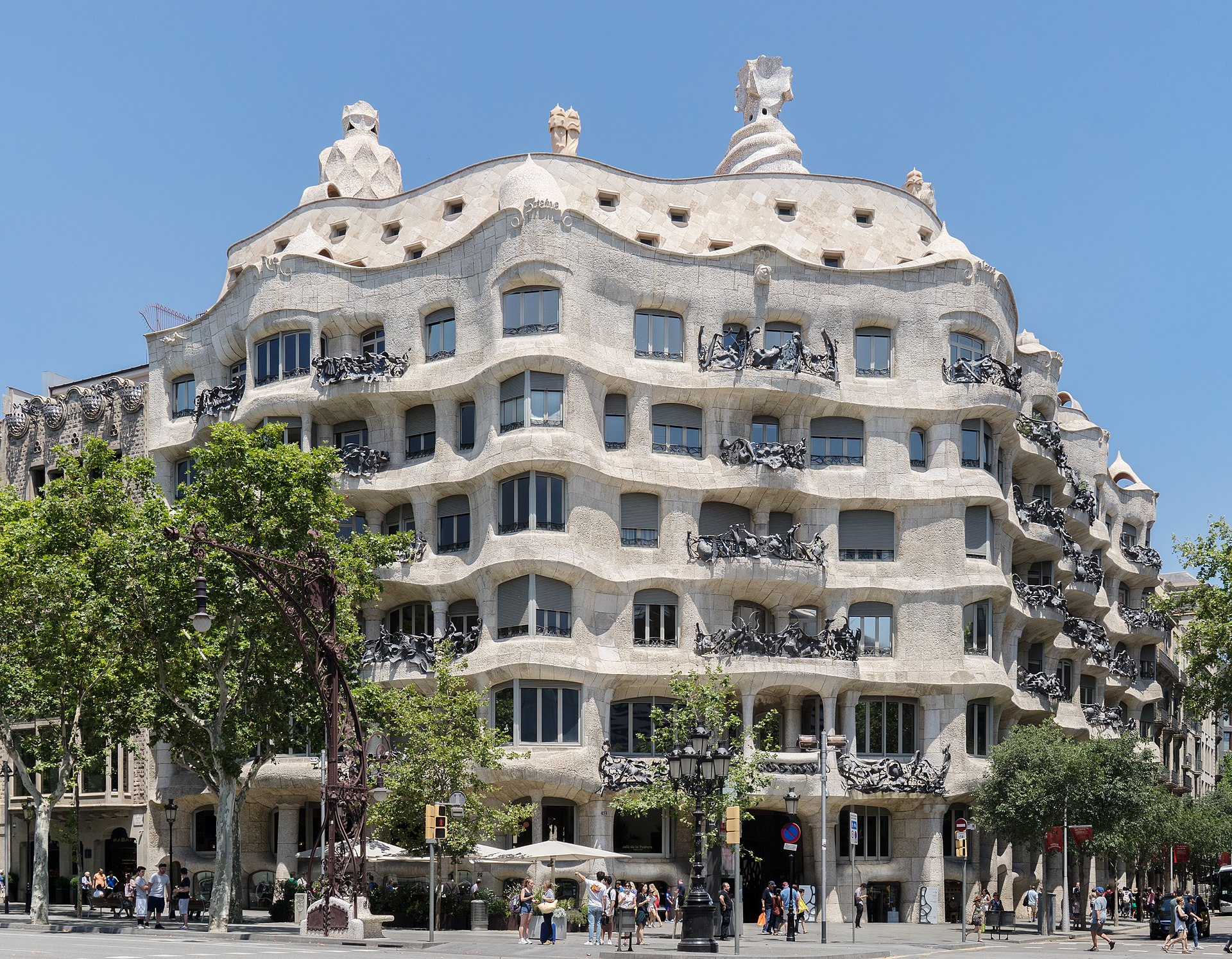
Casa Milà, popularly known as La Pedrera, is a modernist building in Barcelona, Catalonia, Spain. Designed by the architect Antoni Gaudí and built between 1906 and 1912 for the couple Roser Segimon and Pere Milà, it was the last private residence designed by the architect before he dedicated his life to the Sagrada Família.
The structure is renowned for its undulating stone façade and twisting wrought iron balconies, which evoke the appearance of an open quarry. The building features an innovative self-supporting stone facade, an open floor plan, and a spectacular rooftop terrace adorned with sculptural chimneys and ventilation towers that have become iconic symbols of Gaudí's organic architectural style.
Key Facts
- Materials
- Stone, Wrought iron, Ceramic tiles, Steel
- Civilization
- Catalan Modernism
- Accessibility
- Fully accessible with elevators
- Date(s)
- 1906-1912
- Condition
- Well-preserved, cultural center and museum
- Original Function
- Residential apartment building
- Key Figures
- Antoni Gaudí, Pere Milà, Roser Segimon
Commission and Design
1905-1906Pere Milà and Roser Segimon commissioned Gaudí to build a new residence on the Passeig de Gràcia. Gaudí envisioned a structure that broke away from traditional architectural constraints, utilizing a revolutionary steel structure and self-supporting stone facade.
Construction Challenges
1906-1912The project faced significant controversy during construction due to its unconventional design and height, which exceeded local building codes. Gaudí faced legal disputes and fines, and the project was eventually completed with modifications to the original plans.
Post-Construction and Decline
1912-1980sFollowing its completion, the building served as a luxury apartment complex. Over the decades, it underwent various interior modifications and faced periods of neglect, losing some of its original decorative elements.
Restoration and UNESCO Status
1984-PresentIn 1984, Casa Milà was declared a UNESCO World Heritage site. Extensive restoration efforts were undertaken to return the building to its original state, and it was opened to the public as a cultural center and museum, managed by the Fundació Catalunya La Pedrera.
Cultural Significance
Casa Milà represents the pinnacle of Gaudí's secular architecture and the culmination of the Catalan Modernisme movement. It is a testament to the architect's ability to integrate structural engineering with natural, organic forms, influencing generations of architects worldwide.
Today, it serves as a cornerstone of Barcelona's cultural identity, attracting millions of visitors who seek to understand the intersection of art, nature, and urban living in early 20th-century Spain.
Interpretive Notes
Scholarly debates and areas of uncertainty
There is ongoing academic discussion regarding the extent to which Gaudí's assistants, such as Josep Maria Jujol, contributed to the design of the ironwork and interior details. Additionally, the original intended symbolism of the rooftop chimneys remains a subject of interpretation, with theories ranging from religious iconography to purely functionalist sculptural forms.
Visiting Information
Entry Rules
Open daily for tours. Tickets are required and should be booked in advance online to ensure entry. Visitors are requested to follow marked paths and respect the residential areas that remain in use.
Best Times to Visit
Early morning or late afternoon to avoid peak tourist crowds. The rooftop is particularly notable during sunset.
Photography
Personal photography is permitted. Professional or commercial photography requires prior authorization from the foundation.
Preservation Notes
The building is a protected monument. Visitors must not touch the stone surfaces or decorative elements. Restoration work is ongoing to maintain the integrity of the facade and the rooftop sculptures.
Nearby POIs
11 shown- Casa Batllo0.5 km
- Casa Vicens1.3 km
- Basilica de la Sagrada Familia1.4 km
- Barcelona Museum of Contemporary Art1.4 km
- Arc de Triomf1.7 km
- Cathedral of the Holy Cross and Saint Eulalia1.8 km
- Basilica de Santa Maria del Pi1.8 km
- Museu Picasso2 km
- Palau Guell2.1 km
- Santa Maria del Mar2.1 km
- Gaudi House Museum2.2 km
Sources & Further Reading
- [1]Gaudí: The Complete Works — Rainer Zerbst. Taschen (2002)
- [2]La Pedrera: Architecture and History — Fundació Catalunya La Pedrera. Official Museum Publication (2020)View
Key Facts
- Materials
- Stone, Wrought iron, Ceramic tiles, Steel
- Civilization
- Catalan Modernism
- Accessibility
- Fully accessible with elevators
- Date(s)
- 1906-1912
- Condition
- Well-preserved, cultural center and museum
- Original Function
- Residential apartment building
- Key Figures
- Antoni Gaudí, Pere Milà, Roser Segimon
Nearby POIs
11 shown- Casa Batllo0.5 km
- Casa Vicens1.3 km
- Basilica de la Sagrada Familia1.4 km
- Barcelona Museum of Contemporary Art1.4 km
- Arc de Triomf1.7 km
- Cathedral of the Holy Cross and Saint Eulalia1.8 km
- Basilica de Santa Maria del Pi1.8 km
- Museu Picasso2 km
- Palau Guell2.1 km
- Santa Maria del Mar2.1 km
- Gaudi House Museum2.2 km