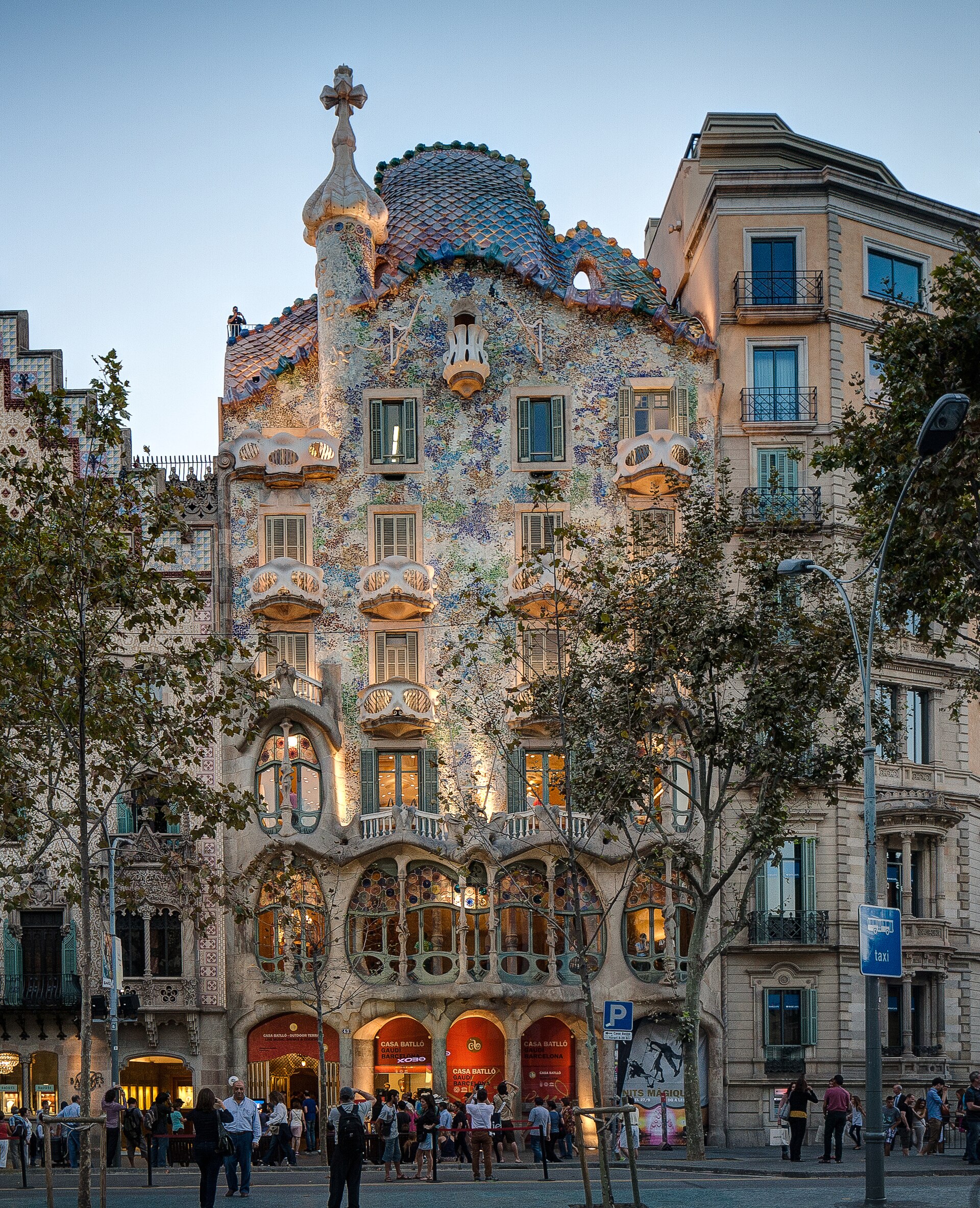
Casa Batlló is a renowned residential building located in the heart of Barcelona, redesigned by the architect Antoni Gaudí between 1904 and 1906. Commissioned by the textile industrialist Josep Batlló, the project involved a radical renovation of an existing 1877 structure, resulting in one of the most significant examples of Catalan Modernism.
The building is celebrated for its highly unconventional design, characterized by an absence of straight lines, the use of organic shapes, and a vibrant, polychromatic façade adorned with trencadís—a mosaic technique using broken ceramic tiles. The interior reflects Gaudí's mastery of light, ventilation, and ergonomic design, serving as a testament to his unique architectural vision.
Key Facts
- Materials
- Stone, Iron, Ceramic, Glass, Wood
- Civilization
- Catalan
- Accessibility
- Wheelchair accessible with elevator access to most floors
- Date(s)
- 1904-1906
- Condition
- Restored and open as a museum
- Original Function
- Residential apartment building
- Key Figures
- Antoni Gaudí, Josep Batlló, Josep Maria Jujol
Original Construction
1877The original building was constructed in 1877 by Emilio Sala Cortés, one of Gaudí's professors. It was a conventional, classical structure typical of the Eixample district at the time.
Gaudí's Renovation
1904-1906Josep Batlló purchased the building and commissioned Gaudí to redesign it. Gaudí essentially rebuilt the façade, redesigned the interior layout, expanded the patio, and added a new floor, transforming the building into an iconic work of art.
Ownership and Preservation
1954-PresentThe Batlló family sold the building in 1954. It was acquired by the insurance company Seguros Iberia and later by the Bernat family in 1993, who undertook extensive restoration efforts to return the building to its original splendor.
Cultural Significance
Casa Batlló is a cornerstone of Barcelona's cultural identity and a primary example of the Modernisme movement. It represents the intersection of industrial wealth, artistic freedom, and the Catalan Renaixença, reflecting the city's transformation into a modern European capital at the turn of the 20th century.
Beyond its architectural merit, the building is a symbol of Gaudí's influence on global design. Its inclusion as a UNESCO World Heritage site underscores its status as a masterpiece of human creative genius, attracting millions of visitors annually who seek to understand the evolution of organic architecture.
Interpretive Notes
Scholarly debates and areas of uncertainty
There is ongoing academic discussion regarding the symbolic interpretation of the façade. While popular culture often refers to the roof as the back of a dragon and the balconies as masks or skulls, some scholars argue these interpretations are retrospective projections rather than Gaudí's original intent, suggesting instead that the forms are purely functional responses to light and ventilation.
Visiting Information
Entry Rules
Open daily. Tickets must be purchased in advance online to guarantee entry. Visitors are encouraged to follow the designated route through the house.
Best Times to Visit
Early morning or late afternoon to avoid peak tourist crowds. Weekdays generally offer a quieter experience than weekends.
Photography
Personal photography is permitted. Professional photography or filming requires prior authorization from the management.
Preservation Notes
The building is a protected heritage site. Visitors must refrain from touching the walls, decorative elements, or furniture. Use of the provided audio guide is recommended to understand the preservation efforts.
Nearby POIs
11 shown- Casa Mila0.5 km
- Barcelona Museum of Contemporary Art1 km
- Cathedral of the Holy Cross and Saint Eulalia1.3 km
- Basilica de Santa Maria del Pi1.3 km
- Arc de Triomf1.3 km
- Museu Picasso1.6 km
- Basilica de la Sagrada Familia1.6 km
- Palau Guell1.6 km
- Santa Maria del Mar1.7 km
- Casa Vicens1.8 km
- Maritime Museum of Barcelona2 km
Sources & Further Reading
- [1]
- [2]Antoni Gaudí: Complete Works — Rainer Zerbst. Taschen (2002)
Key Facts
- Materials
- Stone, Iron, Ceramic, Glass, Wood
- Civilization
- Catalan
- Accessibility
- Wheelchair accessible with elevator access to most floors
- Date(s)
- 1904-1906
- Condition
- Restored and open as a museum
- Original Function
- Residential apartment building
- Key Figures
- Antoni Gaudí, Josep Batlló, Josep Maria Jujol
Nearby POIs
11 shown- Casa Mila0.5 km
- Barcelona Museum of Contemporary Art1 km
- Cathedral of the Holy Cross and Saint Eulalia1.3 km
- Basilica de Santa Maria del Pi1.3 km
- Arc de Triomf1.3 km
- Museu Picasso1.6 km
- Basilica de la Sagrada Familia1.6 km
- Palau Guell1.6 km
- Santa Maria del Mar1.7 km
- Casa Vicens1.8 km
- Maritime Museum of Barcelona2 km