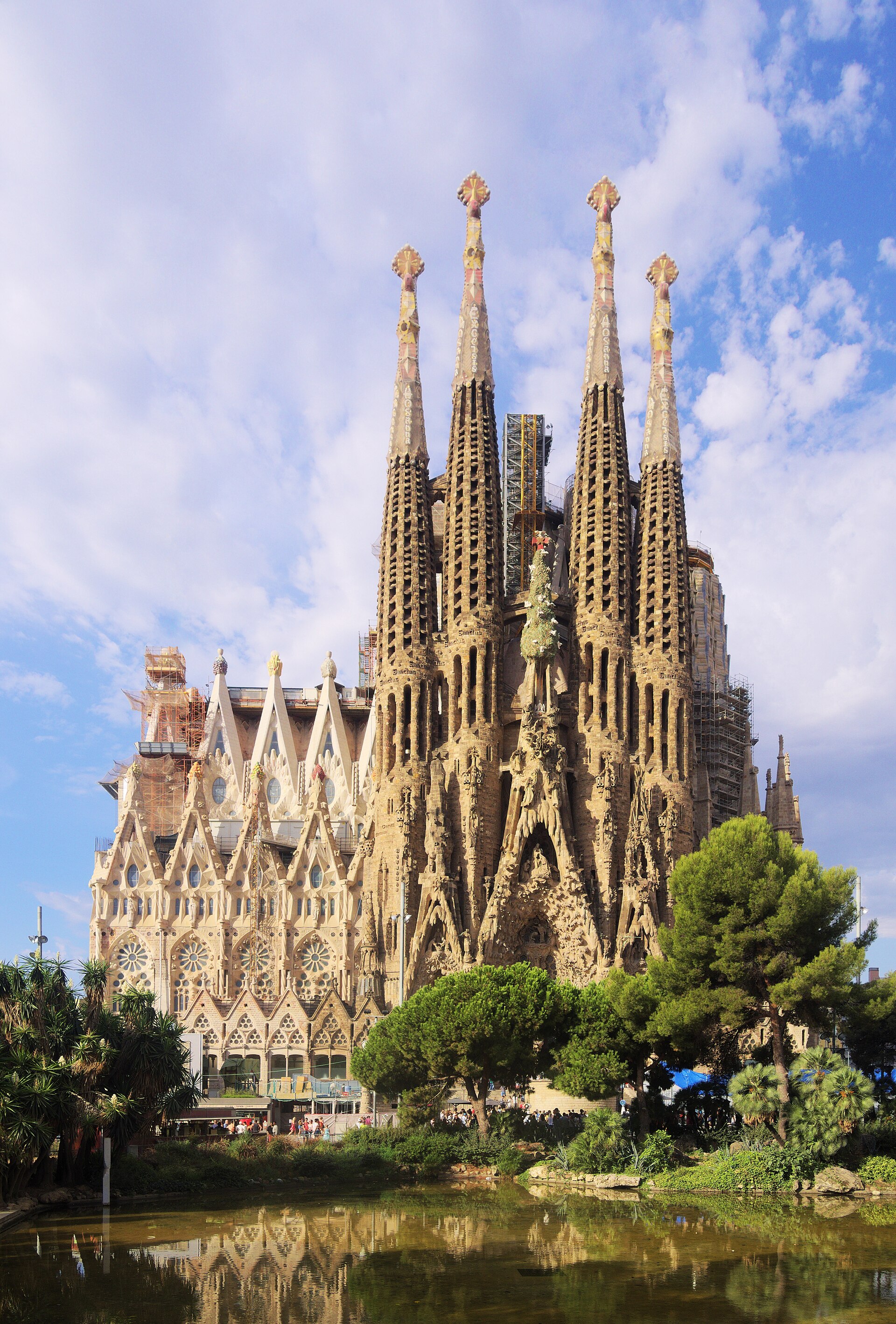
The Basílica de la Sagrada Família is a large Roman Catholic basilica in Barcelona designed by architect Antoni Gaudí. Construction began in 1882 and continues into the 21st century, making it one of the longest-running architectural projects in Europe. The structure combines Gothic and Art Nouveau forms within the Catalan Modernisme movement. Its design incorporates symbolic façades, hyperboloid vaults, and sculptural programs representing scenes from the life of Christ. The basilica was consecrated in 2010 and functions as an active place of worship.
Key Facts
- Materials
- Stone, Reinforced concrete, Ceramic, Glass
- Civilization
- Catalan Modernisme
- Accessibility
- Wheelchair accessible in main areas; towers require stairs or elevator
- Date(s)
- 1882-present
- Condition
- Under construction; active basilica
- Original Function
- Expiatory temple dedicated to the Holy Family
- Key Figures
- Antoni Gaudi, Josep Maria Bocabella
- Architectural Style
- Catalan Modernisme
Foundation and Early Construction
1882-1883Construction began in 1882 under architect Francisco de Paula del Villar. After Villar’s resignation, Antoni Gaudi assumed leadership in 1883 and radically transformed the project’s design into a highly symbolic and structurally innovative basilica.
Gaudi’s Vision
1883-1926Gaudi dedicated the final decades of his life to the project. He developed a complex symbolic program incorporating Christian theology, natural forms, and structural experimentation. At the time of his death in 1926, only the Nativity Façade was substantially complete.
Interruption and Continuation
1936-2000During the Spanish Civil War, parts of Gaudi’s workshop and models were destroyed. Construction resumed gradually in the mid-20th century, guided by surviving drawings and reconstructions of Gaudi’s plans.
21st-Century Construction
2000-presentModern technologies, including digital modeling and prefabrication, accelerated construction. The basilica was consecrated by Pope Benedict XVI in 2010. Completion of the central towers is projected in the coming decades.
Cultural Significance
The Basílica de la Sagrada Família represents the most ambitious project of Catalan Modernisme and serves as a defining symbol of Barcelona. Gaudi’s integration of geometry, theology, and natural forms has made the structure a central case study in modern architectural history. Beyond architecture, the building reflects devotional patronage, civic identity, and the evolving relationship between tradition and innovation. It continues to shape Barcelona’s global cultural image.
Interpretive Notes
Scholarly debates and areas of uncertainty
Scholars debate the extent to which current construction reflects Gaudi’s original intentions, particularly where digital tools and contemporary materials are employed. Questions also arise regarding authenticity, authorship, and the philosophical implications of completing a design posthumously.
Visiting Information
Entry Rules
Open daily; advance online ticket purchase recommended. Entry timed by reservation slot. Modest dress required. Separate tickets required for tower access.
Best Times to Visit
Early morning time slots offer lower crowd density. Weekdays outside peak summer months allow quieter interior viewing. Religious services may restrict tourist access.
Photography
Personal photography permitted without tripods. Commercial photography and drones require prior authorization.
Preservation Notes
Do not touch sculptures or stained glass. Follow designated visitor routes. Construction areas are restricted for safety reasons.
Nearby POIs
11 shownSources & Further Reading
- [1]
- [2]Gaudi — Gijs van Hensbergen. HarperCollins (2001)
- [3]The Architecture of Antoni Gaudi — Juan Bassegoda Nonell. Abbeville Press (1984)
Key Facts
- Materials
- Stone, Reinforced concrete, Ceramic, Glass
- Civilization
- Catalan Modernisme
- Accessibility
- Wheelchair accessible in main areas; towers require stairs or elevator
- Date(s)
- 1882-present
- Condition
- Under construction; active basilica
- Original Function
- Expiatory temple dedicated to the Holy Family
- Key Figures
- Antoni Gaudi, Josep Maria Bocabella
- Architectural Style
- Catalan Modernisme