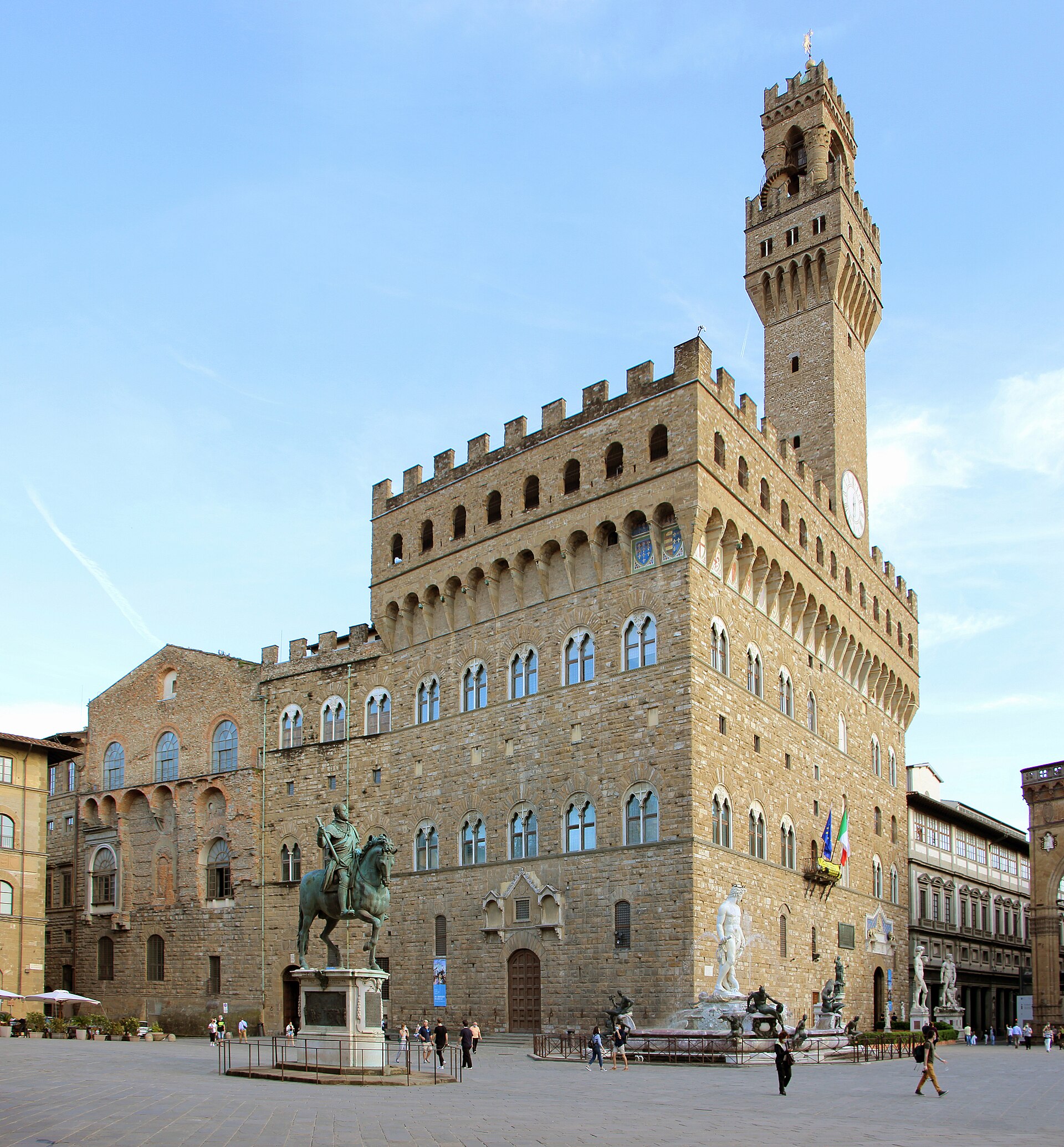
Palazzo Vecchio is the town hall of Florence and one of the most significant civic buildings in Italy. Overlooking the Piazza della Signoria, the fortress-like structure is characterized by its massive Romanesque crenellated walls and the towering Arnolfo Tower, which has served as a symbol of Florentine political power since the 14th century.
Originally constructed to house the Priors of the Guilds and the Gonfaloniere of Justice, the palace has functioned as the seat of government for centuries. Its interior features elaborate chambers, including the Salone dei Cinquecento, which houses monumental works by Giorgio Vasari and Michelangelo, reflecting the transition from medieval civic administration to the grandeur of the Medici Grand Duchy.
Key Facts
- Materials
- Pietra forte sandstone, Brick
- Civilization
- Florentine Republic
- Accessibility
- Partially accessible; elevator available for museum levels
- Date(s)
- 1299-1314
- Condition
- Well-preserved, active town hall and museum
- Original Function
- Seat of the Signoria (government)
- Key Figures
- Arnolfo di Cambio, Cosimo I de' Medici, Giorgio Vasari
Origins and Construction
1299-1314Commissioned by the Republic of Florence, the palace was designed by Arnolfo di Cambio to provide a secure residence for the city's magistrates. It was built atop the ruins of the Palazzo dei Fanti and the Palazzo dell'Esecutore di Giustizia.
The Medici Transformation
1540-1574When Cosimo I de' Medici moved his residence to the palace in 1540, he commissioned Giorgio Vasari to renovate the interior. This period saw the creation of the Studiolo of Francesco I and the expansion of the Salone dei Cinquecento.
Modern Civic Role
19th century - presentFollowing the unification of Italy, the palace served briefly as the seat of the Italian Parliament (1865-1871). Today, it continues to function as the office of the Mayor of Florence while operating as a public museum.
Cultural Significance
Palazzo Vecchio represents the historical intersection of republican ideals and autocratic rule in Florence. Its architecture, specifically the defensive design, reflects the volatile political climate of the medieval city-state, while its interior art serves as a primary record of the Medici family's influence on European culture and patronage.
Interpretive Notes
Scholarly debates and areas of uncertainty
The exact extent of Michelangelo's involvement in the design of the Salone dei Cinquecento remains a subject of academic discussion, particularly regarding his lost mural, 'The Battle of Cascina'. Additionally, the structural integrity of the Arnolfo Tower in relation to the original 13th-century foundations continues to be analyzed by architectural historians.
Visiting Information
Entry Rules
Open daily. Tickets are required for museum entry and tower access. Security screening is mandatory at the entrance. Modest dress is recommended as a sign of respect for the civic space.
Best Times to Visit
Early morning or late afternoon to avoid peak tourist crowds. Winter months offer a quieter experience for viewing the interior frescoes.
Photography
Personal photography is permitted without flash or tripods. Professional photography requires prior authorization from the municipal authorities.
Preservation Notes
The building is subject to ongoing conservation efforts to protect the 16th-century frescoes from humidity and light damage. Visitors are requested not to touch the walls or historical artifacts.
Nearby POIs
11 shownSources & Further Reading
- [1]
- [2]The Architecture of the Palazzo Vecchio — Rubinstein, Nicolai. Oxford University Press (1995)
Key Facts
- Materials
- Pietra forte sandstone, Brick
- Civilization
- Florentine Republic
- Accessibility
- Partially accessible; elevator available for museum levels
- Date(s)
- 1299-1314
- Condition
- Well-preserved, active town hall and museum
- Original Function
- Seat of the Signoria (government)
- Key Figures
- Arnolfo di Cambio, Cosimo I de' Medici, Giorgio Vasari