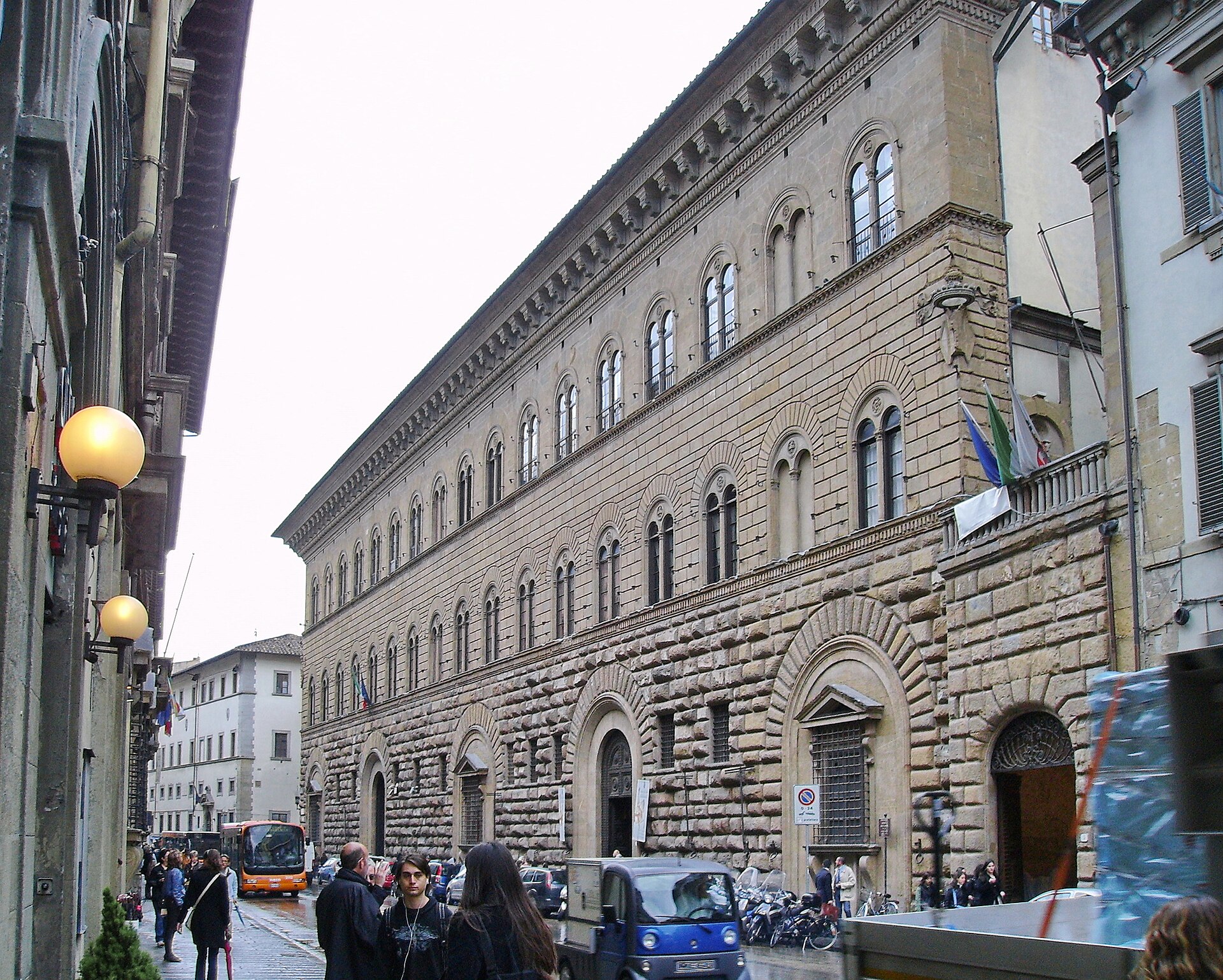
Palazzo Medici Riccardi is a Renaissance palace located in Florence, Italy, commissioned by Cosimo de' Medici, the patriarch of the Medici family. Designed by the architect Michelozzo di Bartolomeo and constructed between 1444 and 1484, the building served as the primary residence for the Medici family during the height of their political influence in the 15th century.
The structure is renowned for its tripartite facade, which utilizes rusticated masonry that transitions from heavy, rough-hewn stone at the base to smooth ashlar at the top. It houses the Chapel of the Magi, a small space decorated with elaborate frescoes by Benozzo Gozzoli, and currently serves as the administrative seat for the Metropolitan City of Florence while operating as a public museum.
Key Facts
- Materials
- Pietra forte sandstone, Brick, Marble
- Civilization
- Italian Renaissance
- Accessibility
- Partially accessible; some upper levels have limited elevator access
- Date(s)
- 1444 - 1484
- Condition
- Well-preserved, active administrative building and museum
- Original Function
- Private residence and business headquarters
- Key Figures
- Cosimo de' Medici, Michelozzo di Bartolomeo, Benozzo Gozzoli, Lorenzo the Magnificent
Commission and Design
1444-1460Cosimo de' Medici rejected an initial design by Filippo Brunelleschi, deeming it too ostentatious, and instead commissioned Michelozzo to create a more restrained palace. The design established the standard for Florentine Renaissance domestic architecture.
The Medici Residency
1460-1540The palace served as the center of political and cultural life in Florence. It hosted major figures of the era, including Donatello and Michelangelo, who lived in the household during his youth under the patronage of Lorenzo the Magnificent.
Acquisition by the Riccardi
1659-1814The Medici family sold the palace to the Riccardi family in 1659. The new owners expanded the building significantly, adding a grand gallery with ceiling frescoes by Luca Giordano and updating the interior decor to reflect Baroque tastes.
Modern Administration
1814-PresentThe palace was purchased by the Tuscan state in 1814 and later became the seat of the Prefecture and the Provincial administration. It underwent extensive restoration in the 20th century to preserve its Renaissance and Baroque features for public viewing.
Cultural Significance
The Palazzo Medici Riccardi is considered the prototype of the Renaissance urban palace. Its architectural language—balancing civic restraint with internal luxury—reflected the Medici family's complex role as private citizens who wielded de facto control over the Florentine Republic.
The chapel remains one of the most significant examples of 15th-century courtly art, blending religious devotion with portraits of the Medici family and their allies, thereby cementing their status as the preeminent dynasty of the era.
Interpretive Notes
Scholarly debates and areas of uncertainty
There is ongoing academic discussion regarding the extent of Brunelleschi's influence on the final design, despite his initial proposal being rejected. Some scholars argue that certain structural elements and the courtyard proportions suggest his influence remained present in the final execution.
Visiting Information
Entry Rules
Open daily except Wednesdays. Tickets are required for museum entry, which includes access to the Chapel of the Magi and the Luca Giordano Gallery. Security checks are mandatory at the entrance.
Best Times to Visit
Weekday mornings are recommended to avoid weekend crowds, particularly for viewing the small Chapel of the Magi, which has limited capacity.
Photography
Personal photography is permitted without flash or tripods. Professional photography requires prior authorization from the administration.
Preservation Notes
The frescoes are highly sensitive to light and humidity; visitors are requested to maintain a respectful distance and avoid touching any wall surfaces or architectural elements.
Nearby POIs
11 shown- Basilica di San Lorenzo0.1 km
- Battistero di San Giovanni0.2 km
- Duomo di Firenze0.2 km
- Museo dell'Opera del Duomo0.3 km
- Galleria dell'Accademia di Firenze0.3 km
- Museo Nazionale di San Marco0.5 km
- Basilica di Santa Maria Novella0.5 km
- Palazzo Strozzi0.5 km
- Museo Nazionale del Bargello0.6 km
- Museo Marino Marini0.6 km
- Palazzo Vecchio0.7 km
Sources & Further Reading
- [1]The Palazzo Medici Riccardi of Florence — Dale Kent. Journal of the Society of Architectural Historians (1981)View
- [2]Michelozzo and the Medici Palace — Harriet Caplow. Garland Publishing (1977)
Key Facts
- Materials
- Pietra forte sandstone, Brick, Marble
- Civilization
- Italian Renaissance
- Accessibility
- Partially accessible; some upper levels have limited elevator access
- Date(s)
- 1444 - 1484
- Condition
- Well-preserved, active administrative building and museum
- Original Function
- Private residence and business headquarters
- Key Figures
- Cosimo de' Medici, Michelozzo di Bartolomeo, Benozzo Gozzoli, Lorenzo the Magnificent
Nearby POIs
11 shown- Basilica di San Lorenzo0.1 km
- Battistero di San Giovanni0.2 km
- Duomo di Firenze0.2 km
- Museo dell'Opera del Duomo0.3 km
- Galleria dell'Accademia di Firenze0.3 km
- Museo Nazionale di San Marco0.5 km
- Basilica di Santa Maria Novella0.5 km
- Palazzo Strozzi0.5 km
- Museo Nazionale del Bargello0.6 km
- Museo Marino Marini0.6 km
- Palazzo Vecchio0.7 km