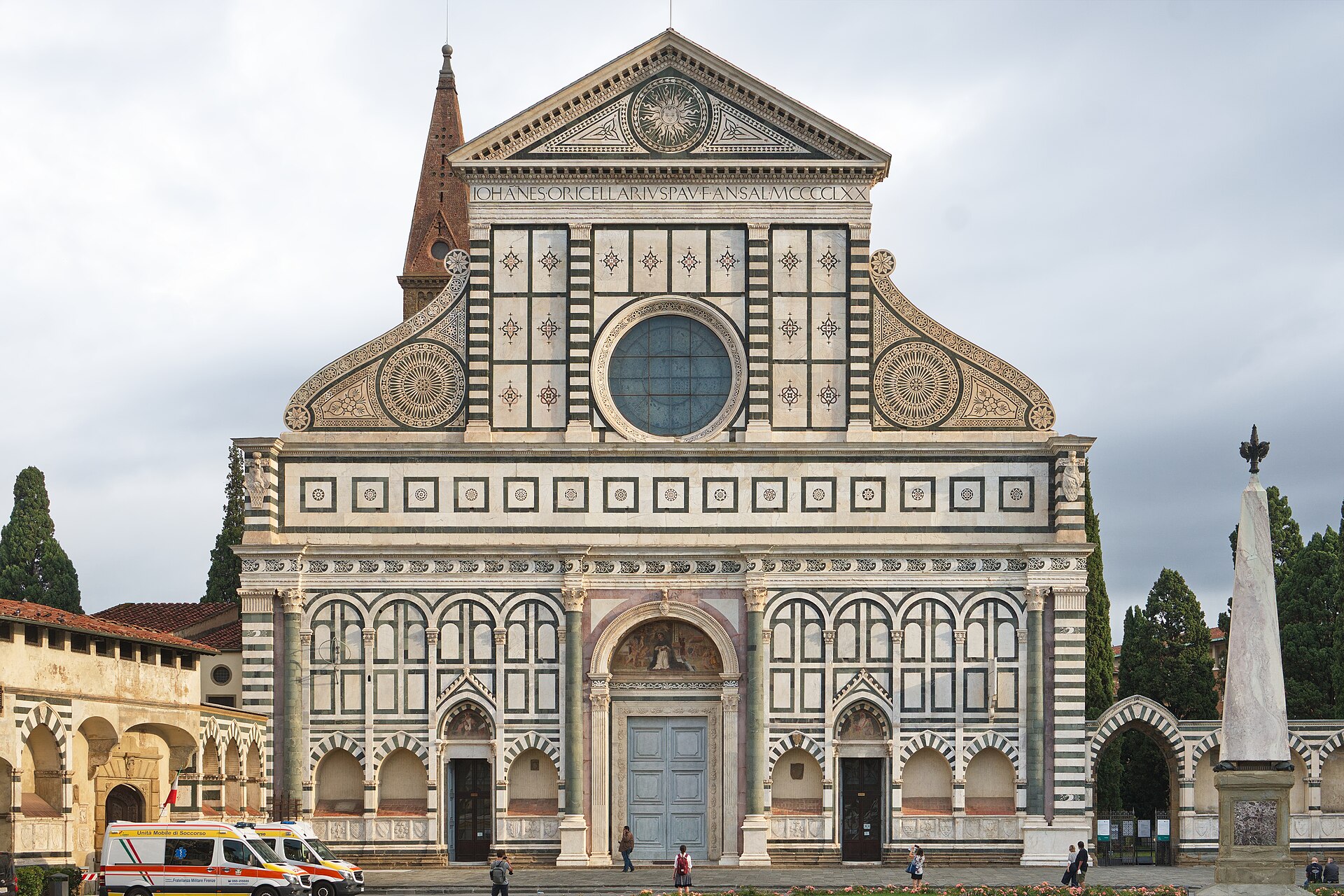
The Basilica di Santa Maria Novella is the first great basilica in Florence and serves as the city's principal Dominican church. Situated across from the main railway station that bears its name, the church is renowned for its striking polychrome marble facade and its profound collection of Renaissance art.
The interior houses masterpieces by some of the most significant artists of the period, including Masaccio’s 'Holy Trinity,' Ghirlandaio’s frescoes in the Tornabuoni Chapel, and Giotto’s 'Crucifix.' The complex also includes a famous cloister and the Spanish Chapel, which reflect the intellectual and spiritual influence of the Dominican Order in medieval and Renaissance Florence.
Key Facts
- Materials
- Green Prato marble, White Carrara marble, Brick, Pietra serena
- Civilization
- Italian (Florentine)
- Accessibility
- Wheelchair accessible via side entrance
- Date(s)
- 1246–1360
- Condition
- Well-preserved, active religious site and museum
- Original Function
- Dominican monastic church
- Key Figures
- Leon Battista Alberti, Domenico Ghirlandaio, Masaccio, Giotto
Foundation and Early Construction
13th CenturyThe church was founded by Dominican friars in 1246 on the site of a smaller 9th-century oratory. Construction of the current Gothic structure began in the mid-13th century and was largely completed by 1360, following the design of two Dominican friars, Sisto da Firenze and Ristoro da Campi.
Renaissance Facade
1456–1470The upper portion of the facade was designed by the humanist architect Leon Battista Alberti. Commissioned by Giovanni Rucellai, Alberti integrated the existing Gothic lower section with a new classical design, utilizing geometric proportions and polychrome marble that would become a hallmark of Florentine Renaissance architecture.
Artistic Patronage
14th–16th CenturyThroughout the Renaissance, the basilica became a repository for the works of Florence's greatest artists. Wealthy families, such as the Tornabuoni and Strozzi, commissioned elaborate chapel decorations, transforming the church into a primary site for the development of Italian painting and fresco techniques.
Modern Era
19th Century–PresentThe complex underwent various restorations to preserve its structural integrity and artistic treasures. Today, it functions as both an active parish church and a state-managed museum, attracting scholars and visitors interested in the intersection of Dominican theology and Renaissance art.
Cultural Significance
Santa Maria Novella stands as a testament to the intellectual and artistic dominance of the Dominican Order in Florence. It served as a center for theological study and a showcase for the wealth and piety of the city's merchant elite, who used the church to cement their social status through artistic patronage.
Beyond its religious function, the basilica is a critical site for the study of architectural transition. The facade remains one of the most important examples of early Renaissance architectural theory, demonstrating how classical principles could be harmonized with existing medieval structures.
Interpretive Notes
Scholarly debates and areas of uncertainty
There is ongoing academic discussion regarding the extent of Leon Battista Alberti's involvement in the lower portion of the facade, which predates his commission. Additionally, the interpretation of the complex iconographic program in the Spanish Chapel continues to be a subject of study, particularly concerning the influence of Dominican anti-heretical rhetoric on the visual narrative.
Visiting Information
Entry Rules
The basilica is open to visitors daily with a paid entry ticket. Modest dress is required (shoulders and knees covered). As an active place of worship, visitors are asked to maintain silence and refrain from entering areas reserved for prayer during liturgical services.
Best Times to Visit
Early morning or late afternoon on weekdays to avoid the peak tourist crowds. The interior is best viewed when natural light illuminates the stained glass and frescoes.
Photography
Photography is permitted for personal use without flash or tripods. Professional photography requires prior authorization from the Opera per Santa Maria Novella.
Preservation Notes
The frescoes are highly sensitive to environmental changes and light. Visitors must adhere to designated paths and refrain from touching any surfaces or artwork. Restoration work is ongoing; some chapels may occasionally be obscured by scaffolding.
Nearby POIs
11 shown- Museo Marino Marini0.3 km
- Basilica di San Lorenzo0.4 km
- Palazzo Strozzi0.4 km
- Battistero di San Giovanni0.5 km
- Palazzo Medici Riccardi0.5 km
- Duomo di Firenze0.6 km
- Museo dell'Opera del Duomo0.7 km
- Fortezza da Basso0.8 km
- Galleria dell'Accademia di Firenze0.8 km
- Palazzo Vecchio0.8 km
- Museo Nazionale del Bargello0.8 km
Sources & Further Reading
- [1]Santa Maria Novella and the Dominican Order in Florence — Creighton E. Gilbert. University of Chicago Press (1992)
- [2]Alberti and the Facade of Santa Maria Novella — Howard Saalman. Journal of the Society of Architectural Historians (1959)View
Key Facts
- Materials
- Green Prato marble, White Carrara marble, Brick, Pietra serena
- Civilization
- Italian (Florentine)
- Accessibility
- Wheelchair accessible via side entrance
- Date(s)
- 1246–1360
- Condition
- Well-preserved, active religious site and museum
- Original Function
- Dominican monastic church
- Key Figures
- Leon Battista Alberti, Domenico Ghirlandaio, Masaccio, Giotto
Nearby POIs
11 shown- Museo Marino Marini0.3 km
- Basilica di San Lorenzo0.4 km
- Palazzo Strozzi0.4 km
- Battistero di San Giovanni0.5 km
- Palazzo Medici Riccardi0.5 km
- Duomo di Firenze0.6 km
- Museo dell'Opera del Duomo0.7 km
- Fortezza da Basso0.8 km
- Galleria dell'Accademia di Firenze0.8 km
- Palazzo Vecchio0.8 km
- Museo Nazionale del Bargello0.8 km