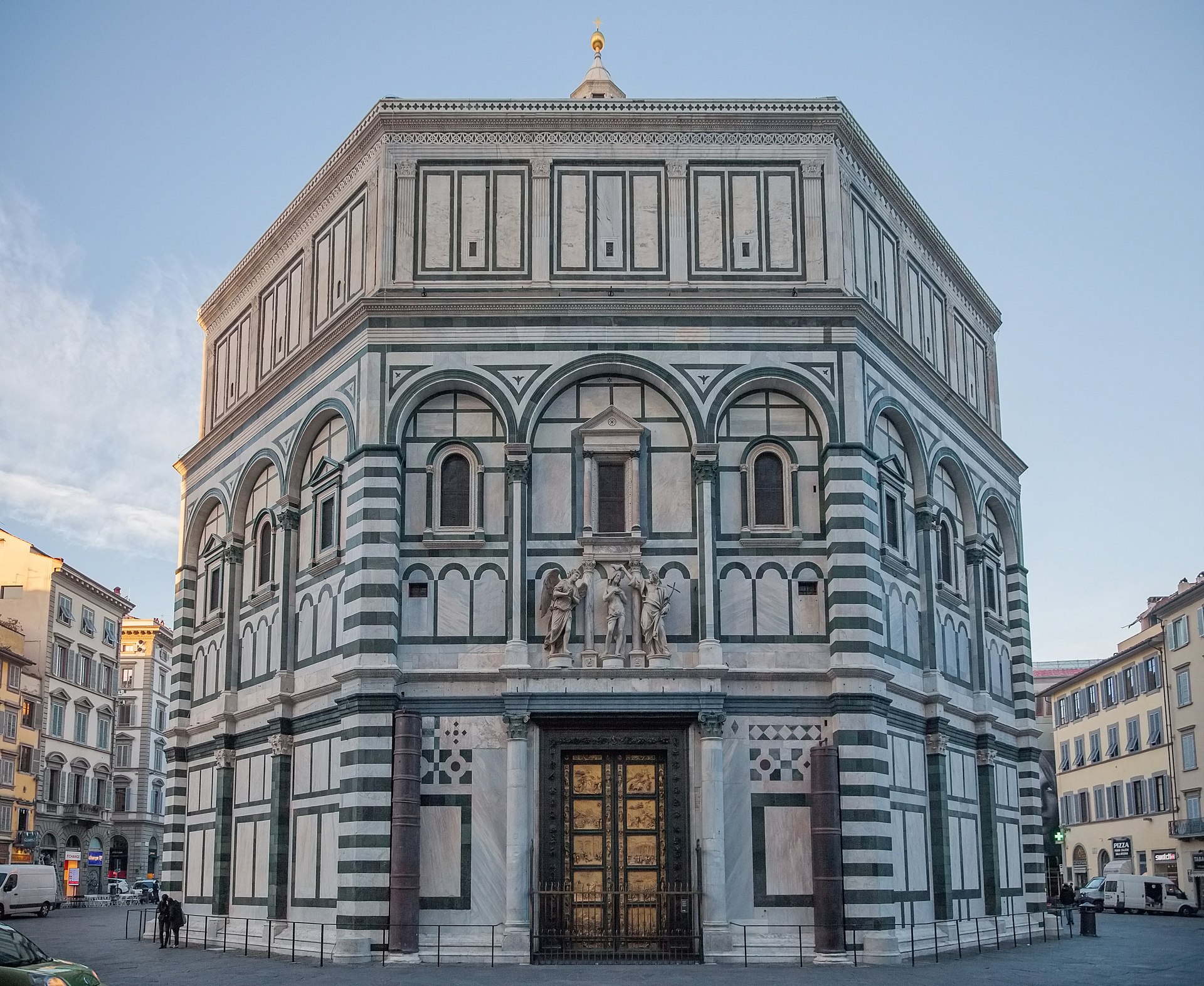
The Battistero di San Giovanni, or Florence Baptistery, is one of the oldest buildings in the city, standing in the Piazza del Duomo opposite the Florence Cathedral. Dedicated to Saint John the Baptist, the patron saint of Florence, it is renowned for its octagonal plan and its three sets of bronze doors, which include the famous 'Gates of Paradise' by Lorenzo Ghiberti.
The exterior is clad in a distinctive geometric pattern of white Carrara marble and green Prato marble, a hallmark of the Florentine Romanesque style. Inside, the dome is decorated with an extensive series of 13th-century Byzantine-style mosaics depicting the Last Judgment, which served as a major influence on later Renaissance artists, including Michelangelo.
Key Facts
- Materials
- Carrara marble, Prato marble, Bronze, Gold leaf
- Civilization
- Italian (Florentine)
- Accessibility
- Wheelchair accessible via ramp
- Date(s)
- 1059-1128 CE
- Condition
- Well-preserved, active religious site
- Original Function
- Baptistery
- Key Figures
- Lorenzo Ghiberti, Andrea Pisano, Michelangelo, Dante Alighieri
Origins and Roman Foundations
4th-5th century CEThe current structure stands on the site of a Roman-era building, likely a temple or a domus. Archaeological excavations have revealed foundations of an earlier baptistery dating back to the late Roman period, establishing the site's long-standing religious significance.
Romanesque Construction
1059-1128The present octagonal baptistery was consecrated by Pope Nicholas II in 1059. The structure was completed in the early 12th century, featuring the characteristic polychrome marble facade that would define Florentine Romanesque architecture.
The Bronze Doors
14th-15th centuryThe baptistery's three bronze portals were commissioned over several decades. Andrea Pisano created the south doors in 1330, while Lorenzo Ghiberti was commissioned for the north and east doors. The east doors, completed in 1452, were famously dubbed the 'Gates of Paradise' by Michelangelo.
Modern Preservation
20th century-presentIn the modern era, the baptistery has undergone extensive restoration, particularly the bronze doors, which were moved to the Museo dell'Opera del Duomo for protection and replaced with high-quality replicas on the exterior.
Cultural Significance
The Baptistery has historically served as the primary site for the baptism of all Florentine citizens, including notable figures such as Dante Alighieri. It represents the intersection of religious devotion and civic pride, acting as the heart of the city's identity during the Middle Ages and the Renaissance.
Beyond its religious function, the building acted as a canvas for the greatest artists of the era. The competition for the bronze doors in 1401 is widely considered the starting point of the Renaissance, marking a shift toward humanistic and naturalistic artistic expression.
Interpretive Notes
Scholarly debates and areas of uncertainty
The exact date of the original Roman structure remains a subject of debate. While some scholars argue for a 4th-century origin based on archaeological findings, others suggest the current building's foundations are entirely medieval, complicating the narrative of its continuous use from antiquity.
Visiting Information
Entry Rules
Open daily to the public. Visitors must maintain a respectful demeanor as it is an active religious site. Modest dress is required (shoulders and knees covered).
Best Times to Visit
Early morning or late afternoon to avoid the peak tourist crowds in the Piazza del Duomo.
Photography
Photography is permitted for personal use without flash or tripods. Professional photography requires prior authorization from the Opera di Santa Maria del Fiore.
Preservation Notes
The interior mosaics are highly sensitive to light and humidity. Visitors are asked to remain on designated paths and avoid touching the marble surfaces or the bronze doors.
Nearby POIs
11 shown- Duomo di Firenze0.1 km
- Basilica di San Lorenzo0.2 km
- Palazzo Medici Riccardi0.2 km
- Museo dell'Opera del Duomo0.2 km
- Palazzo Strozzi0.3 km
- Museo Nazionale del Bargello0.4 km
- Museo Marino Marini0.4 km
- Palazzo Vecchio0.4 km
- Basilica di Santa Maria Novella0.5 km
- Galleria dell'Accademia di Firenze0.5 km
- Galleria degli Uffizi0.5 km
Key Facts
- Materials
- Carrara marble, Prato marble, Bronze, Gold leaf
- Civilization
- Italian (Florentine)
- Accessibility
- Wheelchair accessible via ramp
- Date(s)
- 1059-1128 CE
- Condition
- Well-preserved, active religious site
- Original Function
- Baptistery
- Key Figures
- Lorenzo Ghiberti, Andrea Pisano, Michelangelo, Dante Alighieri
Nearby POIs
11 shown- Duomo di Firenze0.1 km
- Basilica di San Lorenzo0.2 km
- Palazzo Medici Riccardi0.2 km
- Museo dell'Opera del Duomo0.2 km
- Palazzo Strozzi0.3 km
- Museo Nazionale del Bargello0.4 km
- Museo Marino Marini0.4 km
- Palazzo Vecchio0.4 km
- Basilica di Santa Maria Novella0.5 km
- Galleria dell'Accademia di Firenze0.5 km
- Galleria degli Uffizi0.5 km