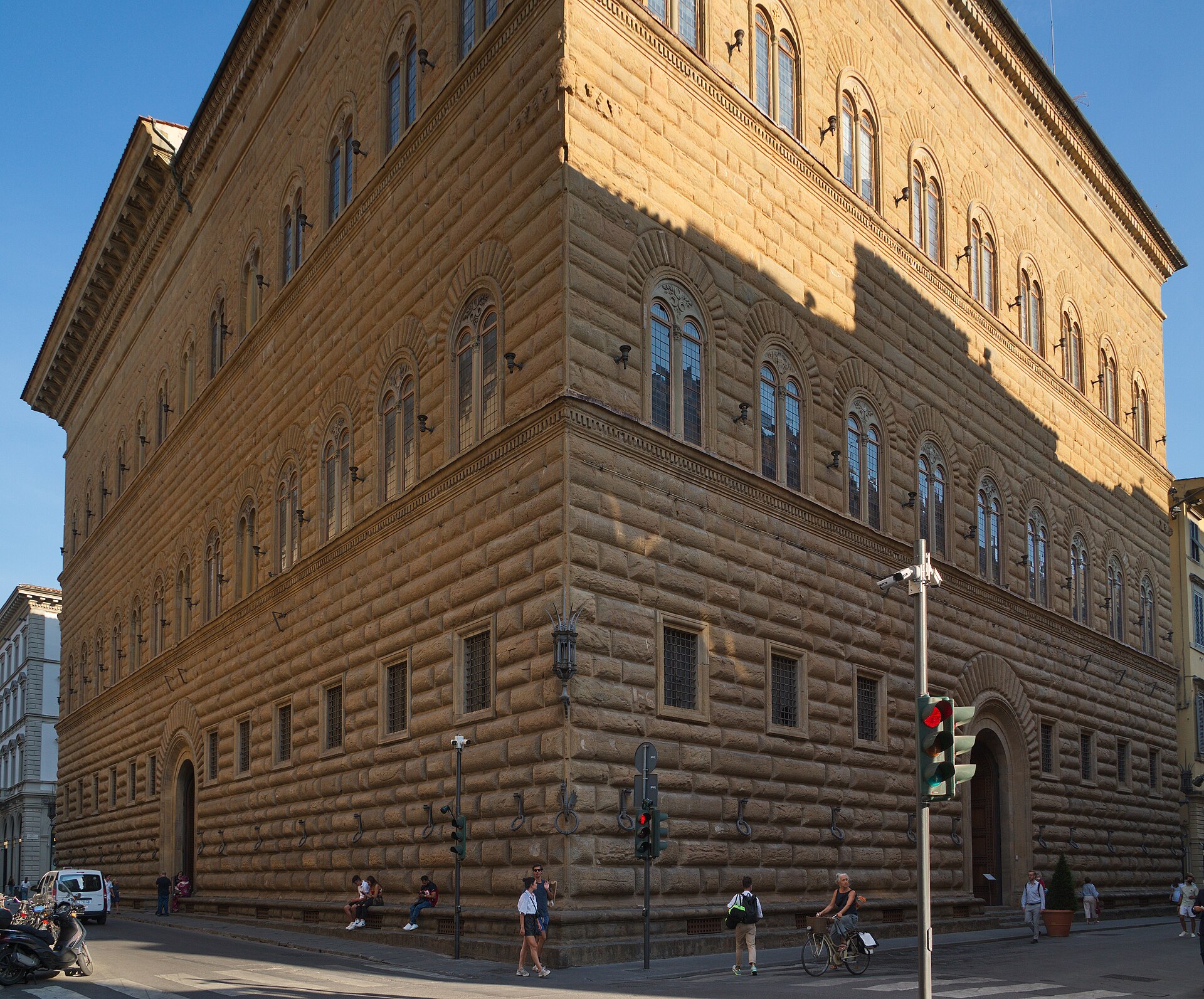
Palazzo Strozzi is a quintessential example of Florentine Renaissance civil architecture, commissioned by Filippo Strozzi the Elder in 1489. Designed to demonstrate the wealth and status of the Strozzi family, the building occupies an entire city block and features a massive, rusticated stone facade that transitions from rough-hewn blocks at the base to smoother masonry at the upper levels.
The structure is organized around a central courtyard, or cortile, which serves as the heart of the palace. Following centuries of private ownership, the building was acquired by the Italian state in 1937 and has since been repurposed as a major cultural center, hosting international art exhibitions and scholarly events while maintaining its architectural integrity.
Key Facts
- Materials
- Pietra forte sandstone
- Civilization
- Renaissance Florence
- Accessibility
- Wheelchair accessible with elevator access to exhibition floors
- Date(s)
- 1489-1538
- Condition
- Well-preserved, active cultural and exhibition center
- Original Function
- Private residence and symbol of family prestige
- Key Figures
- Filippo Strozzi the Elder, Benedetto da Maiano, Simone del Pollaiolo, Baccio d'Agnolo
Commission and Design
1489Filippo Strozzi the Elder commissioned the palace to assert his family's return to power in Florence. He acquired and demolished several existing buildings to create the necessary space for a structure that would rival the Medici Palace in scale and grandeur.
Construction Phase
1489-1538Benedetto da Maiano served as the initial architect, followed by Simone del Pollaiolo (Il Cronaca), who designed the elegant courtyard and the massive cornice. The construction was a multi-generational effort, with the exterior largely completed by the early 16th century.
State Acquisition and Modern Use
1937-PresentThe Italian state purchased the palace in 1937. Since the early 21st century, it has been managed by the Fondazione Palazzo Strozzi, which has transformed the historic interior into a premier venue for major international art exhibitions.
Cultural Significance
Palazzo Strozzi represents the height of the Florentine 'palazzo' typology, characterized by its imposing rusticated exterior and harmonious proportions. It serves as a physical manifestation of the competitive nature of Renaissance banking families, who used architecture to project political and social dominance.
Today, the palace functions as a bridge between historical heritage and contemporary art. Its role as a cultural hub ensures that the building remains a living part of Florence's urban fabric, rather than a static monument, continuing the tradition of the Strozzi family as patrons of the arts.
Interpretive Notes
Scholarly debates and areas of uncertainty
The extent of the influence of the Medici Palace on the design of Palazzo Strozzi is a frequent subject of architectural analysis. While the Strozzi palace clearly adopts the rusticated facade and central courtyard model, scholars debate whether the design was intended as a direct imitation or a deliberate attempt to surpass the Medici in structural refinement and classical proportion.
Visiting Information
Entry Rules
Open daily. Access to the courtyard is free, while exhibitions require a ticket. Visitors are encouraged to book time slots online to manage capacity during peak exhibition periods.
Best Times to Visit
Weekday mornings are generally quieter. The courtyard is particularly atmospheric in the late afternoon when natural light highlights the architectural details of the loggias.
Photography
Personal photography is permitted in the courtyard and public areas. Photography inside exhibition galleries is subject to specific rules set by each individual exhibition, often prohibiting flash or tripods.
Preservation Notes
The building is subject to strict conservation protocols. Visitors are asked to refrain from touching the stone masonry and to follow all signage regarding exhibition flow to protect the historic interior surfaces.
Nearby POIs
11 shown- Museo Marino Marini0.2 km
- Battistero di San Giovanni0.3 km
- Palazzo Vecchio0.4 km
- Basilica di Santa Maria Novella0.4 km
- Duomo di Firenze0.4 km
- Basilica di San Lorenzo0.4 km
- Galleria degli Uffizi0.5 km
- Museo Nazionale del Bargello0.5 km
- Palazzo Medici Riccardi0.5 km
- Museo dell'Opera del Duomo0.6 km
- Palazzo Pitti0.7 km
Sources & Further Reading
- [1]Palazzo Strozzi: A History of the Building — Richard Goldthwaite. Yale University Press (1980)
- [2]The Architecture of the Italian Renaissance — Christoph Luitpold Frommel. Thames & Hudson (2007)
Key Facts
- Materials
- Pietra forte sandstone
- Civilization
- Renaissance Florence
- Accessibility
- Wheelchair accessible with elevator access to exhibition floors
- Date(s)
- 1489-1538
- Condition
- Well-preserved, active cultural and exhibition center
- Original Function
- Private residence and symbol of family prestige
- Key Figures
- Filippo Strozzi the Elder, Benedetto da Maiano, Simone del Pollaiolo, Baccio d'Agnolo
Nearby POIs
11 shown- Museo Marino Marini0.2 km
- Battistero di San Giovanni0.3 km
- Palazzo Vecchio0.4 km
- Basilica di Santa Maria Novella0.4 km
- Duomo di Firenze0.4 km
- Basilica di San Lorenzo0.4 km
- Galleria degli Uffizi0.5 km
- Museo Nazionale del Bargello0.5 km
- Palazzo Medici Riccardi0.5 km
- Museo dell'Opera del Duomo0.6 km
- Palazzo Pitti0.7 km